
An AI travel itinerary planner is a tool that generates personalized, day-by-day travel schedules based on your preferences, budget, and trip constraints, often in under two minutes. The industry term for this process is AI-assisted itinerary generation, and it sits at the intersection of natural language processing and travel logistics. 3 in 10 Americans reported using AI for trip planning in 2026. That number signals a real shift in how people research and build travel plans. AI does the heavy lifting on research and sequencing, but you still bring the final judgment. Think of it as a very fast, very organized research assistant, not a travel agent with local contacts.
What is an AI travel itinerary and how does it work?
An AI travel itinerary is a structured daily travel plan produced by an AI system using your personal inputs. You provide details like destination, travel dates, budget, interests, dietary needs, and pace. The AI then pulls from large datasets covering flights, hotels, local attractions, restaurants, and transportation to build a logical schedule.
The sequencing is one of the most useful parts. AI groups activities geographically and arranges them by time of day, so you are not bouncing across a city inefficiently. A typical output includes morning, afternoon, and evening activities with estimated costs and transit notes between each stop.

The personalization layer is what separates AI planning from a generic travel blog. You can specify that you want low-mobility options, vegetarian-friendly restaurants, or a slow pace with long lunches. The more detail you give, the more relevant the output becomes. Detailed personal criteria consistently produce better results than vague prompts.
Here is what a well-built AI itinerary typically includes:
- Day-by-day schedule with morning, afternoon, and evening slots
- Location sequencing to minimize transit time between stops
- Budget estimates for activities, meals, and transport
- Accommodation suggestions matched to your price range
- Flexibility notes flagging which activities can be swapped
Pro Tip: Treat your first AI prompt as a rough draft. Run it once, review the output, then refine with more specific constraints. Iterating twice usually produces a plan that feels genuinely tailored.
What are the benefits and limitations of AI travel planning?
AI travel planning saves serious time. Typical travel research takes 3+ hours; AI condenses it to under two minutes. That is not a minor convenience. It frees you to spend time on the parts of planning that actually require human taste, like choosing which neighborhood feels right or deciding how much downtime you need.
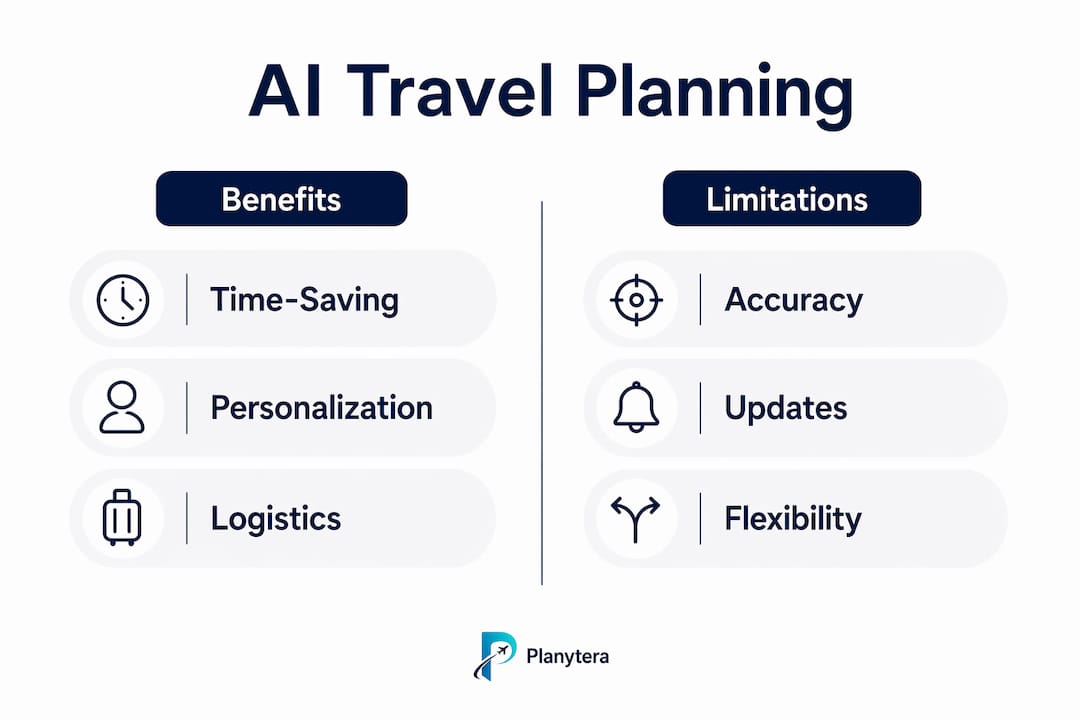
Cost savings are real too. Bundled booking through AI-integrated platforms can save travelers hundreds of dollars compared to booking flights and hotels separately. The AI identifies combinations you would likely miss when searching manually across multiple tabs.
The limitations are just as real, though. AI cannot tell you that a restaurant closed last month, that a museum is under renovation, or that a neighborhood festival will block your route. AI lacks real-time local insights and cannot fully replicate the judgment of someone who was there last week. It also struggles with nuanced personal needs that are hard to express in a prompt, like sensory sensitivities or very specific cultural preferences.
"AI acts best as a research assistant rather than a final authority." Travel experts consistently warn against treating AI-generated plans as finished products.
The biggest risk is over-reliance. Travelers who accept AI outputs without checking them sometimes arrive at closed venues or miss better options nearby. The fix is simple: use AI to build the skeleton, then verify the details.
- Strengths: Speed, cost comparison, logical sequencing, broad destination knowledge
- Limitations: No real-time data, limited local nuance, generic outputs from vague prompts
- Risk: Treating the AI plan as final without cross-referencing official sources
How to use AI travel itinerary tools effectively
Getting good results from AI travel planning comes down to how you interact with it. Generic inputs produce generic plans. Specific inputs produce plans you can actually use.
Follow these steps to get the most from any AI travel itinerary tool:
- Write a detailed prompt. Include destination, travel dates, group size, budget per day, interests, dietary needs, mobility requirements, and preferred pace. The more constraints you give, the more the output fits your actual trip.
- Review the skeleton, not the details. Check whether the day structure and activity flow make sense. Do not assume venue hours, prices, or availability are accurate.
- Verify with official sources. Travel expert Katy Nastro advises cross-referencing AI tips with recent reviews or official sources before finalizing any plan. Check venue websites and local tourism boards.
- Customize manually. Swap out any activity that does not fit your style. Add personal priorities the AI missed, like a specific market or a quiet afternoon.
- Use AI to prepare questions for locals. Preparing questions via AI before arrival helps you get insider knowledge from guides, hotel staff, or residents once you are on the ground.
- Iterate on the output. Run the prompt again with adjusted constraints if the first result misses the mark. Most AI tools let you refine in the same conversation thread.
Pro Tip: Add a line to your prompt like "I prefer fewer activities with more time at each stop" or "include one off-the-beaten-path option per day." These small additions shift the output from generic to genuinely useful.
AI excels at logistical scaffolding like routing and sequencing but cannot update closure status or limited-time events without human verification. That division of labor is the key to using these tools well.
What practical impact does AI have on your travel experience?
AI travel planning changes behavior before, during, and after a trip. The most visible shift is in how people start planning at all. Around 40% of users now begin with destinationless, inspiration-based searches on AI, asking things like "where should I go in october if I love food and hiking?" rather than starting with a fixed destination. That opens up destinations travelers would never have considered through traditional search.
During the trip, AI tools help you adapt on the fly. If a planned activity falls through, you can re-prompt with your current location and remaining time to get a revised afternoon plan in seconds. That kind of flexibility used to require a travel agent or hours of phone calls.
Here is a snapshot of how AI planning affects different stages of a trip:
| Trip Stage | AI Contribution | Human Role |
|---|---|---|
| Inspiration | Suggests destinations based on interests | Decides what resonates |
| Research | Aggregates flights, hotels, attractions | Verifies accuracy |
| Itinerary building | Sequences activities by time and location | Adjusts for personal taste |
| On-the-ground | Adapts plans in real time | Confirms with locals |
| Post-trip | Logs memories and notes | Reflects and shares |
AI-generated itineraries work best as flexible scaffolds, not fixed scripts. Travelers who treat them that way report higher satisfaction because they stay in control while cutting out the tedious parts of planning. You get the structure without losing the spontaneity.
Key Takeaways
AI travel itinerary planning works best when you treat it as a fast, flexible research scaffold that you verify and customize, not a finished plan you follow without question.
| Point | Details |
|---|---|
| AI saves significant planning time | AI condenses multi-hour research into under two minutes, freeing you for higher-value decisions. |
| Detailed prompts produce better plans | Specific inputs covering budget, pace, and dietary needs yield far more relevant itineraries. |
| Always verify AI outputs | Cross-reference venue hours, prices, and availability with official sources before finalizing. |
| Use AI across all trip stages | AI helps with inspiration, sequencing, on-the-ground adjustments, and post-trip journaling. |
| Treat itineraries as starting points | The best travelers iterate on AI outputs and adapt them with local knowledge on arrival. |
Why I think most travelers are using AI planning backwards
Most travelers I talk to use AI travel tools the same way they used to use Google: type in a destination, grab the first result, and call it done. That approach wastes the actual power of these tools.
The real value is in iteration. The first output is almost never the best one. When you push back, add constraints, and ask follow-up questions, the plan gets sharper with each pass. Travelers who do this consistently end up with itineraries that feel handcrafted, not generated.
The other thing I have noticed is that AI planning actually makes people more curious, not less. When a tool suggests a neighborhood or a dish you have never heard of, it opens a door. AI encourages more open-ended, inspiration-driven searches, and that is genuinely expanding where people go and what they do when they get there.
My honest advice: use AI to do the research and structure, then use your own judgment and local conversations to fill in the texture. Travel advisors use AI as a research base, not a replacement for expertise, and that is exactly the right model for independent travelers too. The tool is only as good as the human using it.
— Dom
Planytera brings AI itinerary planning together in one place
Planning a trip should feel exciting, not exhausting. Planytera is an AI-powered trip planner that builds personalized, day-by-day itineraries based on your budget, pace, dietary needs, and travel style. You get a full plan ready in moments, with the flexibility to adjust any part of it as your trip evolves.

Whether you are planning solo, with family, or coordinating a group, Planytera handles the logistics so you can focus on the experience. The platform includes live travel guidance, offline access, and a built-in journal to capture memories along the way. Browse sample itineraries to see what a tailored AI-generated plan looks like in practice, or head straight to Planytera to build your own.
FAQ
What is an AI travel itinerary?
An AI travel itinerary is a personalized, day-by-day travel schedule generated by an AI system based on your inputs, including destination, budget, interests, and pace. It sequences activities, accommodations, and transport logically to reduce planning time.
How accurate are AI-generated travel plans?
AI plans are accurate for general structure and logistics but can contain outdated details on venue hours, prices, or availability. Travel expert Katy Nastro recommends cross-referencing every AI suggestion with official sources or recent reviews before finalizing.
How much time does AI travel planning save?
Typical manual travel research takes over three hours. AI condenses that process to under two minutes, saving roughly 95% of the time you would spend searching across multiple tabs and booking sites.
What information should I give an AI travel planner?
Provide your destination, travel dates, group size, daily budget, interests, dietary needs, mobility requirements, and preferred pace. Specific constraints consistently produce more relevant and usable itinerary outputs than generic prompts.
Can AI replace a human travel advisor?
AI handles research and logistics well but cannot replicate real-time local knowledge or nuanced personal judgment. Travel advisors use AI as a research base and complement it with human expertise, which is the most effective model for any traveler.