
AI-powered itinerary planning is the most effective method for coordinating group travel because it replaces manual back-and-forth with automated preference collection, real-time updates, and instant itinerary generation. Knowing how AI simplifies group trip planning changes everything for families and friend groups who have wasted hours in group chats trying to agree on a single restaurant, let alone a full week abroad. The coordination problem in group travel is real and well-documented. Corporate group travel coordinators spend 34 hours organizing multi-day events for 25 or more attendees. AI cuts that workload by 60–75% through automated preference aggregation and itinerary optimization. That same efficiency applies directly to your family reunion or friends' trip to Portugal.
How AI simplifies group trip planning: the core features

AI tools for group trips solve the hardest part of collaborative travel: getting everyone's input without chaos. The preference collection phase is the most challenging step in group planning. AI handles it by reaching out through familiar channels like SMS, Slack, or email, then using conversational follow-ups to confirm details and resolve gaps.
Once preferences are collected, the AI does the heavy lifting. Here is what a well-built AI travel planner handles automatically:
- Preference aggregation. The system gathers dietary restrictions, budget limits, activity interests, and arrival times from every traveler in the group.
- Itinerary generation. AI optimizes thousands of combinations to produce ranked itinerary proposals that satisfy multiple constraints at once.
- Real-time disruption management. When a flight is delayed, the AI detects it, finds alternatives, recalculates logistics, and notifies the whole group automatically.
- Budget tracking. Automated expense splitting and real-time cost tracking replace the spreadsheet your most organized friend used to maintain.
- Group-specific logistics. AI focuses recommendations on activities suited to group sizes, including group restaurant reservations and shared transport options.
Pro Tip: Ask your AI planner to flag activities with age or mobility restrictions upfront. This saves a round of revisions when you have a mix of kids and grandparents in the group.
How does AI handle conflicting preferences in group travel?
Conflicting preferences are the number one reason group trips stall. Someone wants a beach day. Someone else wants a museum. One person has a gluten allergy. Another has a tight budget. AI handles these conflicts through a structured process rather than a group vote that never ends.
- Private preference submission. Each traveler submits preferences individually before seeing anyone else's input. This prevents anchoring bias, where the first person to speak shapes everyone else's choices.
- Constraint satisfaction modeling. The AI maps all inputs against each other and identifies combinations that satisfy the most constraints. It does not just find a compromise. It finds the best available fit.
- Ranked proposal generation. Instead of one itinerary, the AI produces a ranked set of options. Your group coordinator reviews the top proposals and picks the one that fits best.
- Iterative refinement. AI itinerary generation is iterative, involving drafts and refinements rather than one-shot solutions. You can adjust budget caps, swap activities, or exclude destinations and regenerate in seconds.
- Human-set decision deadlines. AI handles logistics, but a firm decision deadline is still required from a human. Without it, the planning loop never closes.
Pro Tip: Assign one person as the group coordinator before you start. Their job is to review AI proposals and call the final vote. AI gives you the options. A human still needs to say yes.
What are the real time savings from AI travel planning?
The efficiency gains from AI travel planning are not marginal. They are structural. Group travel coordination traditionally involves multiple rounds of polling, spreadsheet updates, and message threads that stretch across days or weeks. AI collapses that process into hours.
"AI reduces group travel coordination workload by 60–75% through automating preference aggregation and itinerary optimization."
That reduction is not just about speed. It is about accuracy. Manual itinerary building introduces errors: double-booked venues, missed dietary needs, budget overruns that nobody caught until checkout. AI tracks all of these in real time.
| Planning task | Manual method | With AI |
|---|---|---|
| Preference collection | Group chat, days of follow-up | Automated via SMS or email, hours |
| Itinerary drafting | One person builds a spreadsheet | AI generates ranked proposals instantly |
| Budget tracking | Shared doc, manual updates | Automated expense splitting in real time |
| Disruption handling | Frantic group messages | AI detects, rebooks, and notifies automatically |
| Final confirmation | Another round of messages | Coordinator approves one proposal |
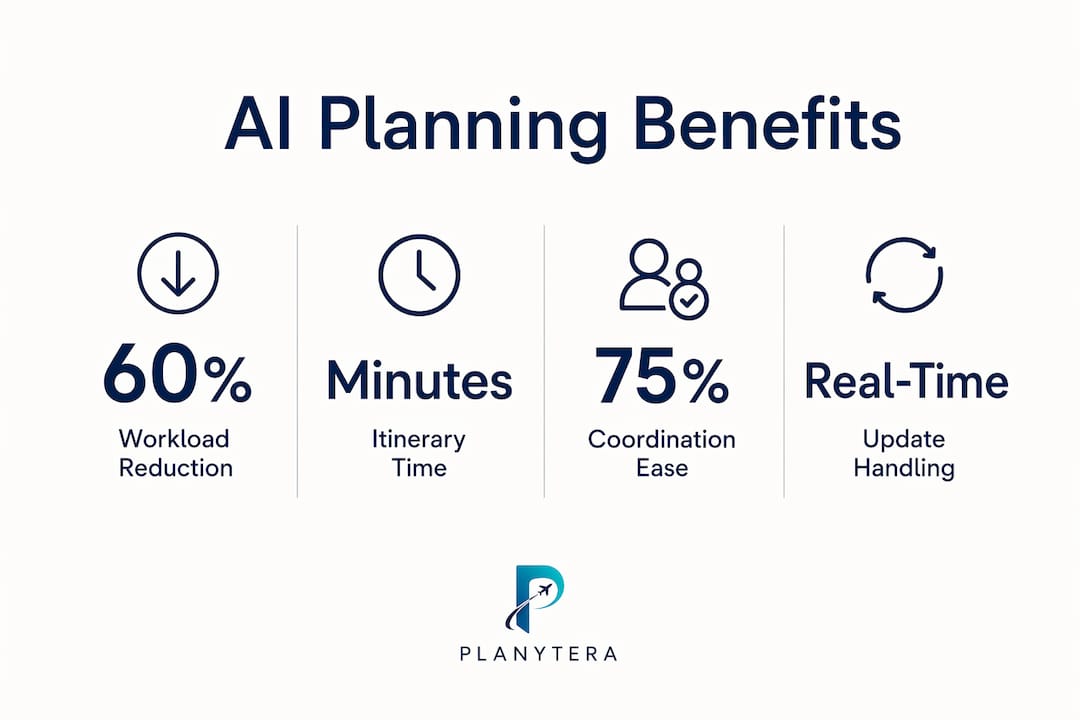
Real-time updates also reduce stress on travel day. When a flight delay hits, the AI detects it, finds alternative flights, and recalculates the group's logistics immediately. No one person has to manage the crisis alone. That shift from reactive scrambling to automated handling is where groups feel the biggest relief.
Planytera builds this kind of real-time responsiveness directly into its AI travel itinerary system, so your group stays informed without anyone playing the role of full-time travel manager.
How to integrate AI tools into your group planning process
Getting the most from automated trip organization requires a few deliberate habits. AI does the coordination work, but your group still sets the conditions for success.
- Set a preference submission deadline. Give everyone 48 hours to submit their inputs. Late submissions create delays that no AI can fix.
- Assign a coordinator role. One person reviews AI-generated proposals and makes the final call. This prevents decision paralysis when the group gets multiple good options.
- Use AI drafts as starting points. Treat the first itinerary as a flexible draft, not a finished plan. Refine it collaboratively by adjusting one or two constraints at a time.
- Pick one communication channel. AI collects preferences most efficiently when everyone uses the same channel. Mixing SMS, email, and app messages creates gaps in the data.
- Confirm personal details directly. AI handles the logistics. A quick personal message to confirm dietary restrictions or mobility needs adds a human layer that builds trust in the final plan.
Understanding how travel preferences are categorized by AI systems helps your group submit more useful inputs from the start. The more specific your inputs, the better the itinerary the AI produces.
Pro Tip: Budget inputs matter more than most groups realize. Ask everyone to submit their daily spend comfort level privately. AI uses that data to filter out options that would make half the group uncomfortable.
Planytera handles budget-driven itinerary generation by categorizing costs and matching activity suggestions to each group member's stated range. No one has to feel awkward about money.
Key Takeaways
AI reduces group travel coordination workload by 60–75% by automating preference collection, itinerary generation, budget tracking, and real-time disruption management.
| Point | Details |
|---|---|
| Preference collection is the hardest step | AI gathers inputs via SMS, email, or apps and uses follow-ups to confirm details. |
| Ranked proposals replace group debates | AI generates multiple itinerary options so a coordinator can choose, not negotiate. |
| Real-time updates prevent travel-day chaos | AI detects flight delays, finds alternatives, and notifies the group automatically. |
| Human deadlines are non-negotiable | AI handles logistics, but a firm decision deadline from a human keeps planning on track. |
| Budget inputs drive better itineraries | Private budget submissions let AI filter options without awkward group money conversations. |
Why I think most groups underestimate what AI actually does here
Most travelers assume AI travel planning is just a fancier search engine. You type in a destination, it spits out a list of hotels. That framing misses the real value entirely.
What AI does in group travel is act as a neutral coordinator. It has no stake in the outcome. It does not get tired of the group chat. It does not favor the loudest voice in the room. When preferences conflict, it runs the math and shows you the best available fit across all constraints. That is genuinely different from anything a human coordinator can do at scale.
The limitation I keep seeing is not the technology. It is the human side. Groups that skip the decision deadline step end up in an endless refinement loop. The AI keeps generating options. Nobody commits. The trip never gets booked. AI is not a substitute for group commitment. It is a tool that makes commitment easier to reach.
The feature I am most excited about watching develop is real-time preference updating during the trip itself. Right now, most AI tools handle pre-trip planning well. Mid-trip adaptation, like rerouting a day plan when it rains or finding a last-minute dinner for 12, is where the next generation of tools will earn their place. Planytera's live travel guidance feature is already moving in that direction, and that is worth paying attention to.
— Dom
Plan your next group trip with Planytera
Group travel gets easier when one tool handles the coordination for you. Planytera generates personalized, day-by-day itineraries that account for dietary needs, budget ranges, activity preferences, and group size from the start.
You can see AI-generated itineraries for real group trip scenarios before committing to anything. Planytera also offers offline access and live travel guidance so your group stays on track even when the Wi-Fi does not cooperate. Check out Planytera's subscription plans to find the right fit for your group size and trip frequency. Your next group trip deserves a plan that actually works for everyone.
FAQ
How does AI collect preferences from every group member?
AI travel planners reach out through familiar channels like SMS, email, or in-app messaging and use conversational follow-ups to confirm each person's inputs. This removes the need for a shared spreadsheet or a group chat that nobody reads.
Can AI handle dietary restrictions and accessibility needs?
Yes. AI itinerary generation maps dietary restrictions, mobility needs, and activity preferences as constraints and filters all suggestions accordingly. Planytera incorporates these details directly into its day-by-day planning process.
What happens when a flight is delayed during a group trip?
AI detects the delay in real time, identifies alternative flights, recalculates the group's logistics, and sends automatic notifications to all travelers and the coordinator. No one person has to manage the disruption manually.
How long does it take AI to generate a group itinerary?
AI generates a full itinerary in minutes once preference inputs are collected. Refinements based on feedback take seconds, compared to hours of manual revision.
Does AI replace the need for a human trip coordinator?
AI handles the logistics, but a human coordinator is still needed to set decision deadlines and approve final proposals. The coordinator's role shifts from doing the work to reviewing and confirming what AI produces.