
Budget is the primary constraint in itinerary generation. It determines which destinations, hotels, activities, and transport options make the final plan. Without a defined budget, even the most detailed itinerary is just a wish list. The role of budget in itinerary generation goes far beyond setting a spending ceiling. It acts as an active filter that shapes every decision from day one, and tools like AI itinerary planners and travel budget calculators have made this process faster and more reliable than ever. Planytera, for example, builds budget compliance directly into its itinerary construction process so you never end up with a plan you can't afford.
How is budget integrated into itinerary generation?
Budget integration in itinerary generation means treating your total trip spend as a hard limit, not a suggestion. Budget validation requires that the sum of all cost line items stays at or below the total trip budget before a plan is accepted. This is the difference between a narrative itinerary and a financially sound one.
The major cost categories that feed into this validation are:
- Accommodation: Nightly rates multiplied by the number of nights, per room or per person
- Transportation: Flights, trains, car rentals, and local transit, each priced individually
- Food and dining: Daily meal estimates based on destination price levels
- Activities and entry fees: Museum tickets, tours, excursions, and experiences
- Miscellaneous: Tips, souvenirs, SIM cards, and small daily purchases
AI itinerary systems also handle currency normalization automatically. If you're pricing a trip across multiple countries, costs get converted to a single currency before validation runs. This prevents the common error of comparing euros and dollars as if they were equal.
Per-person and per-day breakdowns are calculated after summing all major categories and adding a contingency buffer. These conversions matter because they catch math errors that are easy to miss in a spreadsheet. A $3,000 trip for two people over seven days is $214 per person per day. Knowing that number upfront changes how you evaluate every booking decision.
Pro Tip: Set your total budget before you start researching destinations. Locking in the number first prevents the trap of falling in love with an expensive option and then trying to justify it.
Why do daily budget caps matter more than trip totals?
A single trip total is not enough to keep spending on track. Daily budget compliance checks catch overspending at the day level, not just at the end of the trip. This distinction is critical. Without daily caps, you can blow 60% of your budget in the first three days and spend the rest of the trip cutting corners.
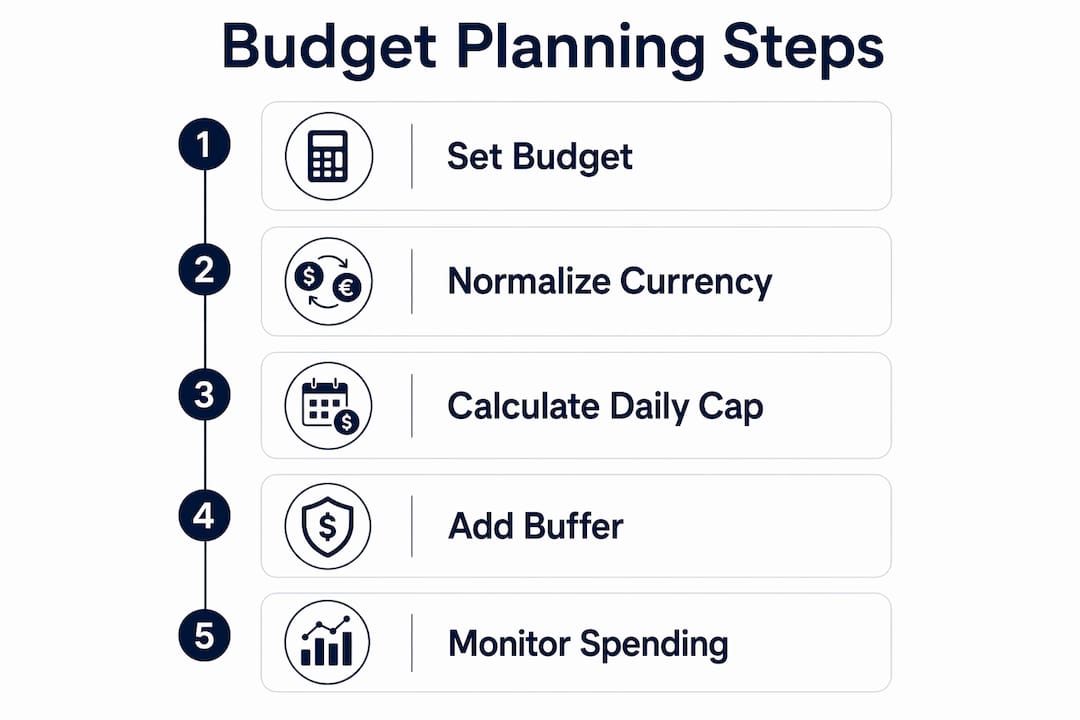
Daily caps work because they give you a decision framework in real time. When you know Day 3 in Paris has a $180 limit, you choose the brasserie over the Michelin-starred restaurant without agonizing over it. The cap makes the decision for you.
Here is how to set daily caps that actually work:
- Calculate your base daily budget. Divide your total trip budget by the number of travel days. This is your starting point.
- Subtract fixed daily costs. Accommodation and pre-booked transport are already committed. Remove them from the daily variable budget.
- Identify high-spend days. Arrival and departure days often cost more due to airport transfers and meals. Allocate more to those days.
- Add a contingency buffer. A 10%–15% buffer covers insurance, taxes, unexpected fees, and price changes. Build it into the total before you divide by days.
- Review after each day. Adjust the remaining days if you overspend or underspend. This keeps the whole trip balanced.
The buffer percentage matters more than most travelers realize. A 10% buffer on a $2,000 trip is $200. That covers one missed train, one surprise museum fee, or one night of overpriced airport food. Without it, those moments become stressful.
Pro Tip: Use a higher buffer of 15% for trips to destinations with volatile pricing, peak season travel, or countries where tipping is expected but hard to predict.
How does budget interact with transport, time, and preferences?
Budget does not operate alone. Feasibility in itinerary planning requires budget decisions to coexist with travel time windows, venue opening hours, and personal preferences. A plan that fits the budget but requires a four-hour bus ride between two morning activities is not a good plan.

The most useful way to understand this interaction is through trade-offs. Spending more on transport often unlocks better experiences within the same total budget. A faster train between cities costs more but gives you two extra hours at your destination. Route optimization models treat transport cost and time as linked constraints, balancing both against the overall trip budget and experience goals.
| Scenario | Budget impact | Time impact | Best choice |
|---|---|---|---|
| Budget bus vs. express train | Lower cost | +3 hours travel | Train if activities are time-sensitive |
| Central hotel vs. suburb hotel | Higher cost | Saves 1–2 hours daily | Central if daily transport adds up |
| Cooking in vs. dining out | Lower cost | Saves time on reservations | Cook in on rest days, dine out on activity days |
| Group tour vs. private guide | Lower cost | Fixed schedule | Group tour for popular sites, private for flexibility |
The table above shows that the cheapest option is rarely the best option when time is factored in. A suburb hotel saves $40 per night but adds $20 in daily transport and 90 minutes of commuting. The net saving shrinks fast.
AI planners enforce this multi-constraint validation automatically. They check whether a proposed activity fits within the daily budget, whether travel time between venues is realistic, and whether venues are open at the planned time. All three checks run together, not separately.
Practical tips for using budget to guide your itinerary decisions
Budget-aware itinerary planning is a skill. The travelers who get the most from their trips are the ones who treat the budget as a living document, not a one-time calculation.
- Break costs down by category before you book anything. Estimate accommodation, transport, food, and activities separately. Vague totals hide where money actually goes.
- Prioritize your non-negotiables first. If a cooking class in Florence is the highlight of your trip, fund it first. Build the rest of the itinerary around what's left.
- Update costs as you book. Prices change. Replace estimates with actual confirmed costs as soon as you have them. This keeps your budget accurate throughout the planning process.
- Check transport trade-offs explicitly. Before booking the cheapest option, calculate the time cost. Multiply travel hours by what your time is worth to you on vacation.
- Use AI itinerary planners for real-time compliance. Budget-aware planners flag overruns and re-run planning steps automatically, so you catch problems before they become bookings.
- Review your per-day estimates regularly. A quick check every few days of planning prevents the slow drift where small additions push you over budget without you noticing.
Most travelers over-trust narrative itineraries. A beautifully written day-by-day plan feels solid, but without explicit numeric accounting, it is easy to miss that the total adds up to twice your budget. Explicit cost tracking reduces that risk significantly.
Pro Tip: Build a simple cost tracker with five columns: category, estimated cost, actual cost, difference, and notes. Update it every time you confirm a booking. The "difference" column tells you exactly where your estimates were wrong.
Key takeaways
Budget is the single most important constraint in travel itinerary generation. It requires daily caps, contingency buffers, and multi-constraint validation to produce plans that are both affordable and executable.
| Point | Details |
|---|---|
| Budget as a hard constraint | Every cost line item must sum to or below the total trip budget before a plan is finalized. |
| Daily caps over trip totals | Day-level spending limits prevent early overspending and keep the whole trip balanced. |
| Contingency buffer | A 10%–15% buffer absorbs unexpected fees, price changes, and last-minute costs. |
| Transport trade-offs | Spending more on faster transport often saves time and unlocks higher-value activities. |
| AI validation | Budget-aware planners flag overruns automatically and revise plans to stay within limits. |
Budget is a living constraint, not a starting number
Most travelers set a budget once and then ignore it until they check their bank account mid-trip. That is the wrong approach, and I have seen it derail otherwise well-planned trips more times than I can count.
The travelers who stay on budget are the ones who treat it as an active constraint throughout the planning process. They update estimates when prices change. They re-balance daily caps when one day runs over. They build in buffers not because they expect to need them, but because they know pricing is never perfectly predictable.
The other thing I have seen consistently is that narrative itineraries give people false confidence. A detailed day-by-day plan with beautiful descriptions feels thorough. But if no one has checked whether the numbers add up, it is not a plan. It is a story. Explicit numeric accounting is what separates a plan you can execute from one that falls apart at the first booking.
Per-day budget caps are the single most underused tool in travel planning. They make decisions easier during the trip, not just during planning. When you know your daily limit, you stop agonizing over individual choices. The number does the work for you.
Contingency buffers get skipped because they feel like admitting defeat. They are not. They are the reason your trip does not get derailed by a $30 airport taxi or a museum that raised its entry fee since you last checked.
— Dom
Plan your next trip with Planytera

Planytera builds budget constraints directly into every itinerary it generates. You enter your total budget, travel dates, and preferences, and Planytera produces a day-by-day plan with cost breakdowns per traveler and per day. It checks travel times, venue hours, and spending limits together, so the plan you get is one you can actually follow. You can see real examples of what a budget-aware itinerary looks like by browsing sample trips before you commit to anything. When you are ready to build your own, Planytera's AI trip planner handles the heavy lifting so you can focus on the trip itself.
FAQ
What is the role of budget in itinerary generation?
Budget is a hard financial constraint that every cost in the itinerary must stay within before the plan is accepted. It shapes which destinations, activities, and transport options are included.
Why are daily budget caps better than a single trip total?
Daily caps catch overspending early so you can rebalance remaining days before the damage is done. A trip total alone only reveals the problem after it is too late to fix.
How much contingency buffer should I add to my travel budget?
A 10%–15% buffer is standard practice. It covers unexpected fees, taxes, price changes, and last-minute expenses that are common on most trips.
How does transport cost affect the rest of my itinerary budget?
Spending more on faster transport can free up time for additional activities, making the overall trip more valuable within the same total budget. The trade-off between cost and time is worth calculating explicitly.
Can AI itinerary planners enforce budget limits automatically?
Yes. AI planners like Planytera validate costs against your budget during plan construction and flag overruns before you finalize anything, replacing guesswork with numeric confirmation.