
Day-by-day travel planning is the process of organizing your trip into daily schedules that anchor fixed activities and arrange flexible options to create a balanced, efficient, and enjoyable itinerary. The industry term for this practice is itinerary planning, and the two phrases describe the same core method. Done well, a daily travel itinerary reduces stress, prevents burnout, and gives you the mental space to actually enjoy where you are. The key principles are simple: lock in 1–2 fixed anchors per day, cluster activities by geography, and protect open time for rest and surprises.
What is day-by-day travel planning, and how does it work?
Day-by-day travel planning means breaking your entire trip into individual daily schedules, each built around a small number of confirmed activities. Think of each day as having a skeleton. The bones are your fixed commitments like a museum reservation or a dinner booking. Everything else hangs loosely around them. A well-planned itinerary gives you freedom rather than constraining you. That shift in mindset changes how you approach the whole process.
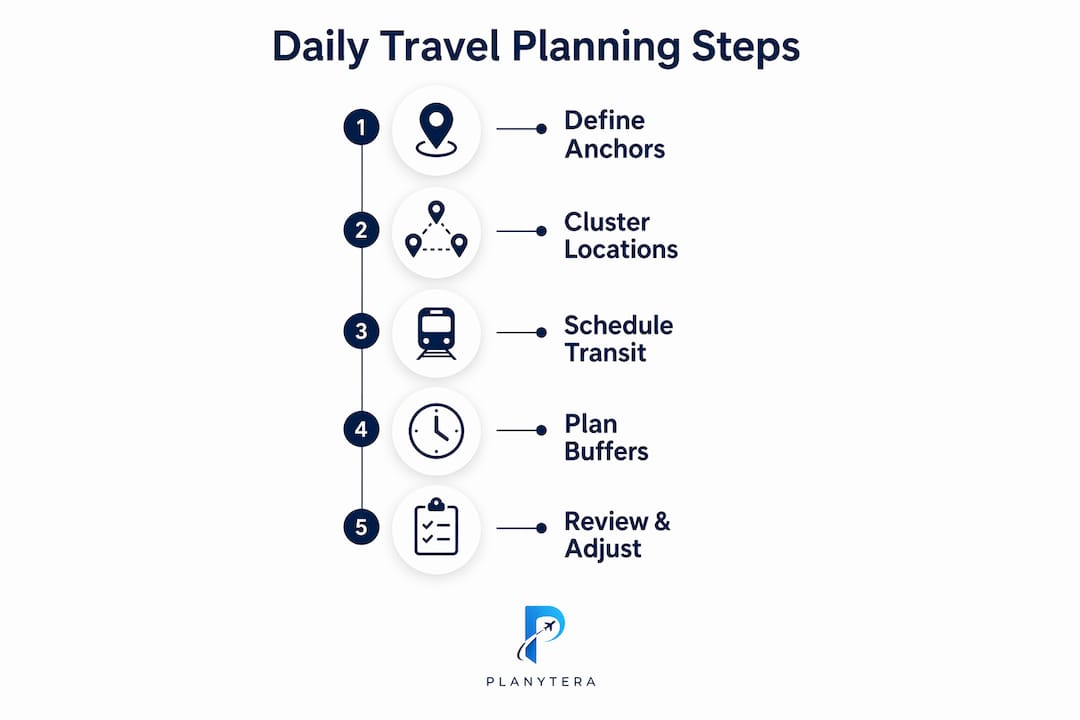
The method works in four layers. First, you confirm your logistics: flights, accommodation, and any timed reservations. Second, you map your activities by location so nearby things share the same day. Third, you assign 1–2 anchor activities per day and leave the rest open. Fourth, you build in buffer time so delays do not derail the whole schedule. Each layer depends on the one before it, which is why step-by-step travel planning produces better results than filling a calendar at random.
Step-by-step process for building a daily itinerary:
- List all fixed commitments first. Flights, hotel check-ins, tours with set times, and restaurant reservations go on the calendar before anything else.
- Count your usable days, not your nights. A 5-night trip often yields only 3 full functional days after transit and check-in logistics.
- Group activities by neighborhood or district. Assign each geographic cluster to a specific day.
- Assign 1–2 anchors per day. Planning more than 2 fixed anchors raises the probability of feeling rushed by more than 50%.
- Add buffer time. Block 2–3 hours of unscheduled time into each day for rest, delays, or detours.
- Create a tiered backup list. Separate your confirmed anchors from preferred activities and backup options so you always have a plan B.
Pro Tip: Write your daily plan in three columns: "Must Do," "Want to Do," and "If Time Allows." This tiered structure keeps your day from collapsing if one activity runs long.
How does geographic clustering enhance daily travel efficiency?
Geographic clustering is the practice of grouping activities by neighborhood or district so you spend your time experiencing places, not commuting between them. Grouping attractions by neighborhood cuts transit time by 30–50%. That is a significant portion of any travel day recovered and redirected toward actual experiences.
The contrast with arbitrary scheduling is stark. Without clustering, a traveler in Rome might visit the Colosseum in the morning, cross the city to the Vatican at noon, and then backtrack to Trastevere for dinner. That routing wastes 90 minutes or more in transit. With clustering, the morning and afternoon stay in the same zone, and the evening moves to the next natural district.
Here is how to identify and apply geographic clusters:
- Use a map first. Before assigning any activity to a day, drop all your planned attractions as pins on a map. Patterns emerge immediately.
- Define half-day blocks. Focusing on one neighborhood per half-day improves pacing and reduces exhaustion.
- Let geography drive the schedule. If two attractions are within walking distance, they belong on the same day regardless of category.
- Account for transit between clusters. If you must cross the city, schedule that transition at midday when energy is high, not at the end of a long afternoon.
| Scheduling approach | Average daily transit time | Energy impact |
|---|---|---|
| Arbitrary (no clustering) | High | Fatigue sets in earlier |
| Geographic clustering | Reduced by 30–50% | More energy for experiences |
| Half-day neighborhood blocks | Minimal | Sustained pace throughout the day |
The table above shows why clustering is not just a convenience. It is the single most important structural decision in a daily travel itinerary.
Why balancing anchors with flexible time matters in every itinerary
An anchor activity is any commitment with a fixed time or location that shapes the rest of your day. A cooking class at 10:00 AM is an anchor. A ferry departure at 3:00 PM is an anchor. These are non-negotiable, and they give your day its structure. Everything else should remain flexible.

The research on this is clear. Scheduling about 60% of your time and leaving 40% open prevents burnout and creates space for spontaneity. Those empty slots absorb delays, accommodate weather changes, and make room for the unexpected café or market you stumble across. The 40% is not wasted time. It is where many of the best travel memories get made.
Common mistakes travelers make when overplanning:
- Booking back-to-back tours with no transit time between them
- Treating every item on a wish list as a confirmed commitment
- Forgetting that meals, especially in new cities, take longer than expected
- Ignoring fatigue on days 3 and 4 of an intense trip
- Counting travel time as "free time" rather than as a scheduled block
Pro Tip: Treat your afternoon buffer like a meeting you cannot cancel. Block it on your schedule so you do not fill it with more activities the night before.
Experienced travelers recommend leaving 2–3 hours of buffer time each day. Actual travel frequently takes 30–50% longer than expected due to transit complexity or unforeseen events. That buffer is not pessimism. It is the difference between a trip that flows and one that feels like a race.
How to tailor your daily plan based on trip length and energy
Not every day of a trip carries the same weight. The first and last days almost always have reduced usable time, and ignoring that fact leads to overambitious scheduling. Tailoring your daily plan to your actual energy levels is what separates a realistic itinerary from one that looks good on paper but falls apart on the ground.
Follow this framework for multi-day trips:
- Treat arrival day as orientation only. Experts recommend minimal scheduling on the first day for recovery and orientation. A short walk, a nearby meal, and early sleep set you up for the days ahead.
- Build intensity gradually. Days 2 and 3 are typically your highest-energy days. Schedule your most demanding anchors, like long hikes or full-day tours, here.
- Insert a slow day in the middle of long trips. For trips of 7 days or more, plan one low-intensity day around the midpoint. A slow day might mean a local market, a long lunch, and a park. This resets your energy for the second half.
- Plan your last full day lightly. Leave room for last-minute shopping, a favorite spot revisited, or simply sitting somewhere beautiful without a schedule.
- Protect departure morning. Treat it like arrival day. One light activity at most, and confirm all logistics the night before.
For multi-city trips, a master overview itinerary that separates transit and connection planning from local day details keeps things clear. You see the big picture at a glance without losing the daily specifics. This approach works especially well when you are moving between cities every 2–3 days and need to track both local plans and travel logistics simultaneously.
The best itineraries conserve energy and mental focus by banking logistics ahead of arrival. When you already know where you are going and roughly when, your brain can relax and take in the experience instead of solving problems on the fly. That is the real payoff of good planning.
Key Takeaways
Day-by-day travel planning works best when it functions as a flexible skeleton, not a rigid script, with 1–2 anchors per day, geographic clustering, and 40% open time built in from the start.
| Point | Details |
|---|---|
| Limit daily anchors | Cap fixed activities at 1–2 per day to avoid feeling rushed and itinerary failure. |
| Cluster by geography | Group attractions by neighborhood to cut transit time by 30–50% and preserve energy. |
| Protect open time | Schedule only 60% of each day and leave 40% unplanned for rest and spontaneity. |
| Count usable days, not nights | A 5-night trip often yields just 3 full functional days after transit and logistics. |
| Taper intensity over the trip | Place high-energy days early, insert a slow day mid-trip, and keep the last day light. |
The planning mistake I see most often
Most travelers I talk to treat their itinerary like a contract. Every slot filled, every hour assigned, every attraction confirmed. Then day two arrives, the museum line is longer than expected, lunch runs over, and suddenly the whole afternoon is behind schedule. The stress that follows is not a travel problem. It is a planning problem.
The best itineraries act as a skeleton for decision-making on the ground, not a minute-by-minute script. When I plan a trip, I confirm my anchors, cluster my days by neighborhood, and then deliberately leave gaps. Those gaps feel uncomfortable when you are sitting at home with a blank afternoon on your schedule. On the ground, they feel like breathing room.
The other thing I have noticed is that travelers consistently underestimate the first and last days. You arrive tired. You leave stressed about logistics. Treating those days like full travel days is a setup for frustration. Give yourself permission to do less on the bookends. You will enjoy the middle days far more because of it.
Real couple itineraries, like the day-by-day examples on the Planytera blog, show this balance in practice. Structure and spontaneity are not opposites. The right plan makes spontaneity possible.
— Dom
How Planytera builds your daily itinerary for you
Planning a trip day by day takes time, research, and a lot of tab-switching. Planytera does the heavy lifting for you.

Planytera's AI trip planner generates personalized daily itineraries in moments, incorporating your pace, budget, dietary needs, and travel style. It applies the same principles covered here: fixed anchors, geographic clustering, and built-in flexibility. You get a ready-to-use travel schedule template that you can adjust on the fly, share with travel companions, and access offline. Whether you are planning a solo weekend or a two-week family trip, Planytera turns the process from a chore into a head start. Check out sample itineraries to see exactly what a finished plan looks like before you commit.
FAQ
What is day-by-day travel planning?
Day-by-day travel planning is the process of organizing a trip into individual daily schedules, each built around 1–2 fixed anchor activities with flexible time built in around them.
How many activities should I plan per day?
Limit each day to 1–2 anchor activities. Planning more than 2 fixed anchors raises the probability of feeling rushed by more than 50%.
Why should I leave unscheduled time in my itinerary?
Scheduling only 60% of your day and leaving 40% open prevents burnout, absorbs delays, and creates space for spontaneous discoveries that often become trip highlights.
What is geographic clustering in travel planning?
Geographic clustering means grouping activities by neighborhood or district so you minimize transit time. This approach cuts daily commute time by 30–50% and keeps your energy levels higher throughout the day.
How do I plan around arrival and departure days?
Keep arrival and departure days light. Experts recommend minimal scheduling on the first day for recovery and orientation, and treating the departure morning the same way to avoid last-minute stress.