
Pace-sensitive itinerary design is the practice of building travel schedules that consciously manage activity levels, transitions, and recovery time to maximize enjoyment and reduce fatigue. Known more formally in travel planning circles as travel pace management, this approach treats rest and buffer time as structural necessities, not optional extras. Personalized travel experiences built on this framework feel fundamentally different from standard attraction lists. You finish each day energized rather than depleted. The result is a trip that holds together under real conditions, not just on paper.
What is pace-sensitive itinerary design at its core?
Pace-sensitive itinerary design is a structural framework that manages the logistical and mental costs of travel to improve both survival and enjoyment. The core insight is simple: most travelers burn out not from too many attractions, but from too many transitions. Frequent location changes carry friction costs, including packing, transport, and reorientation, that accumulate faster than distance alone would suggest. Each move shortens your recovery window and adds cognitive load.
Energy cycles and cognitive load
Your energy as a traveler follows a predictable arc across a trip. The first two days carry excitement and adrenaline. By day three or four, the body starts demanding recovery. A pace-sensitive plan accounts for this arc by distributing high-demand activities earlier in the trip and building in lighter days as the week progresses. Ignoring this cycle is the single most common reason trips feel exhausting in retrospect.
Traveler-centric vs. destination-centric planning
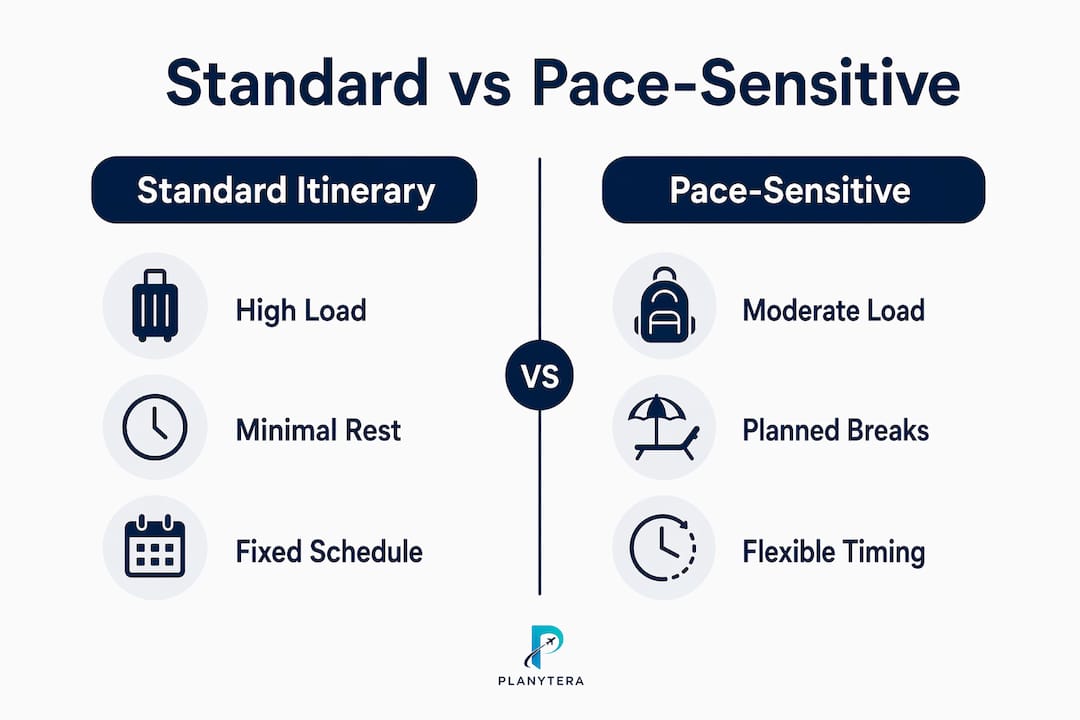
Destination-centric planning asks, "What does this city offer?" Traveler-centric planning asks, "What can this traveler actually absorb in a day?" The difference sounds subtle, but it changes every decision you make. Traveler-centric design consistently produces higher satisfaction, better engagement, and more meaningful memories than itineraries built around attraction checklists.

The role of buffer time
Buffer time is structural, not wasted. It prevents cascading stress when delays hit and gives your itinerary the flexibility to absorb the unexpected without forcing painful trade-offs. A missed train connection on a tightly packed schedule can unravel an entire day. The same delay on a pace-sensitive plan is a minor inconvenience.
- Transitions carry hidden costs. Every city change means packing, transport, and relearning a new neighborhood.
- Energy is finite and nonlinear. Day four of a six-day trip is typically the lowest-energy point.
- Buffer time is elasticity. It is not empty space. It is the margin that keeps the plan functional.
- Traveler type matters. Families, solo travelers, and those with mobility needs all have different energy profiles that require different pacing structures.
Pro Tip: Track how you feel at the end of each travel day on your next trip. You will quickly identify your personal energy pattern and use it to calibrate future itineraries.
How to implement pace-sensitive design in your itinerary
Applying travel pace management to a real trip requires a few concrete decisions made before you book anything. The sequence below works for trips of three days or longer and adapts across traveler types.
-
Limit anchor activities to two per day. Planning experts recommend a maximum of two major anchor activities per day. More than two and the itinerary starts functioning as a to-do list rather than a travel experience.
-
Group activities by location. Cluster everything in the same neighborhood or district into a single day. This cuts transit time, reduces reorientation costs, and leaves more room for spontaneous stops.
-
Use the split-day model. The split-day structure places one activity in the morning, a midday break of at least 90 minutes, and a second activity in the late afternoon. This rhythm sustains energy and reduces decision fatigue across the full day.
-
Schedule a slow day around day four. For trips of five days or longer, a dedicated rest day around the fourth day combats cumulative fatigue effectively. This day can include a leisurely meal, a short walk, or simply staying in. It is not wasted time. It is what makes the final days of the trip enjoyable.
-
Adjust for your traveler profile. Families with young children need rest windows every two to three hours. Solo travelers with high energy can push slightly harder but still benefit from a midday pause. Travelers with mobility needs require buffer time around every transition, not just the major ones.
-
Place buffer time strategically. Buffer time works best when positioned around high-risk transitions like intercity travel and departure days, not distributed evenly. A 30-minute buffer before a flight means nothing. A two-hour buffer before an intercity train on day five means everything.
Pro Tip: When building your day-by-day plan, write the midday break into the schedule as a fixed block, not an "if we have time" item. Treat it like a museum reservation.
Common mistakes in itinerary pacing and how to avoid them
Most itinerary failures trace back to a small set of recurring errors. Recognizing them before you plan saves you from learning them the hard way on the road.
-
Treating arrival and departure days as full sightseeing days. Arrival and departure days carry unique constraints: luggage, check-in logistics, transit time, and adjustment periods. Scheduling two anchor activities on arrival day almost always leads to burnout by day two.
-
Underestimating cumulative fatigue. A single long day feels manageable. Four consecutive long days feel catastrophic. Fatigue compounds. What drains you on day one at 20% will drain you at 60% by day four. Build recovery before you need it, not after.
-
Ignoring transition friction. Moving between cities every day feels exciting in theory. In practice, frequent location changes reduce recovery time and increase fatigue faster than any single activity could. Fewer moves mean more energy for the experiences that matter.
-
Treating buffer time as wasted time. Buffer time is not a gap in your schedule. It is the structural elasticity that keeps everything else on track. Filling it with optional activities defeats its purpose entirely.
-
Overbooking with optional activities. A list of "maybe" activities sounds harmless. In practice, it creates decision fatigue at exactly the moment you are most tired. Decide in advance, or leave the slot genuinely open.
How does pace-sensitive design enhance personalized travel experiences?
Pace-sensitive planning shifts the focus from what a destination offers to what a traveler can genuinely absorb and enjoy. That shift changes the quality of every experience on the trip. When you are not exhausted, you notice more. You engage with locals, linger over meals, and remember the details that make a trip worth taking.
Personalized itineraries that reflect traveler energy levels, preferences, and goals produce higher engagement, greater comfort, and more meaningful experiences than generic schedules. This is not a soft claim. It is the direct result of designing around the traveler rather than the destination.
Pace-sensitive design also creates margin for spontaneous discovery. When your schedule has breathing room, you can say yes to the unexpected: a local market you stumbled across, a conversation that turned into a two-hour lunch, a viewpoint that was not in any guide. Rigid, overloaded itineraries eliminate that possibility entirely.
The table below shows how pace-sensitive design compares to standard itinerary planning across key experience factors.
| Factor | Standard itinerary | Pace-sensitive itinerary |
|---|---|---|
| Daily activity load | 3–5 major activities | 1–2 anchor activities |
| Transition frequency | High (daily city changes common) | Low (grouped by location) |
| Buffer time | Minimal or absent | Strategically placed |
| Rest days | Rare or unplanned | Scheduled around day four |
| Spontaneous discovery | Limited by tight schedule | Built in through open margins |
| End-of-trip energy | Often depleted | Sustained through recovery design |
Accommodating diverse traveler profiles is where pace-sensitive design earns its real value. A family traveling with a toddler and a solo backpacker have almost nothing in common in terms of energy management. Pace-sensitive design gives both a framework that works, because it starts with the traveler, not the destination.
Key Takeaways
Pace-sensitive itinerary design produces better travel experiences by treating rest, buffer time, and transition management as core planning elements rather than afterthoughts.
| Point | Details |
|---|---|
| Limit daily anchor activities | Cap major activities at two per day to prevent itinerary overload and decision fatigue. |
| Use the split-day model | Structure each day as morning activity, midday break, and late afternoon activity to sustain energy. |
| Schedule a rest day | For trips of five or more days, plan a slow day around day four to combat cumulative fatigue. |
| Place buffer time strategically | Position buffer time around high-risk transitions like intercity travel, not spread evenly. |
| Design around the traveler | Traveler-centric planning consistently produces more satisfying experiences than destination-centric lists. |
Why pacing is the planning skill most travelers never learn
Most travelers I have talked to describe their worst trips the same way: "We tried to do too much." They are not wrong, but the real problem runs deeper than ambition. The itinerary itself was built without any structural understanding of how energy, transitions, and recovery actually work on the road.
The trips that hold up are the ones where someone made a deliberate decision to leave space. Not because they ran out of things to do, but because they understood that the quality of each experience depends on the state you arrive in. You cannot fully appreciate a museum when you are running on four hours of sleep and two missed meals.
The mindset shift that matters most is moving from "how much can we fit in" to "how much can we actually absorb." That question changes everything. It is the difference between a checklist and a memory. Planytera's itinerary planning approach reflects this thinking directly, building pace and preference into the plan from the start rather than treating them as secondary concerns.
— Dom
Plan your next trip with Planytera
Applying pace-sensitive principles manually takes time and experience. Planytera does the heavy lifting for you.

Planytera's AI trip planner builds personalized, day-by-day itineraries that account for your pace preferences, dietary needs, and budget from the first prompt. You get a tailored plan ready in moments, with the flexibility to adjust any day on the fly. Whether you are planning solo, with family, or as a group, Planytera factors in rest days, buffer time, and activity grouping automatically. No spreadsheets, no guesswork, and no overloaded days you will regret by day three.
FAQ
What is pace-sensitive itinerary design?
Pace-sensitive itinerary design is the practice of building travel schedules that manage activity levels, transitions, and recovery time to reduce fatigue and improve enjoyment. It treats rest and buffer time as structural parts of the plan, not optional gaps.
How many activities should you plan per day?
Planning experts recommend limiting each day to a maximum of two major anchor activities. More than two turns the itinerary into a to-do list and increases the risk of burnout.
What is the split-day model in travel planning?
The split-day model structures each travel day as one morning activity, a midday break of at least 90 minutes, and one late-afternoon activity. This rhythm sustains energy and reduces decision fatigue across the full day.
When should you schedule a rest day on a trip?
For trips of five days or longer, a dedicated slow day around the fourth day effectively combats cumulative fatigue. This rest day keeps energy levels sustainable for the remainder of the trip.
Why does buffer time matter in an itinerary?
Buffer time prevents cascading delays from disrupting the entire schedule. It works best when placed around high-risk transitions like intercity travel and departure days, where unexpected delays are most likely to occur.