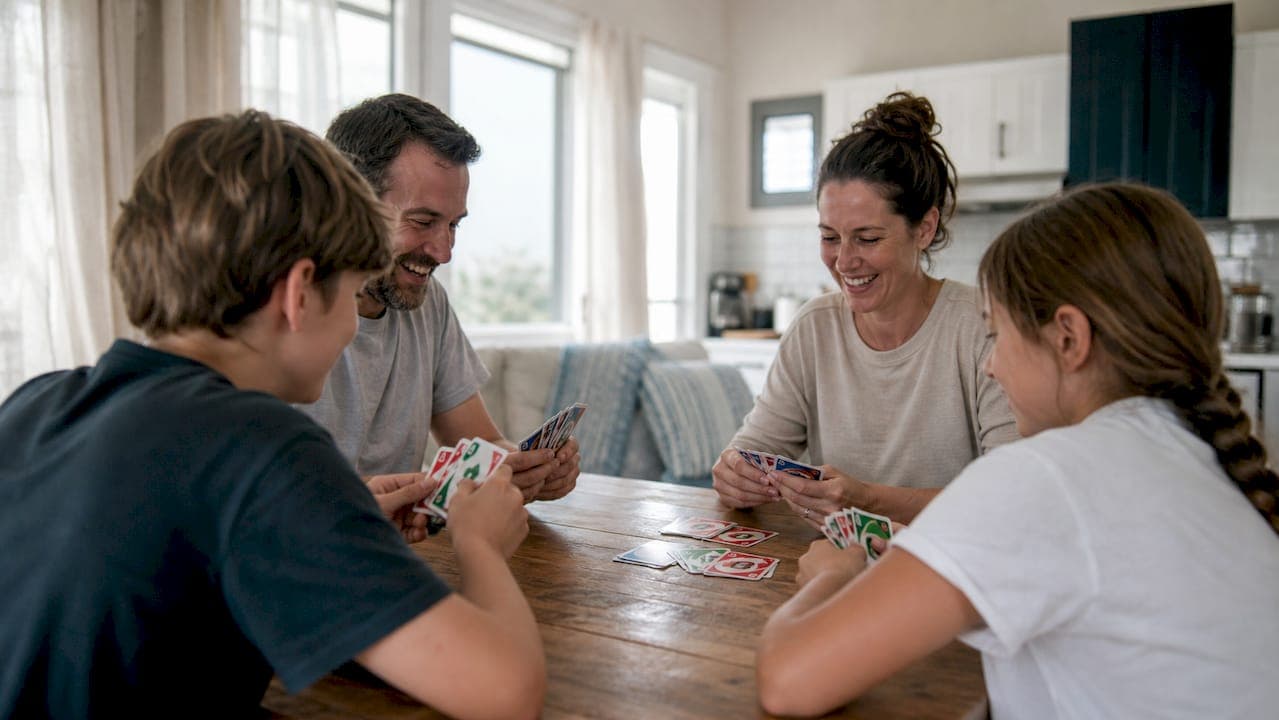
Schedule predictable rest windows into your family trip and you'll notice the difference by day two. The role of rest time in family itineraries isn't a nice bonus — it's the structural element that keeps everyone functional, happy, and actually present for the good parts. The practical rule of thumb: build in 10–30 minute micro-breaks between activities every day, a 2–4 hour half-day rest after any travel-heavy or high-stimulation outing, and one to two full "home days" per week of travel.
Here's why this matters right now, before you finalize any plans:
- Downtime restores attention and motivation and supports creativity — but only when people genuinely detach from demanding mental tasks (Scientific American).
- Short breaks improve mood, boost concentration, and lower burnout risk for both kids and adults (Cleveland Clinic).
- Schedule and environment changes are stressful for children; involving them in planning and bringing familiar items reduces that stress (CDC).
Your next step: pick a rest frequency that fits your trip length, block those windows on your shared calendar now, and treat them as non-negotiable. Planytera's AI itinerary builder lets you lock rest blocks directly into your day-by-day plan so they don't get squeezed out when the schedule gets busy.
Key Takeaways
Scheduling predictable rest windows — micro-breaks daily, half-days after heavy outings, and one to two full home days per week — is the single most effective structural change you can make to a family itinerary.
| Point | Details |
|---|---|
| Three-tier rest system | Build micro-breaks (10–30 min), half-day rests (2–4 hrs), and 1–2 full home days into every week of travel. |
| Align rest with biology | Schedule midday rest blocks to match children's natural nap windows and the early-afternoon energy dip. |
| Pack a rest kit | Bring familiar comfort items, a white-noise app, and quiet activities to reduce friction when rest time starts. |
| Involve kids in planning | Giving children a say in rest activities reduces resistance and helps them feel ownership over the trip. |
| Use Planytera to lock it in | Planytera's editable, collaborative itineraries let you block rest windows first and build activities around them. |
Table of Contents
- Why downtime on vacation is backed by real science
- How to schedule rest time so it actually sticks
- What a rest day actually looks like for families
- How rest needs shift by child age and trip length
- How to protect rest time before and during the trip
- Three sample itineraries that build rest in from the start
- Rest days are the part families remember most
- Planytera makes it easy to lock rest time into your trip
- Sources
Why downtime on vacation is backed by real science
Rest isn't wasted time. It's the mechanism that makes everything else on your trip work better.
Scientific American reports that downtime restores attention and motivation and fosters creativity — and that the benefits increase when people mentally detach from demanding thinking, not just pause between tasks. For families, that means a rest window filled with passive screen time or logistics planning doesn't deliver the same recovery as genuine low-demand time.
"Short periods of downtime improve mood, boost attention and concentration, and reduce the risk of chronic stress and burnout." — Cleveland Clinic
For kids specifically, the CDC notes that changes in schedule and environment are inherently stressful. Predictable rest windows act as anchors in an otherwise unfamiliar day, preserving routines that help children regulate their emotions and behavior.
Caregivers benefit too, in a distinct way. Research in restorative tourism links a destination's perceived restorative qualities and a caregiver's ability to mentally detach to measurable psychological recovery and higher life satisfaction after the trip. The practical implication: rest design should reduce caregiving cognitive load, not just pause activity.
Key benefits at a glance:
- Attention restoration for both kids and adults after stimulating sightseeing
- Mood stabilization that prevents afternoon meltdowns and caregiver irritability
- Creativity and bonding — unstructured time together often produces the memories families talk about for years
- Caregiver recovery through mental detachment, not just physical rest
How to schedule rest time so it actually sticks
Concrete frequency is what separates a plan that holds from one that collapses by day three.
The three-tier system:
- Micro-breaks (daily): 10–30 minutes between activities. Sit at a café, find a bench, let kids run in a park. No agenda.
- Half-day rest (after heavy days): 2–4 hours of low-demand time following any travel-heavy or highly stimulating day. Schedule this as a midday block, not an afterthought.
- Full home day (1–2 per week): A complete low-effort day. Stay in or very local. No museums, no transit, no itinerary pressure.
Timing by natural rhythm:
Align rest windows with biological energy dips. Early afternoon (roughly 1:00–3:00 PM) is when both children and adults hit a natural low. Road trips benefit from a midday stop at a rest area or park rather than pushing through. City tours work best with a morning activity block, a midday retreat to the hotel or a quiet café, and a gentle late-afternoon walk. Beach vacations naturally support this rhythm — morning beach time, midday shade and rest, late-afternoon return.
A sample day structure you can copy:
- 8:00 AM: Breakfast at the rental or hotel (low-effort, familiar)
- 9:00–11:30 AM: One main activity (museum, nature trail, local market)
- 11:30 AM: 20-minute micro-break — snack, sit, decompress
- 12:00–2:30 PM: Lunch + rest block (nap for younger kids, quiet time for older ones)
- 3:00–5:00 PM: Gentle afternoon activity (short walk, pool, free play)
- 5:30 PM: Easy dinner, early wind-down
Protect the window — dos and don'ts:
- Do treat rest blocks like confirmed reservations — they don't move
- Do use the rest window for low-demand shared activities (reading, quiet games)
- Don't use rest time to catch up on logistics, research tomorrow's plan, or scroll through your phone
- Don't schedule back-to-back high-stimulation activities and expect a 10-minute break to compensate
What a rest day actually looks like for families
A "home day" doesn't mean everyone stares at the ceiling. Business Insider's family travel coverage describes home days as staying in pajamas, playing board games, ordering easy meals, and simply not going anywhere demanding — and families consistently report lower stress and better moods afterward.
Full home day ideas:
- Board games or card games at the rental
- Reading aloud together or independent reading time
- Unstructured pool or backyard time
- A short, easy walk in the immediate neighborhood
- Cooking or assembling a simple meal together
Half-day rest options:
- Return to the hotel after a morning outing and spend the afternoon at the pool
- Find a local park and let kids direct the play
- Visit a low-key café or bookstore with no time pressure
Micro-break formats:
- Sit on a bench and people-watch for 15 minutes
- Ice cream stop with no next destination announced
- Five minutes of quiet in the car before the next stop
What does NOT count as restorative rest: crowded tourist attractions, screen-heavy passive time (high-stimulation video games or action movies), or any activity that requires sustained planning or decision-making. Psychology Today explains that idle time and the brain's default mode network support creativity and recovery — and that requires genuinely low-demand mental activity.
Pro Tip: Pack a small "rest kit" — a favorite stuffed animal, a deck of cards, a coloring book, and a portable white-noise app. Having these ready removes the friction of setting up rest time in an unfamiliar place and signals to kids that a quiet period is starting.

How rest needs shift by child age and trip length
Age changes everything about how much rest you need to build in and where to place it.
By age group:
- Infants and toddlers: Multiple predictable naps are non-negotiable. Mayo Clinic's nap timing guidance shows that many children ages 4 months to 1 year nap both morning and early afternoon, and children up to age 3 often need 1–2 hours of afternoon sleep. Build your entire daily schedule around these windows, not the other way around.
- Preschool and early school age (3–7): One longer midday rest plus short micro-breaks. These kids tire faster than they show — watch for irritability and clinginess as early fatigue signals.
- Older kids and teens (8+): Shorter micro-breaks work, but predictable downtime still matters. Teens especially benefit from unstructured time that isn't directed by parents.
By trip length:
- Weekend trip (2–3 days): Build micro-breaks daily; skip a full home day but protect one half-day rest.
- 7-day trip: One to two full home days, placed after the most activity-dense stretches (typically days 3–4 and day 6).
- Multi-week trip (10+ days): One home day per 5–6 days of travel, plus daily micro-breaks and at least two half-day rests per week.
For children with chronic health conditions, the CDC recommends working with their healthcare providers to determine appropriate itinerary timing — rest schedules for these kids should be set with medical input, not just general rules of thumb.
How to protect rest time before and during the trip
Planning rest is one thing. Keeping it on the schedule when everyone wants to see one more thing is another.
Before you leave:
- Block rest windows in your shared trip calendar the same way you book activities — Google Workspace's guidance on downtime recommends treating breaks like scheduled events so they actually happen
- Reserve lodging with a comfortable common space or a kid-friendly room setup
- Plan at least two meals per trip that require zero commute (grocery pickup, delivery, or in-unit cooking)
- Share the plan with older kids so the home day isn't a surprise
Pack your rest kit:
- One or two familiar comfort items per child (a favorite toy, a small blanket)
- Portable white-noise app or small speaker
- Sunshade or blackout travel curtain for naps in bright rooms
- Simple quiet activities: coloring books, a deck of cards, one small toy
Scripts that work:
- "Tomorrow is our home day — we're staying in, playing games, and having an easy morning. No rushing."
- "We're taking a quiet hour now so we have energy for the afternoon."
- "You get to pick what we do during rest time — as long as it's calm."
Involving kids in choosing rest activities, as the CDC advises for trip planning generally, gives them ownership and reduces resistance. Check out kid-friendly travel planning resources for more on building routines that travel with you.
Three sample itineraries that build rest in from the start
These three examples show how rest windows fit into real trip structures. Adapt the timing to your family's rhythm.
| Trip Type | Length | Rest Frequency | Sample Day Structure |
|---|---|---|---|
| City break | 4 days | Daily micro-breaks + 1 half-day rest on day 3 | Morning: museum or landmark. Midday: hotel rest (1–2 hrs). Afternoon: short neighborhood walk. Evening: early dinner. |
| Beach vacation | 7 days | Daily micro-breaks + 1 full home day (day 4) | Morning: beach. Midday: shaded rest at rental. Afternoon: pool or free play. Evening: easy local meal. |
| Road trip | 10 days | Daily micro-breaks + 2 full home days (days 4 and 8) | Morning: drive 2–3 hrs with a rest-area stop. Midday: picnic + 1-hr rest. Afternoon: one activity. Evening: early stop. |
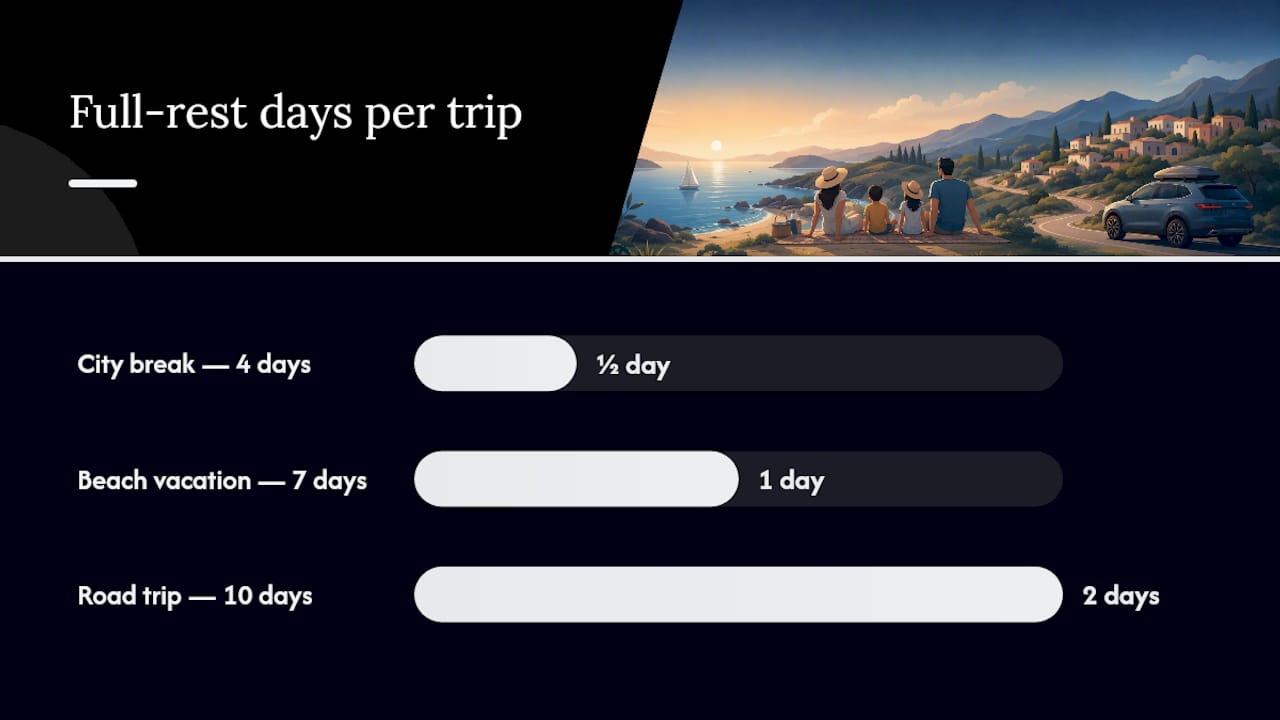
City break swap options: If a full half-day feels like too much, replace it with two 45-minute micro-breaks on the same day and an early bedtime.
Beach vacation swap options: Swap the full home day for two half-day rests on days 3 and 5 if your family prefers shorter, more frequent breaks.
Road trip swap options: On a 10-day trip with young toddlers, consider three home days instead of two, placed every three days of driving.
For ready-to-use daily schedule templates, the kid-friendly daily travel schedules resource has five examples you can copy directly.
Rest days are the part families remember most
Here's the honest truth most travel content skips: the days families remember most fondly are rarely the packed museum days. They're the slow mornings, the spontaneous card games, the afternoon when nobody had anywhere to be.
The resistance to scheduling rest usually comes from a fear of "wasting" the trip. But the evidence points the other way. Restorative tourism research shows that caregivers who mentally detach during vacation report higher life satisfaction afterward. That's not a soft finding — it's a measurable outcome tied directly to how the trip was designed.
The shift that works: stop treating rest as what happens when you run out of energy, and start treating it as infrastructure. Block it first. Build activities around it. A family that arrives at day five with energy intact will get more out of the remaining days than one that pushed hard and hit a wall on day three.
Planytera makes it easy to lock rest time into your trip
Planning rest windows is straightforward when your itinerary tool does the heavy lifting. Planytera generates personalized, day-by-day family itineraries that you can edit in real time — so blocking a home day or a midday rest window takes seconds, not a spreadsheet rebuild.

Key features that directly support rest planning:
- Calendar-style day blocks you can mark as rest windows or home days
- Collaborative editing so every family member sees the plan and the breaks
- Offline access for mid-trip adjustments when you're away from Wi-Fi
- Live itinerary edits when plans change and rest needs to shift
If day four turns into an exhausted home day instead of a city tour, you adjust the plan in the app and move on. No guilt, no scrambling. For families who want to adjust itineraries mid-trip, Planytera's live-edit feature makes that feel easy rather than stressful. Start building your family itinerary with rest windows already built in.
Sources
These are the primary sources behind the guidance in this article:
- Take That Vacation: Why Time Off Makes You a Better Worker
- Why Downtime Is Essential for Brain Health
- Traveling Safely with Infants and Children | CDC Yellow Book™
- Baby naps: Daytime sleep tips - Mayo Clinic
- Family Travel Tip: Add 'Home Days' to Your Itinerary to Rest, Recharge - Business Insider
- Engaging with restorative environments in wellness tourism. Current Issues in Tourism. 2022;26(5):789-806. (2025 DOI entry)