
Splitting a group travel budget is the process of fairly dividing all trip costs among participants to maintain transparency and prevent financial conflicts. Whether you are coordinating a weekend trip for six friends or a multi-city vacation for a family reunion, shared expense management is the single biggest factor in whether a group trip ends on a high note or in awkward silence. This split group travel budget guide covers every step: how to categorize costs, which splitting methods work best, which digital tools do the heavy lifting, and how to keep communication clear before and during the trip.
What categories of expenses exist in a group travel budget?
Separating expenses into "Shared" and "Individual" buckets before booking is the industry standard for avoiding reconciliation headaches at the end of a trip. When every traveler knows which costs belong to the group and which belong to them personally, disputes shrink dramatically.
Group travel costs fall into three clear categories:
- Shared fixed costs. These are expenses the whole group pays equally regardless of individual choices. Accommodation, group transportation like a rented van or charter bus, and entry fees for group activities all belong here. Everyone benefits equally, so equal division is straightforward and defensible.
- Variable shared costs. These are group expenses where participation differs. A group dinner where two people skip dessert, or a boat tour where one traveler sits it out, falls into this category. Splitting these equally can quietly overcharge the people who opted out.
- Personal expenses. Flights booked individually, souvenirs, personal spa treatments, and any upgrade a single traveler chooses are personal costs. The cleanest approach is for each traveler to pay these at the point of sale, keeping them entirely out of the group ledger.
Getting this categorization right before you book anything saves hours of back-and-forth later. A shared spreadsheet or a group chat pinned message works fine for small groups. For larger groups, a dedicated app handles the sorting automatically.
Which splitting methods work best for group travel?

No single method fits every group. The right choice depends on your group's size, income diversity, and appetite for administrative detail.
| Method | Best for | Main drawback |
|---|---|---|
| Equal split | Small groups with similar spending habits | Can overcharge members who skip costly extras |
| By-usage (itemized) | Groups with mixed activity participation | Requires detailed tracking of every expense |
| Proportional (income-based) | Groups with significant income gaps | Needs unanimous agreement or breeds resentment |
| Shared kitty (trip fund) | Groups wanting a simple pooled system | Requires a trusted treasurer and clear top-up rules |
Equal split is the fastest method. Everyone pays the same amount for every shared expense. The problem is that equal splits silently overcharge travelers who skip expensive dinners or optional excursions. Use this method only when the group has similar budgets and similar participation.
By-usage or itemized splitting is the fairest method for groups with varied participation. Each traveler pays only for what they actually consumed. If three out of eight people skip the wine-pairing dinner, those three pay nothing for it. This method requires consistent logging, but it eliminates the most common source of post-trip resentment.
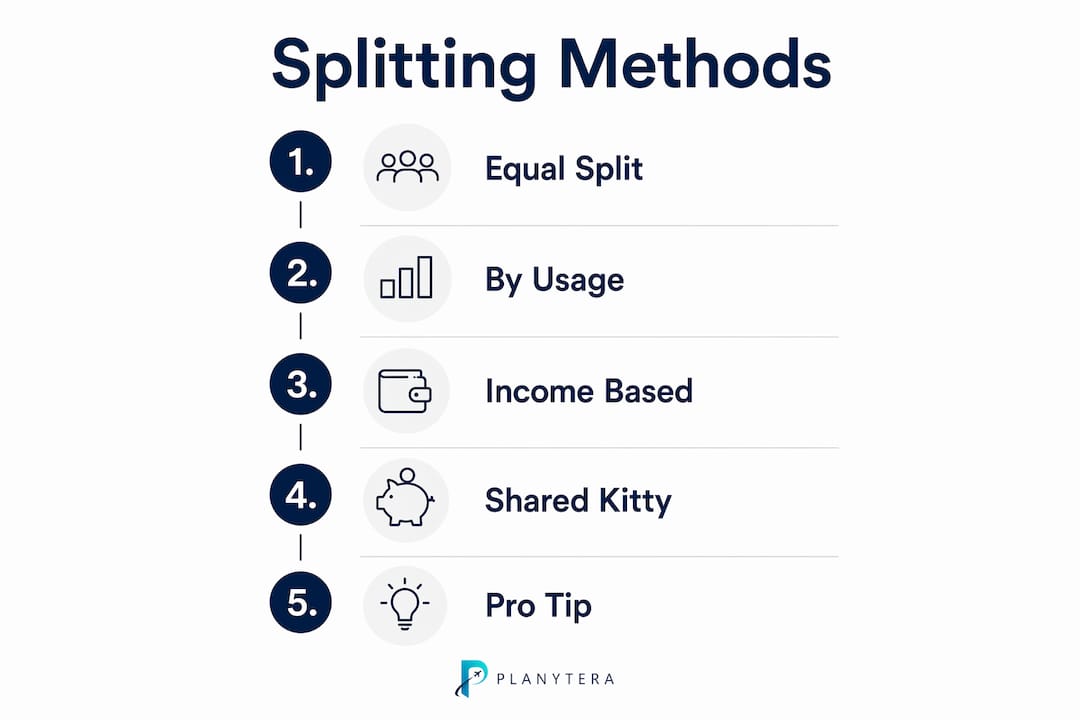
Proportional or income-based splitting adjusts each person's share based on their financial capacity. This method works well in theory but requires unanimous consent to avoid making lower-income travelers feel singled out or higher-income travelers feel penalized.
The shared kitty is a pooled trip fund that everyone contributes to upfront. A designated treasurer manages the fund and pays shared expenses from it. This method works well for groups that want to avoid constant individual reimbursements, but it requires a clear top-up process when the fund runs low.
Pro Tip: Agree on your splitting method before anyone books anything. A five-minute group chat decision upfront prevents a five-hour argument at checkout.
How do digital tools simplify group expense tracking?
Digital expense-tracking apps are the current standard for managing shared travel costs. They handle multi-currency conversion, real-time balance updates, and custom splits without requiring anyone to maintain a manual spreadsheet.
Key features to look for in a group travel expense app:
- Real-time balance updates. Every traveler sees who owes what the moment an expense is logged. This prevents the "I thought you paid for that" confusion that derails trips.
- Custom split options. Good apps let you split by equal shares, exact amounts, or percentages. This covers all three expense categories described earlier.
- Multi-currency support. For international trips, automatic currency conversion removes the need for manual calculations at every border.
- Offline access. Connectivity is unreliable in many destinations. Apps that work offline and sync when reconnected keep records accurate even in remote areas.
- Export options. A downloadable summary at the end of the trip gives everyone a clear record and simplifies final settlements.
Tricount has over 17 million users and offers offline access, making it a reliable choice for international group trips. That user base reflects how widely group coordinators have moved away from spreadsheets toward purpose-built tools.
Using apps to log expenses in real time fosters accountability and reduces end-trip awkwardness. When balances are visible to everyone throughout the trip, no one is surprised by a large settlement request on the last day.
What are the best practices for smooth group budget communication?
Budget misalignment, not the total cost of a trip, is the biggest source of tension in group travel. Two travelers with very different spending comfort levels will clash regardless of how fair the splitting method is. Addressing this before the trip starts is the most effective thing a coordinator can do.
Follow these steps to keep communication clear and conflicts rare:
- Run an anonymous pre-trip budget check. Ask each traveler to submit their daily budget comfort level privately before the group finalizes any plans. Anonymity removes social pressure and gives you an honest picture of the group's financial range.
- Document the agreed rules. Write down the splitting method, the expense categories, and the settlement schedule. Share it in a group chat or email thread so everyone has a reference point.
- Separate shared and personal expenses explicitly. Confirm before booking which costs go into the group ledger and which each traveler handles independently.
- Designate a treasurer. One person should manage the shared kitty, log group expenses, and send balance updates. Rotate this role on longer trips to distribute the administrative load.
- Build in a 10–20% buffer. Adding a buffer to pooled funds covers tips, local taxes, and unexpected costs without requiring a mid-trip top-up request.
- Settle balances regularly. Do not wait until the last day. Weekly settlements on longer trips keep amounts manageable and prevent anyone from feeling like they are carrying the group financially.
"Budget misalignment is the key tension source in group travel. Agreeing on spending tiers upfront, before any bookings are made, is the single most effective way to prevent financial conflict during the trip."
Pro Tip: Create a simple one-page trip finance document before departure. List the splitting method, the treasurer's name, the settlement schedule, and the buffer amount. Send it to everyone and ask for written confirmation. This one step eliminates most mid-trip money arguments.
For coordinators managing family trips with mixed age groups and budgets, the family budget travel guide on the Planytera blog covers additional strategies for multi-generational cost sharing.
Key Takeaways
Fair group budget splitting requires clear expense categories, an agreed method, and consistent tracking from the start of planning through the final settlement.
| Point | Details |
|---|---|
| Categorize expenses first | Separate shared fixed costs, variable shared costs, and personal expenses before booking anything. |
| Choose the right method | Equal splits work for uniform groups; by-usage splits are fairest for groups with mixed participation. |
| Use a dedicated app | Apps with real-time updates and offline access prevent errors and reduce end-trip disputes. |
| Build in a buffer | Add 10–20% to pooled funds to cover tips, taxes, and unexpected costs without mid-trip friction. |
| Communicate upfront | Anonymous budget checks and documented rules prevent misalignment before it becomes conflict. |
Why clear budgets are the real foundation of a great group trip
Most group trips that go sideways financially do not fail because the trip was too expensive. They fail because nobody talked about money honestly before departure. I have seen well-planned itineraries fall apart in the last 48 hours because one person felt they had been quietly subsidizing everyone else the entire time.
The uncomfortable truth is that the splitting method matters far less than the conversation you have before choosing it. A group that agrees on an equal split with full awareness of its limitations will have a better trip than a group that uses a mathematically perfect by-usage system that nobody understood or trusted.
Income-based splits are worth mentioning here because they sound generous in theory. In practice, forcing income-based contributions without unanimous consent creates resentment on both sides. The traveler paying more feels taxed for their success. The traveler paying less feels patronized. Default to equal splits for shared items and let individuals pay their own personal costs. That combination handles the vast majority of group trips without drama.
The other thing most guides skip: the treasurer role is genuinely underrated. Giving one person clear authority to manage the fund, log expenses, and send updates removes the ambiguity that causes passive-aggressive tension. Rotate the role if the trip is long. But always have one.
For coordinators managing couples within a larger group, the couples travel budgeting guide offers useful context on how pairs within a group can manage their share without complicating the group ledger.
— Dom
How Planytera helps you plan and budget group trips
Group trip planning gets complicated fast. Planytera takes the friction out of it with AI-powered, day-by-day itineraries that factor in your group's budget from the start.
With Planytera, you set your budget parameters and the platform builds a tailored plan around them, covering accommodation, activities, and dining without blowing the numbers. The AI trip planner works for solo travelers, couples, families, and full group trips, adjusting pace and preferences for everyone involved. You can also browse subscription plans to find the option that fits your group's planning needs, whether you are organizing a weekend getaway or a two-week international trip.
FAQ
What is the fairest way to split group travel expenses?
By-usage or itemized splitting is the fairest method for groups with mixed participation, since each traveler pays only for what they consumed. For groups with uniform participation, an equal split is simpler and works just as well.
How do you handle personal vs. shared costs in a group trip?
The standard practice is to separate shared and personal expenses before booking. Shared costs like accommodation and group transport go into the group ledger; personal costs like individual flights and souvenirs are paid directly by each traveler.
Should you use an app to track group travel expenses?
Yes. Apps with real-time balance updates and multi-currency support eliminate manual calculation errors and reduce end-trip disputes. Tricount, with over 17 million users, is a widely used option that also works offline.
How much buffer should a group travel fund include?
A 10–20% buffer above the estimated trip cost covers tips, local taxes, and unexpected expenses. This prevents mid-trip top-up requests that can create friction within the group.
What causes the most conflict in group travel budgets?
Budget misalignment between travelers with different spending comfort levels is the leading cause of group travel conflict. Running an anonymous pre-trip budget check before finalizing plans is the most effective way to address this early.