
Travel customization is defined as the process of designing a trip around your specific preferences, values, and goals rather than fitting you into a pre-built package. What does travel customization involve, at its core, is a shift from generic itineraries to experiences built around who you are as a traveler. The industry term for its most advanced form is "bespoke travel" or "tailor-made travel," and the gap between that and simply swapping a hotel room is enormous. 52% of travelers in 2026 are willing to share personal data for more tailored offers. That number tells you how seriously travelers now take personalization.
What does travel customization involve at its core?
Travel customization uses your data, your preferences, and your context to shape every element of a trip. That means arrival method, dining choices, daily pace, guide style, and budget all get considered together. It is not about picking from a dropdown menu of hotel categories. True customization starts from scratch with every logistical detail built against a unique brief.
The hospitality industry distinguishes between two approaches. The first is preference-based customization, where you select from existing options. The second is bespoke travel design, where a planner or AI system builds your trip from a blank page. Most travelers have only experienced the first. The second produces meaningfully different results.

What does travel personalization mean in practice? It means your motivations matter as much as your budget. A traveler going to Japan for a solo wellness reset needs a completely different itinerary than one going for a family food tour, even if both have the same budget and travel dates.
How does technology power personalized travel planning?
AI and CRM systems now do the heavy lifting in travel personalization. They capture your past booking behavior, dietary needs, preferred travel pace, and even life stage to build recommendations that actually fit. Combining historical data with current context like motivations, timing, and budget is what separates effective personalization from ineffective guessing.
Here is how tech-enabled customization shows up at different stages of your trip:
- Planning phase: AI trip planners generate day-by-day itineraries based on your stated preferences, budget, and travel style.
- Booking phase: CRM systems surface relevant upgrades, dining options, and experiences based on your profile.
- During travel: Live guidance tools adjust recommendations in real time based on weather, crowd levels, or your mood.
- Post-trip: Feedback loops feed your experience back into the system to improve future recommendations.
Planytera uses this exact approach. It generates tailored day-by-day plans that account for dietary requirements, pace, and budget, and travelers can adjust their itineraries on the fly as plans change.
Pro Tip: Tell your AI trip planner your "why" before your "what." Sharing that you want to reconnect with a partner or recover from burnout produces far more relevant suggestions than just listing destinations.
The travel preference categories that matter most to AI systems include pace preference, dietary needs, accommodation style, activity intensity, and cultural interest level. The more clearly you define these, the better your results.
What are the different types of travel customization?
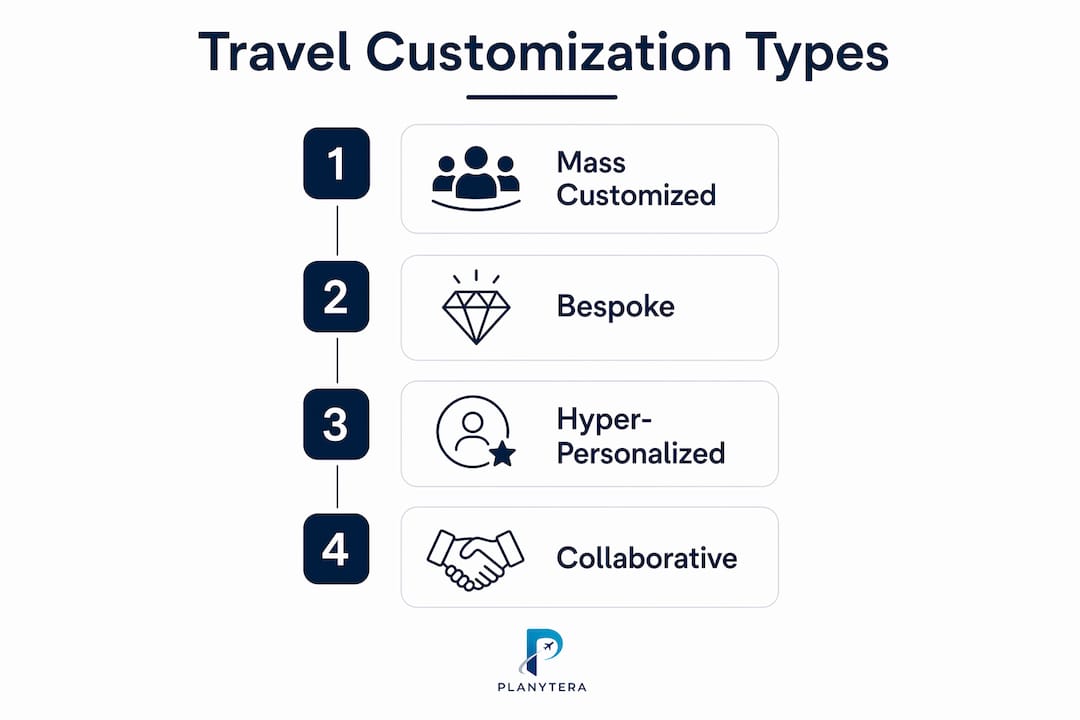
Not all customization is equal. The three main levels differ significantly in depth, effort, and outcome.
| Type | What it means | Example |
|---|---|---|
| Mass customized | Choose from preset options within a fixed package | Pick your room type and one excursion from a list |
| Semi-customized | Mix and match components with some flexibility | Select flights, hotel, and two guided experiences independently |
| Fully bespoke | Every element built from scratch around your brief | A 10-day itinerary designed around your dietary needs, pace, and emotional goals |
Bespoke itineraries address preferences including arrival methods, dining, pacing, and guide selection rather than simple hotel swaps. That distinction matters because most travelers think they have experienced customization when they have only experienced the first or second tier.
Hyper-personalization takes the fully bespoke model further. It factors in your emotional state, relationship goals, and life context. True travel customization starts in the planning phase by understanding traveler emotions, motivations, and values rather than just amenity preferences. This is why what does romantic travel customization mean goes beyond booking a nice hotel. It means designing shared experiences that match where a couple is emotionally, not just geographically.
Collaborative customization is another growing type. Planytera supports this directly by letting families and groups plan together, with each person contributing preferences before the AI generates a unified itinerary that works for everyone.
What are the common pitfalls of travel customization?
The biggest misconception about travel customization is that more personalization always means a better trip. It does not. Over-personalization causes cognitive overload, leaving travelers with too many tailored options and no mental space to enjoy any of them. The goal is a curated experience with room to breathe, not a minute-by-minute schedule.
Several other pitfalls show up regularly:
- Cultural blind spots: AI systems often assume uniform preferences within a region. AI-driven personalization frequently misses intercultural nuances critical for humanized experiences. A traveler from São Paulo and one from rural Portugal may share a language but have very different expectations.
- Confusing customization with upgrades: Swapping a standard room for a suite is not customization. It is an upgrade. Real customization changes the structure of your experience, not just its quality tier.
- Ignoring emotional goals: Travelers who only describe logistics miss the most important input. What you want to feel at the end of a trip shapes every good customization decision.
- Over-relying on past behavior: Your last trip does not define your next one. Good systems ask about your current motivations, not just your booking history.
Pro Tip: When working with any AI trip planner or travel designer, describe your ideal last evening of the trip first. That single detail reveals more about your real travel goals than any checklist.
How can you effectively customize your own travel experience?
Getting the most from travel customization requires a shift in how you approach planning. Most travelers start with a destination and work outward. The better approach works in reverse.
- Start with your emotional goal. Travelers increasingly see vacations as tied to self-improvement and relationship building. Decide what you want to feel or achieve before you pick a destination.
- Define your non-negotiables. Dietary needs, mobility requirements, budget hard limits, and pace preferences should be stated upfront. These are not preferences. They are constraints that shape everything else.
- Use an AI trip planner for the first draft. Tools like Planytera generate a complete day-by-day itinerary fast. You get a working structure to react to rather than a blank page to fill. Understanding how AI travel itineraries work helps you give better inputs and get better outputs.
- Adjust for flexibility. Build at least one unscheduled half-day per three days of travel. Customization works best when it creates a framework, not a rigid schedule.
- Communicate motivations, not just preferences. Telling a planner "I want to feel restored" produces better results than "I like nature." Motivation gives context. Preference gives only direction.
Budget shapes the entire customization process. How your budget affects itinerary generation is worth understanding before you start, because a well-defined budget unlocks better recommendations at every tier.
Key Takeaways
Travel customization produces meaningfully better experiences when it starts from your emotional goals, uses accurate preference data, and balances curated structure with genuine flexibility.
| Point | Details |
|---|---|
| Bespoke vs. basic | True customization builds from scratch; picking from preset options is not the same thing. |
| Data plus context | Effective personalization combines past behavior with current motivations, budget, and life stage. |
| Avoid over-personalization | Too many tailored options cause cognitive overload; build in unscheduled time. |
| Emotional goals first | Stating what you want to feel produces better itineraries than listing destinations alone. |
| AI accelerates planning | AI trip planners like Planytera generate a working itinerary fast, giving you a structure to refine. |
Why I think most travelers are still missing the point
The travel industry has done a good job selling the idea of personalization. It has done a poor job delivering the real thing. Most of what gets called "customized travel" is still just a menu with more options.
What I have seen shift in 2026 is the conversation around emotional intent. The traveler journey is evolving from transactional booking to emotional and relationship-driven experiences. That is not marketing language. It reflects a real change in what travelers say they want when you ask them directly.
The risk I watch for is cognitive overload dressed up as personalization. When a platform gives you 47 "tailored" restaurant options, that is not customization. That is a search engine with your name on it. The best customized travel I have seen involves fewer choices, not more. A good travel designer or AI system narrows the field based on your brief and presents three strong options, not thirty.
My honest advice: treat your next trip as a brief, not a booking. Write down what you want to experience emotionally. Share that with whatever tool or person is helping you plan. The technology in 2026 is genuinely capable of building something meaningful from that input. The gap is almost always on the traveler's side, not the platform's.
— Dom
Planytera turns your travel brief into a real itinerary
You have the goals. Planytera does the planning. The AI trip planner at Planytera takes your preferences, budget, dietary needs, and travel pace and generates a complete day-by-day itinerary in minutes. No spreadsheets, no hours of research, no generic packages.
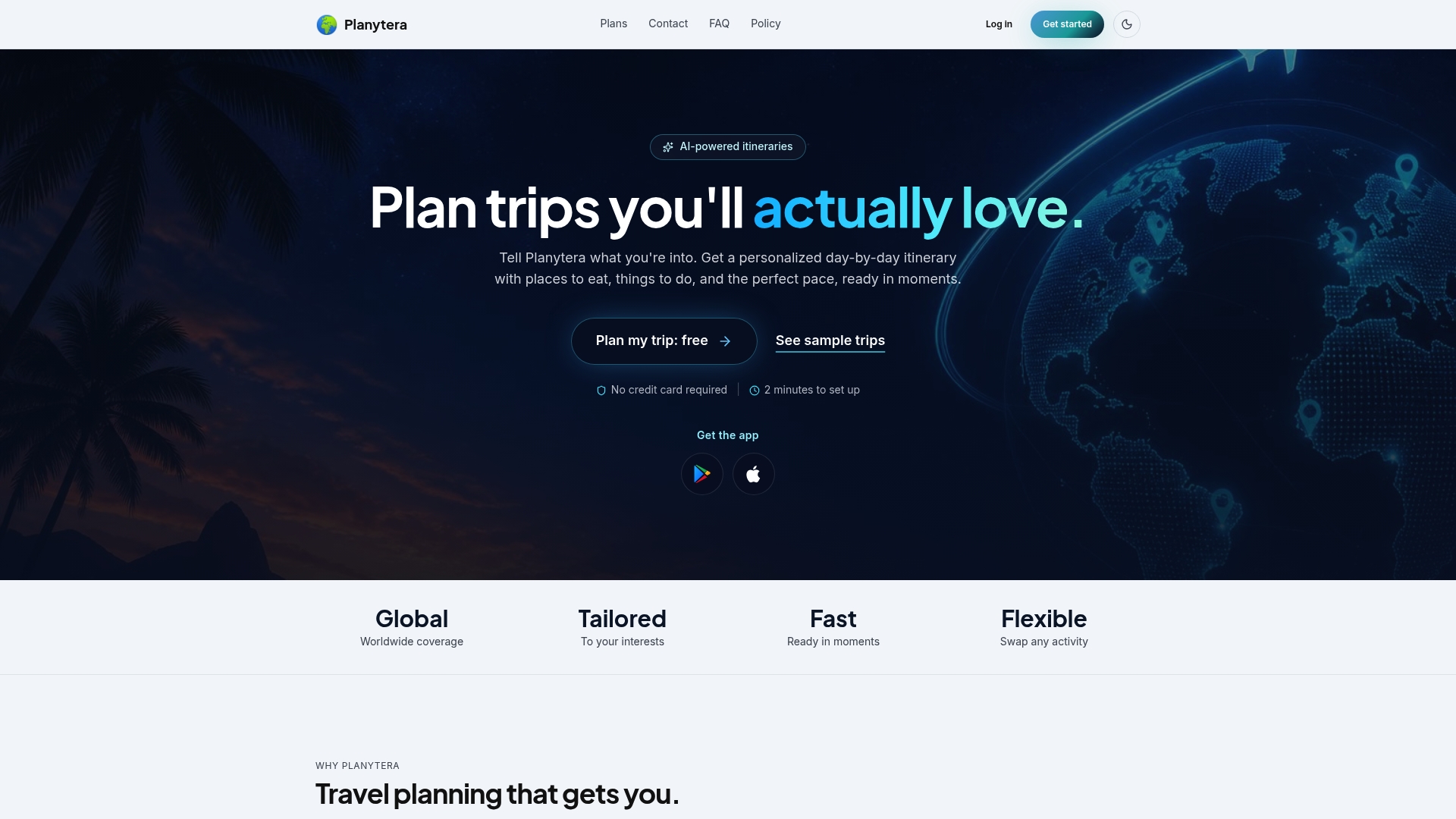
You can adjust your plan on the fly, collaborate with travel companions, and access your itinerary offline. Want to see what a finished plan looks like before you commit? Browse real itinerary examples to get a feel for the depth and detail Planytera produces. For travelers who plan frequently, subscription plans give you ongoing access to AI-powered planning whenever your next trip takes shape.
FAQ
What does travel customization involve exactly?
Travel customization involves designing every element of a trip around your specific preferences, motivations, budget, and emotional goals rather than selecting from a fixed package. At its most advanced level, it builds a complete itinerary from scratch.
How is travel personalization different from customization?
Travel personalization uses your data and behavior to tailor recommendations automatically, while customization involves actively shaping the trip structure yourself. In practice, the two work together in modern AI-powered planning tools.
What does romantic travel customization mean?
Romantic travel customization means designing shared experiences around where a couple is emotionally, not just picking a scenic destination. It considers relationship goals, shared pace preferences, and the kind of memories both travelers want to create.
How does AI help with custom travel planning?
AI trip planners like Planytera combine your stated preferences, budget, and travel style to generate a tailored day-by-day itinerary fast. They replace hours of manual research with a working plan you can adjust in real time.
Can over-personalization make travel worse?
Yes. Research from the International Journal of Contemporary Hospitality Management shows that too many tailored options cause cognitive overload. The best customized itineraries narrow your choices based on a clear brief rather than multiplying them.