
Family travel plans change daily because a short, predictable set of factors — illness, kids' sleep and moods, weather, transport delays, budget surprises, and double-booked events — collide with the reality of traveling with children. The good news: most of these disruptions are manageable when you have a clear first move ready.
Your first 10 minutes when plans shift:
- Designate one communicator. One adult handles all provider calls and messages. Everyone else focuses on the kids.
- Open your shared itinerary. Pull up the current plan so the whole group sees the same information.
- Triage safety and health first. Is anyone sick or unsafe? That decision comes before any rebooking.
Once those three steps are done, you have breathing room to work through the rest calmly.
Key Takeaways
Family travel plans shift daily because illness, budget pressure, weather, and kids' needs are constant variables — and the families who handle it best build flexibility in before the trip starts.
| Point | Details |
|---|---|
| Designate one communicator | One adult handles all provider calls during a disruption so the other can focus on the kids. |
| Safety and sleep come first | Triage health and rest before any rebooking decision — a tired or sick child changes every other priority. |
| Build in a buffer day | One unscheduled day absorbs illness, delays, and surprises without canceling paid activities. |
| Document every expense | Keep receipts for all out-of-pocket costs; travel insurance and credit-card protections require them. |
| Planytera for live edits | Planytera's shared, editable itineraries let your whole group see real-time changes the moment plans shift. |
Table of Contents
- Why family travel plans change daily: the real causes
- How daily changes affect your family's safety, budget, and mood
- Before you go: planning habits that reduce daily plan churn
- Day-of playbook: what to do the moment plans shift
- How to limit costs when plans change
- Apps and shared systems that make real-time changes manageable
- What recent family travel research tells us about plan changes
- How to balance spontaneity and structure so everyone actually enjoys the trip
- A trip that almost wasn't
- Planytera keeps your family's plans flexible when the day changes
- Sources
Why family travel plans change daily: the real causes
The term "family trip unpredictability" gets used loosely, but the triggers are actually quite specific. Knowing which category a disruption falls into tells you immediately whether to prevent it, prepare for it, or simply accept it.
Children's illness and physical needs top the list. A fever at 6 AM cancels a theme park day faster than any weather event. Kids also have narrower sleep windows than adults, and a missed nap or a late bedtime can turn the next morning's plans into a negotiation.
Weather and attraction closures are the second most common driver. Outdoor activities, water parks, and beach days are especially vulnerable. Many venues close or limit capacity with little notice, and weather apps are notoriously unreliable beyond 48 hours.
Transport delays and cancellations cascade quickly. A two-hour flight delay means a missed hotel check-in window, a lost dinner reservation, and overtired kids arriving somewhere unfamiliar at midnight. A flat tire on a road trip has the same domino effect.
Scheduling conflicts catch families off guard more than they expect. Double-booked events, overlapping school or sports calendars, and the logistics of coordinating multiple caregivers or grandparents all create friction mid-trip.
Budget shifts force real-time decisions. An unexpected car repair, a resort fee nobody budgeted for, or a restaurant that costs three times what you expected can push the whole day's plan sideways. Travelzuma's survey data shows that roughly 25% of families change their destination to a closer or less expensive option, about 24% switch travel mode or class, and around 20% shorten their trip when costs force a change.
Technology and booking errors are underrated culprits. A confirmation email that never arrived, a hotel that overbooked, or an activity app that glitched during checkout can unravel a carefully planned day.
"Kidfluence" is real. The 2025 Family Travel Survey from NYU SPS found that most parents are likely or very likely to travel with children in the next 12 months — and highlights a growing trend of children acting as co-planners. When kids help choose activities, they also feel more entitled to change their minds about them mid-trip.
Pro Tip: Involve your kids in setting two or three "non-negotiables" before you leave home. When they own those choices, they're far less likely to derail the rest of the day lobbying for something different.
How daily changes affect your family's safety, budget, and mood
Plan changes don't just cost time. They ripple through every part of the trip, and different family members feel each impact differently.
Common impacts at a glance:
- Increased stress for the adults managing logistics, especially when providers are hard to reach
- Higher costs from last-minute rebooking, non-refundable deposits, and change fees
- Lost time spent on hold, searching for alternatives, or waiting for transportation
- Fatigue that compounds across consecutive disrupted days
- Sibling or partner friction when expectations weren't aligned to begin with
Parents absorb the most logistical stress. Younger children feel disruption through hunger, tiredness, and confusion about why the plan changed. Teenagers often experience it as disappointment or embarrassment, especially when a highly anticipated activity falls through. Grandparents traveling with the group can feel sidelined when fast decisions get made without them.
The emotional arc of a disrupted day usually follows a predictable pattern: initial frustration, a period of scrambling, and then — when the family adapts well — a story that becomes a favorite memory. BBC reporting on family travel shows that budget constraints, paid-leave norms, and local practicalities shape how flexibly families can re-plan, which means the families with the most flexibility built in tend to recover fastest. Research consistently suggests that children who experience and adapt to disrupted plans develop stronger problem-solving skills and emotional resilience — so the chaos isn't just survivable, it's actually useful.
Before you go: planning habits that reduce daily plan churn
The best time to handle a mid-trip change is before the trip starts. These steps cut both the frequency and the cost of daily disruptions.
**1. For a family trip, that premium is usually worth it. For flights, look for tickets that allow free date changes rather than just credits, and read the fare rules before you buy.
2. Add buffer days. A buffer day — one day with nothing booked — absorbs delays, illness, and the unexpected without forcing you to cancel paid activities. Travel bloggers who specialize in long-term family travel consistently name buffer days as their single most effective strategy.
3. Build a priority matrix. Before you leave, agree as a family on what's non-negotiable versus nice-to-have. A simple version:
- Must-do: Kids' sleep schedule, any pre-paid non-refundable activity, medical needs
- High priority: The one activity each family member chose
- Nice-to-have: Everything else
When a conflict arises, you already know the answer.
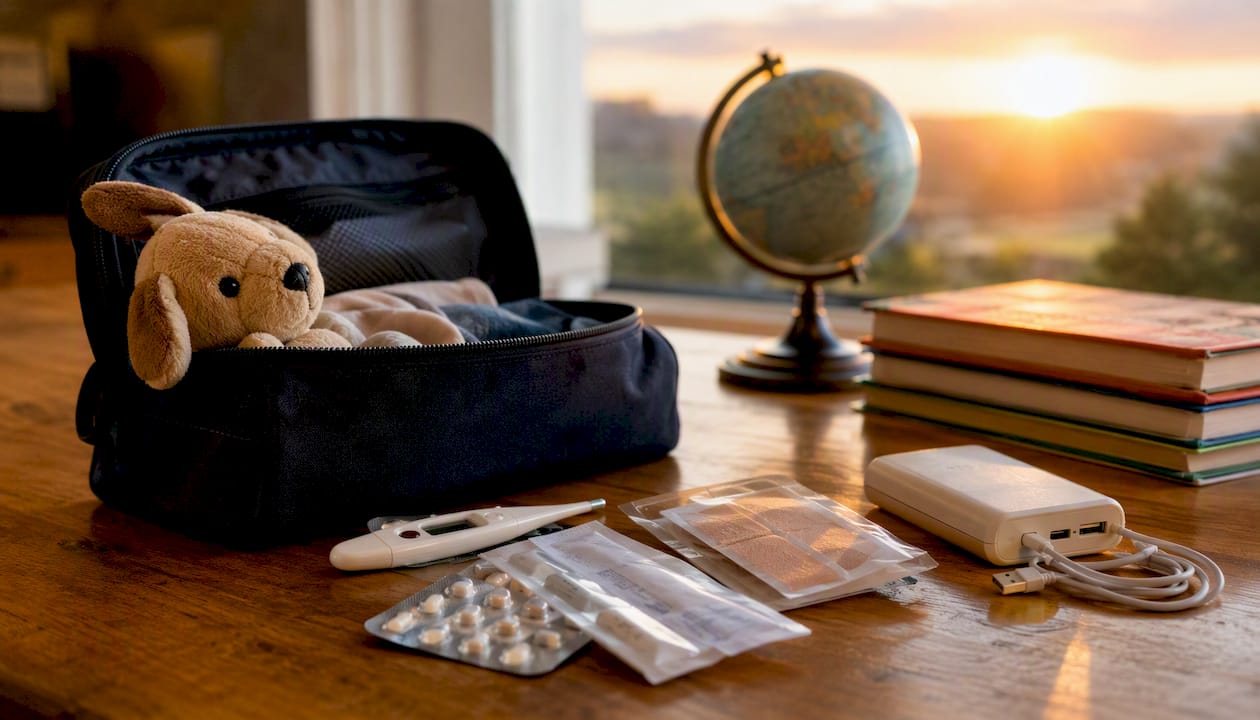
4. Pack a family health and comfort kit. Include fever reducers, antihistamines, motion sickness medication, bandages, a thermometer, and any prescription medications with a copy of the prescription. Add comfort items for younger kids (a familiar toy or snack) and phone chargers with a portable battery pack.
5. Print or download key confirmations. Hotel addresses, booking reference numbers, and emergency contacts should be accessible offline. Don't rely on a single app or email thread.
6. Assign roles. Decide in advance who handles provider calls, who manages the kids during a disruption, and who tracks expenses for potential insurance claims.
Pro Tip: Keep one shared document — a Google Doc, a notes app, or a dedicated travel app — with every booking reference, provider phone number, and the family priority matrix. When plans shift, everyone looks at the same place instead of texting each other for information.
Day-of playbook: what to do the moment plans shift
When something goes wrong, the first 30 minutes matter most. Here's a step-by-step sequence that works whether you're dealing with a sick child, a cancelled flight, or a closed attraction.
First 10 minutes:
- Safety and health check. Is anyone injured or ill? If yes, that's the only priority. Everything else waits.
- Designate the communicator. One adult owns all provider contact. The other stays with the kids.
- Open the shared itinerary. Identify what's affected and what isn't.
First hour:
- Triage: quick win or postpone? Can you swap today's activity for tomorrow's and keep both? Or does the change cascade?
- Contact providers early. The earlier you call, the more options you have. Most hotels and airlines offer better solutions before a no-show than after.
- Check ticket and booking policies. Look for the cancellation window, credit option, or rebooking fee before you commit to any decision.
- Rebook if necessary. Use the provider's app or website first — phone hold times are often long. Screenshot every confirmation.
- Log all new expenses. Keep receipts for anything you pay out of pocket. You'll need them for travel insurance or credit-card protection claims.
Before bedtime:
- Communicate the new plan to everyone. Kids especially need to know what tomorrow looks like so they can reset expectations.
- Escalate if needed. Medical emergency: call 911. Lost passport: contact the nearest U.S. embassy or consulate. Theft: file a police report immediately, as insurance requires it.
Sample scripts you can use right now:
Rebooking lodging: "Hi, I have a reservation under [name] for tonight. We've had a family emergency and need to either postpone by one night or cancel. Can you tell me what options are available under my booking?"
Postponing an activity: "Hello, I booked [activity] for today at [time]. We have a sick child and can't make it. Is there any flexibility to reschedule or receive a credit toward a future date?"
For practical examples of mid-trip itinerary adjustments that have worked for real families, those templates are worth bookmarking before you leave home.
How to limit costs when plans change
Not every change costs money, but the ones that do can add up fast. Here's how to stay cost-smart.
Common fee types to know:
- Airline change fees: Many U.S. carriers eliminated basic change fees on main cabin and above for domestic flights, but basic economy fares still carry restrictions. Always check the fare class.
- Hotel cancellation windows: Most flexible rates require cancellation 24–48 hours before check-in. Some resort properties extend that to 72 hours or charge a resort fee regardless of cancellation.
- Activity and tour refund windows: These vary widely. Many operators offer credits but not cash refunds. Read the policy at booking, not at cancellation.
Rules of thumb for rebook vs. accept a credit:
- Accept a credit if you'll realistically use it within 12 months and the rebooking fee is under $50 per person.
- Rebook immediately if the alternative is losing the full amount and a comparable option is available at a similar price.
- Walk away from a non-refundable booking if the cost of attending (transport, childcare, health risk) exceeds the booking value.
Travel insurance and credit-card protections cover more than most families realize. Trip interruption coverage typically reimburses non-refundable costs when a covered reason (illness, severe weather, carrier cancellation) forces a change. Many premium travel credit cards include trip delay reimbursement, lost baggage coverage, and emergency medical assistance. Check your card's benefits guide before buying a separate policy.
The FTA's 2025 report found that 45% of families now pay closer attention to cancellation and refund policies when booking — a direct response to the financial sting of unplanned changes.
Pro Tip: When calling customer service about a fee waiver, use this phrase: "I understand your policy, and I'm hoping you can help me find a solution that works for both of us." Agents have more discretion than the policy page suggests, and a calm, collaborative tone gets results far more reliably than frustration.
For a deeper look at family budget travel planning, including how to build cost buffers into your trip from the start, that guide covers the full picture.
Apps and shared systems that make real-time changes manageable
The right tech setup cuts coordination time from 20 minutes of group texts to two minutes of shared updates. Here's what actually helps.
Features worth prioritizing in any travel app:
- Easy multi-person sharing so every adult in the group sees the same itinerary
- Offline access for areas with poor cell coverage (national parks, rural roads, international destinations)
- Live travel advisories and real-time alerts for flight status or weather
- Built-in rebooking links so you can act without switching between five apps
- Editable day-by-day plans that update instantly for everyone when one person makes a change
Practical setup before you leave:
- Pin the shared itinerary link in your family group chat so nobody has to search for it mid-crisis
- Download offline maps for every destination (Google Maps and Maps.me both support this)
- Subscribe to flight status alerts through your airline's app or a service like FlightAware
- Set calendar reminders for cancellation windows — 48 hours before each booking is a useful default
When to call vs. when to use an app: Use apps and websites for standard rebooking during business hours. Call directly when the situation is urgent, when you need a fee waiver, or when the app is showing an error. A real person has more flexibility than an automated system.
Involving kids in tech: Older children (10 and up) can have read-only access to the shared itinerary. This reduces the "what are we doing today?" questions and gives them a sense of ownership. Keep personal booking details (payment info, passport numbers) in a separate, password-protected document.
AI-powered group trip planning has made collaborative itinerary management significantly faster, especially for families coordinating across multiple devices and time zones.
What recent family travel research tells us about plan changes
The data behind family trip unpredictability is more specific than most parents realize.
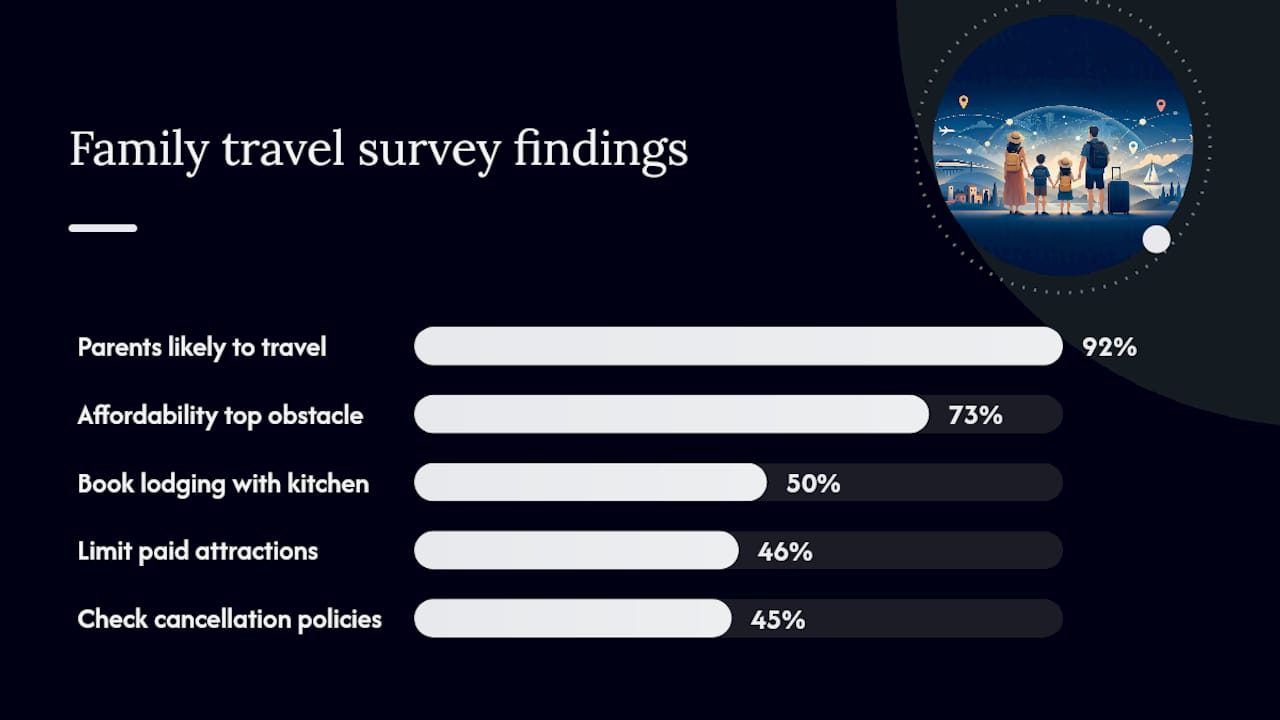
The 2025 Family Travel Survey from NYU SPS found that most parents are likely or very likely to travel with children in the next 12 months. The average U.S. family spent approximately a significant amount on travel in 2024. Yet many families cite affordability as their top obstacle, and some families specifically book lodging with a kitchen to cut food costs, while a notable portion limit paid attractions.
That gap between high travel intent and tight budgets is exactly where daily plan changes originate. When a family is already stretching to afford the trip, any unexpected cost — a $40 parking fee, a $25 activity upgrade, a $15 resort charge — forces a real-time trade-off.
| Survey finding | Percentage | What it means for daily planning |
|---|---|---|
| Parents likely to travel with kids | 92% | High volume of families navigating these challenges |
| Cite affordability as top obstacle | 73% | Budget pressure is the leading cause of mid-trip changes |
| Book lodging with a kitchen | 50% | Families pre-plan cost buffers to stay flexible |
| Limit paid attractions | 46% | Fewer fixed commitments means easier pivots |
| Pay closer attention to cancellation policies | 45% | Families are protecting themselves from change costs |
A practical example: a family flying from Chicago to Orlando books a non-refundable theme park ticket three months out. A child gets sick the morning of the visit. Because the family had also booked a flexible hotel rate and kept one buffer day, they postpone the park visit by 24 hours, use the hotel's kitchen to avoid a restaurant bill, and the trip stays on track. The flexible hotel rate cost $30 more per night. The park ticket would have cost $400 to replace.
BBC's reporting on family travel adds useful context: paid-leave norms and household budgets shape how much flexibility families actually have when plans shift. U.S. families with limited paid leave face harder trade-offs than those with more schedule flexibility, which is one reason pre-trip planning pays such outsized dividends.
How to balance spontaneity and structure so everyone actually enjoys the trip
Structure and spontaneity aren't opposites. The families who enjoy travel most tend to use structure as a container for spontaneity, not a replacement for it.
The practical version of this looks like: book the things that require advance reservations (flights, hotels, one or two anchor activities), then leave the rest of each day loosely planned. That way, when a child spots an interesting market or everyone decides they'd rather swim than sightsee, you can say yes without losing money or time.
A few specific habits that work well:
Set one anchor per day. One confirmed, non-negotiable activity gives the day shape. Everything around it is flexible. Kids know what to look forward to, and parents have one fixed point to organize the day around.

Use "maybe" lists instead of full itineraries. A list of five things you might do today is far less stressful to abandon than a scheduled itinerary. When one option falls through, you pick the next one.
Build in unstructured time deliberately. A two-hour block with no plan isn't wasted time. It's where kids play in a fountain, parents sit at a café, and the trip becomes a memory rather than a checklist.
The reflective piece from West Door Open frames family travel as a managed project rather than a holiday — and that framing is useful. Accepting that you're the project manager, not just a vacationer, makes it easier to delegate, adapt, and let go of the plan when the plan needs to change.
Kid-friendly daily travel schedules with built-in flexibility blocks are a good starting point if you want a template rather than building from scratch.
A trip that almost wasn't
There's a particular kind of morning that every traveling parent knows: the one where everything goes wrong before 8 AM. On one trip, a connecting flight was cancelled, the rebooking put us six hours behind schedule, and the kids were already melting down in the terminal. The instinct was to treat it as a disaster. Instead, we opened the shared itinerary, dropped the afternoon activity (which we'd booked as refundable), and used the extra time to find a local playground near the new hotel. The kids remember the playground. They don't remember the cancelled flight.
The replicable lesson isn't "stay calm" — that's easier said than done. The lesson is: have one flexible booking and one backup option ready before the day starts. That single habit is what turns a derailed day into a detour rather than a disaster. A resource like Leadership VITAE's reflection on reframing family trips puts it well: changing your inputs — your expectations, your backup plans, and how you show up — changes the outcome more reliably than trying to prevent every disruption.
Planytera keeps your family's plans flexible when the day changes
When a flight delay, a sick child, or a sudden weather shift rewrites your day, the last thing you need is a static PDF itinerary and a stack of confirmation emails. Planytera gives your family a live, editable day-by-day plan that updates in real time — so when one thing changes, everyone sees the new version immediately.

Here's how Planytera maps directly to the moments this article describes:
- Transport delay? Edit the itinerary on the spot and share the updated plan with your whole group in one tap.
- Sick child? Swap today's activities for tomorrow's without rebuilding the whole schedule.
- Budget crunch? Built-in cost estimates help you compare rebooking options before you commit.
- No cell signal? Offline access keeps your plan available anywhere, from national parks to rural roads.
- Multiple adults coordinating? Collaborative sharing means grandparents, partners, and caregivers all work from the same plan.
Start your family's flexible itinerary on Planytera and see how a personalized, editable plan changes the way your family travels. If you're ready to compare plans, the Planytera subscription options include a free tier to get started with no commitment.
Sources
These sources back the data and strategies in this article and are worth bookmarking for your next trip.
- FTA-Survey2025-Report
- The 2025 Family Travel Survey Highlights the Rise of 'Kidfluence' and New Booking Behaviors Amid High Travel Intent, Technology, and Affordability Concerns | NYU SPS
- Survey: Family summer travel still booming, but costs are having a big impact - Travelzuma
- Family summer travel: how families in different countries spend and plan — BBC