
The fastest reliable way to build a custom travel package is to lock in traveler preferences, generate an AI draft, then verify and refine it by hand. Do that and you have a usable itinerary within hours, not weeks. This hybrid approach also lines up with what the numbers show: custom itineraries produce roughly 40% higher traveler satisfaction than standard packages, but only when someone actually checks the AI's work. Platforms like Planytera are built for exactly this workflow, generating personalized day-by-day plans you then confirm against real-world details.
Before you open any tool, capture three things:
- The traveler's pace (relaxed, packed, or somewhere in between)
- Any dietary, mobility, or accessibility non-negotiables
- A total budget number, not a vague range
Pro Tip: Write these three items down before you touch an AI planner. A draft built on fuzzy inputs takes twice as long to fix as one built on clear ones.
Table of Contents
- Custom Travel Package Creation Guide: Defining Preferences First
- Choosing the Right Package Structure and Components
- Pricing and Costing Your Travel Package
- Finding and Vetting Partners and Suppliers
- Turning Your Plan Into a Day-by-Day Itinerary
- Presenting the Package So Customers Actually Book
- Handling Customer Feedback and Adjusting Packages
- Managing Risk: Cancellations, Emergencies, and Contingency Plans
- Tools and Software That Make Package Creation Easier
- Marketing Custom Travel Packages to the Right Buyers
- Why Hybrid Planning Beats Both Extremes
- Custom Travel Package Creation Guide: Key Takeaways
- Build Your Next Package With Planytera
- Sources
Custom Travel Package Creation Guide: Defining Preferences First
A custom package only feels custom if the inputs behind it are specific. Vague requests like "somewhere relaxing" produce generic drafts no matter how good your tool is. The fix is a short preference brief you fill out before generating anything.
Here's a workable sequence:
- Pace and rhythm. Ask how many activities per day feels right. Two guided stops plus free time reads very differently from a packed six-stop itinerary.
- Dietary and mobility needs. Note allergies, vegetarian or halal requirements, wheelchair access, or a preference for minimal walking.
- Must-see items. Get three to five non-negotiables so the plan has anchors, not just filler.
- Budget framing. Decide whether you're working with a total trip figure or a per-day allocation, and build in a 10 to 15% buffer for surprises.
For groups, assign one person to own the shared document (a spreadsheet or shared doc works fine) and set a deadline for input. This whole step takes 10 to 15 minutes for a solo trip, closer to 30 minutes for a family with mixed needs. Planytera's preference categories guide offers a ready-made template if you'd rather not build one from scratch.
Choosing the Right Package Structure and Components
Not every trip needs the same shape. A tailor-made package works when the traveler has strong opinions and time to iterate. A dynamic package (flights, hotel, and a few activities bundled but adjustable) fits travelers who want flexibility without full customization. A pre-packaged itinerary suits first-timers to a destination who want a proven route. Short excursions work as add-ons or as standalone weekend offerings.
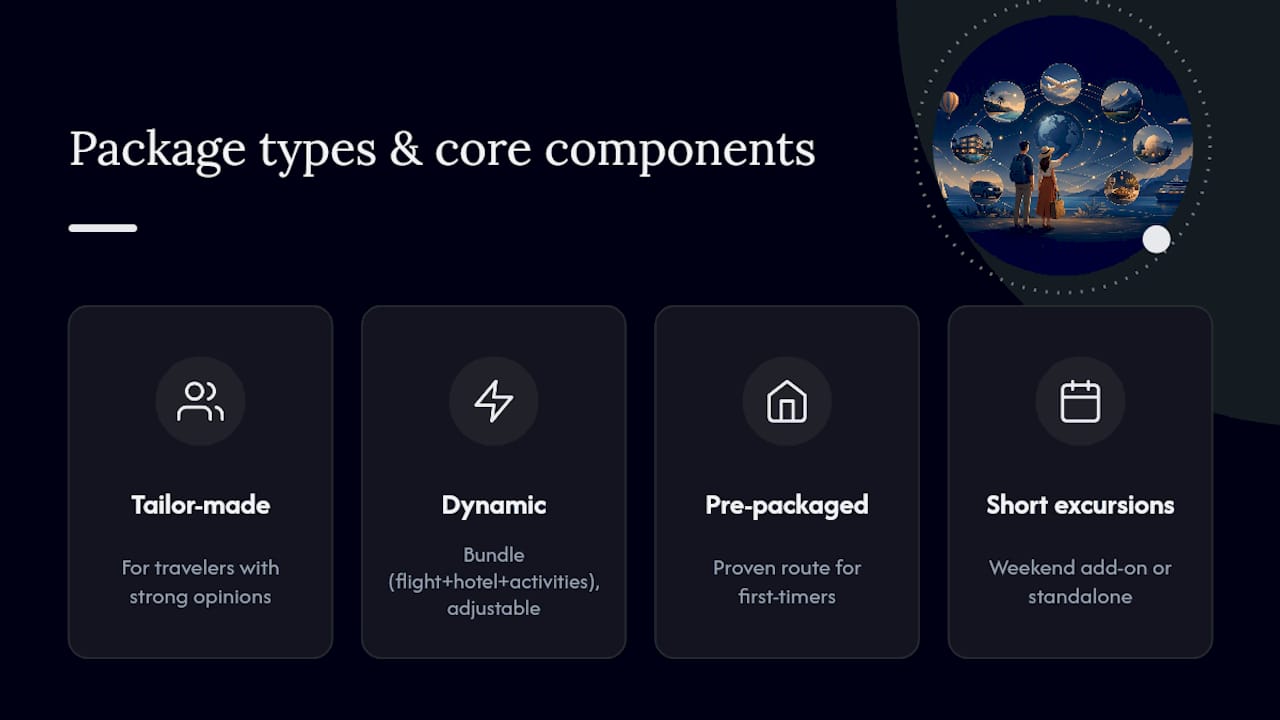
Whatever the format, the core components stay the same: accommodation, transfers, activities, meals, any required equipment, and entry tickets. Skip one and you create a gap the traveler has to fill themselves, which defeats the point of a package.
The most reliable structure borrows from a three-layer model: a foundation (the must-haves, like lodging and the headline activity), a differentiator (something that makes this package stand out, like a private guide or a sunrise excursion), and flexible options (add-ons the traveler can opt into). This three-layer approach tends to convert better than a flat list of inclusions because it gives buyers an obvious upgrade path.

Pro Tip: Aim for packages between three and ten days for most leisure trips. Anything shorter reads as an excursion, and anything longer needs more built-in flexibility to avoid burnout.
Pricing and Costing Your Travel Package
Every component needs its own line item before you set a final price: hotel rate per night, transfer cost per leg, activity fees per person, and any booking or processing fees from suppliers. Skip this step and you'll discover your margin is thinner than you thought after the trip is already sold.
Two formulas do most of the work:
- Markup = (selling price minus cost) divided by cost. A $100 cost priced at $130 is a 30% markup.
- Margin = (selling price minus cost) divided by selling price. That same $130 package has a 23% margin.
The gap between those two numbers surprises a lot of new planners, and it's worth double-checking before you commit to a price. From there, build tiers: Essential covers the foundation layer only, Premium adds the differentiator, and Luxury stacks in the flexible options. Price the Luxury tier first and let it anchor the other two. Buyers comparing three options tend to gravitate toward the middle one, a well-documented pricing behavior that works in your favor if you set the anchor correctly.
Offer group rates once you hit four or more travelers on the same dates, and reserve discounts for slow-season fill rather than across-the-board price cuts.
Finding and Vetting Partners and Suppliers
You have two paths to build your supplier network: direct outreach to hotels, guides, and transport companies, or working through a vetted marketplace network that has already done supplier screening. Direct outreach gives you better margins and a personal relationship; a network trades some margin for speed and built-in vetting, since these platforms typically handle contract and payment logistics for you.
Whichever path you choose, confirm four things before booking anyone:
- Insurance coverage — ask for proof, not just a verbal assurance.
- Cancellation policy — get it in writing, including deadlines.
- Capacity limits — especially for small-group activities and transfers.
- Payment terms — deposit percentage, final payment date, and currency.
Keep a simple allocation log so you know exactly what's booked, held, or pending, and always have a local emergency contact number for every destination on the itinerary.
Turning Your Plan Into a Day-by-Day Itinerary
This is where the hybrid workflow earns its reputation. Generate the first draft with an AI planner, then move to verification. Skipping the second half is how travelers end up outside a "closed on Mondays" museum.
- Generate the draft. Feed in your preference brief and let the AI planner build a day-by-day skeleton.
- Map the routes. Drop each stop into a mapping tool like Google My Maps to see actual drive and walk times between locations, not the AI's estimate.
- Run feasibility checks. Confirm opening days, booking lead times, transport schedules, and seasonal weather patterns for each stop.
- Check event calendars. Local festivals or closures can wreck a tight schedule if you don't catch them early.
Each of these steps takes roughly 20 to 30 minutes for route mapping and 15 to 25 minutes for feasibility checks, and it's worth verifying AI-suggested hours and connections independently even when the draft looks solid. For international trips with multiple countries or visa requirements, start planning six to twelve months out.
Pro Tip: Leave one buffer block every two to three days. Overpacked itineraries are the single most common complaint in post-trip surveys, and a two-hour gap fixes most of it.
Presenting the Package So Customers Actually Book
A package page needs a specific set of elements to convert, not just a pretty photo and a price tag. Include a hero image, three to five highlight bullets, a day-by-day summary, a clear inclusions and exclusions list, a pricing table by tier, and terms that are easy to find rather than buried in a footer.
- Show duration in the "3 days / 2 nights" format. Clear duration formatting reduces pre-booking questions more than any other single presentation detail.
- Place your call-to-action after the day-by-day summary, not just at the top of the page.
- Offer instant availability where possible, with editable add-ons so travelers can customize without starting a new quote request.
- State your cancellation and refund policy in plain language, ideally right next to the price.
Collect a short post-trip survey after every booking. Feedback on pacing, communication, and value directly informs which packages to keep and which to retire.
Handling Customer Feedback and Adjusting Packages
Feedback only helps if you act on it systematically, not just when a complaint lands in your inbox. Set up a short post-trip survey covering pace, communication, value for money, and whether the itinerary matched expectations. Three or four questions get you more completed responses than a ten-question form.
When feedback points to a real pattern, adjust the package template, not just the next traveler's plan. If three separate groups mention the second day feels rushed, that's a structural problem with the itinerary, not a one-off. Fix it at the template level so you're not solving the same complaint every month.
Not all feedback deserves equal weight. A single traveler's dislike of a specific restaurant is noise; five travelers mentioning transfer delays is signal. Weigh comments against how often they recur before rebuilding a component.
For adjustments mid-trip, have a lightweight change process ready: a traveler wants to swap an activity, so know in advance which supplier changes are free, which carry a fee, and how fast you can confirm a substitute. Building this flexibility into your original supplier agreements, rather than negotiating it in the moment, saves real stress when a traveler asks for a change three days before departure.
Review your full package catalog on a quarterly basis, keeping the packages that consistently book well and revising or retiring the ones that don't.
Managing Risk: Cancellations, Emergencies, and Contingency Plans
Every custom package needs a contingency plan before it needs one in real life. Start with cancellation tiers: full refund up to a set number of days out, partial refund inside that window, and no refund inside a final short window closer to departure. Put these numbers in writing and share them with the traveler at booking, not after a cancellation request arrives.
Build a supplier-side buffer too. If a tour guide cancels or a hotel overbooks, you need a backup option already identified, not one you're scrambling to find the night before. Keep a short list of backup suppliers for your most-booked destinations.
For emergencies during travel, give every traveler a printed or digital card with:
- A 24/7 local emergency contact
- The nearest hospital or clinic to their accommodation
- Your own emergency line, staffed or forwarded appropriately
Travel disruptions like flight delays and severe weather need a "what happens next" plan baked into the itinerary itself rather than improvised on the fly. A same-day flight cancellation. A closed border crossing. A sudden storm that grounds a ferry. Each of these needs a pre-identified alternative, even if it's just a rebooking policy with the original supplier. Building in buffer days, as covered in the itinerary section, is your first line of defense here, since it absorbs most minor disruptions without requiring any active intervention.
Tools and Software That Make Package Creation Easier
You don't need enterprise software to build strong custom packages, but a few categories of tools genuinely save time. AI trip planners handle the first-draft heavy lifting, generating a day-by-day structure based on the preferences you feed in. This is the starting point, not the finish line, since AI drafts still need manual verification for hours, prices, and connections.
Mapping tools like Google My Maps let you visualize the full route, spot backtracking, and estimate realistic transfer times between stops. This step catches problems no AI draft reliably catches on its own, since travel time estimates vary wildly by season and local traffic patterns.
Shared documents or lightweight project tools keep group input organized when multiple travelers are weighing in on the same trip. For itinerary storage, live updates, and offline access once travelers are on the ground, a platform like Planytera bundles all of this. Solo planners can usually manage with a spreadsheet and a mapping tool. Groups and agencies handling multiple trips at once benefit more from a dedicated planning platform that keeps everything centralized and shareable, since coordinating changes across five separate documents gets messy fast once more than two or three people are involved.
Marketing Custom Travel Packages to the Right Buyers
Custom packages sell better when you market to a specific traveler profile, not a destination. Defining who the package is for (a couple celebrating an anniversary, a multigenerational family, a solo hiker) outperforms leading with "Italy trip" as your entire pitch. The destination is the setting; the traveler profile is the hook.
Use real itinerary examples in your marketing wherever you can. A day-by-day preview builds more trust than a generic feature list, because it shows exactly what a booking gets rather than asking travelers to imagine it. Planytera's couple itinerary examples are a good model for the level of specificity that converts.
Email and social content work best when they highlight the differentiator layer from your package structure, not the basics every competitor also offers. If your differentiator is a private sunset tour, lead with that image and story, not with "5-star hotel included."
Reviews and testimonials from past travelers carry more weight than any ad copy you write yourself, so build a simple system to request them right after the trip ends, while the experience is still fresh. Partner content and guest posts on relevant travel sites, like this piece on personalizing tours for any traveler, can also extend your reach into audiences already primed for customization.
Why Hybrid Planning Beats Both Extremes
Fully manual planning burns hours you don't have. Fully automated planning produces drafts that look polished but occasionally get an opening day or a transport schedule wrong. The middle path, AI draft plus human verification, consistently outperforms either extreme, and it's the model Planytera builds around: AI-generated day-by-day plans, live guidance once travelers arrive, offline access for spotty connections, and a trip journal for keeping the details afterward.
Use full manual planning only for highly unusual requests an AI tool hasn't seen much of. Lean on a managed platform for everything else, especially recurring trip types where the verification checklist barely changes.
— Dom
Custom Travel Package Creation Guide: Key Takeaways
The hybrid workflow of defining preferences, generating an AI draft, and manually verifying feasibility produces a usable, higher-satisfaction custom travel package faster than either fully manual or fully automated planning.
| Point | Details |
|---|---|
| Capture preferences first | Write down pace, dietary needs, mobility limits, and budget before generating any draft. |
| Structure in three layers | Build a foundation, a differentiator, and flexible add-on options for each package. |
| Verify every AI draft | Check opening hours, transport schedules, and lead times manually before booking anything. |
| Price with clear formulas | Separate markup from margin and anchor pricing tiers with a top Luxury option. |
| Use Planytera for the full cycle | Generate day-by-day drafts, verify live, and keep offline access and journaling in one platform. |
Build Your Next Package With Planytera
Planytera is the alternative to spreadsheets and scattered browser tabs for building a custom travel package. Instead of manually stitching together preferences, routes, and pricing, you get a day-by-day draft generated in minutes, ready for the verification steps covered above.
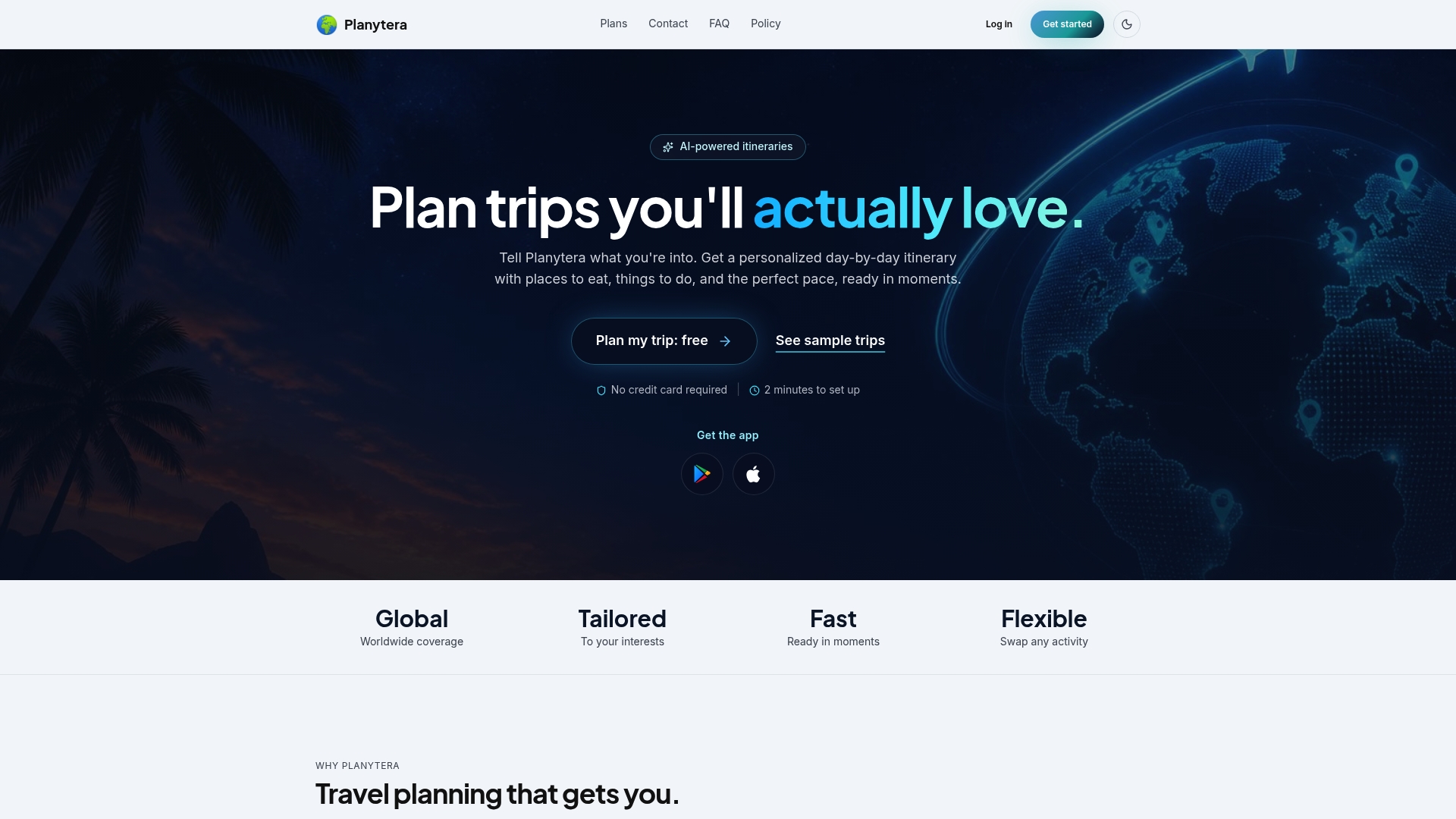
The platform fits solo travelers refining their own trip, families coordinating shared input, and small agencies running multiple client packages at once. Every plan factors in pace, dietary needs, and budget from the start, and you can edit on the fly as new preferences come in. Live guidance and offline access mean the plan still holds up once travelers are on the ground with no signal, and the trip journal captures the details worth remembering afterward. Read more on Planytera's personalized itinerary approach or check the acceptable use guidelines for platform details. Ready to build your first draft? Head to Planytera and generate your next itinerary in minutes.
Sources
- Custom travel itineraries: step-by-step guide, 40% more satisfaction - Around Travel
- How to Create Travel Packages That Actually Sell | DMCQuote
- Tactech
- How to Plan a Custom World Travel Package Without the Stress | Condor Tours