
A personalized travel itinerary is a custom trip plan built around your specific preferences, budget, pace, and interests, designed so every day of your trip reflects what you actually want to do. Unlike a standard package tour that pushes the same schedule on every traveler, a tailored travel itinerary treats your trip as uniquely yours. The global personalized travel market is projected to reach $317 billion by 2029. That number signals a clear shift: travelers are moving away from one-size-fits-all plans and toward experiences built specifically for them.
What is a personalized travel itinerary and how does it work?
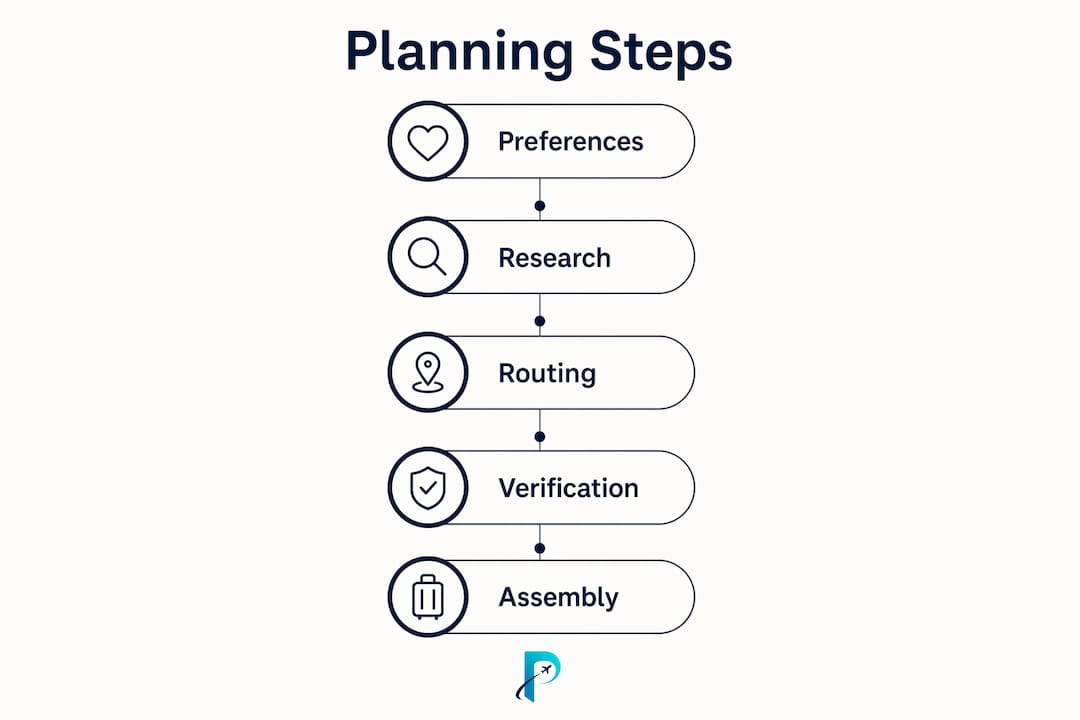
A personalized travel itinerary, also called a custom travel plan in the industry, is built through a structured process that starts with you and ends with a day-by-day schedule you can actually follow. The process typically moves through six stages: defining your preferences, researching destinations, setting a budget, mapping your route, verifying logistics, and assembling the final plan.

Defining your preferences
The first step is the most personal. You identify what matters most: food restrictions, activity level, must-see landmarks, travel pace, and group size. A solo traveler planning a food-focused trip through Japan needs a completely different plan than a family of five heading to a beach resort. Getting this step right determines everything that follows.
Researching and routing
Once preferences are clear, the planning shifts to destination research and route sequencing. Good route mapping reduces backtracking and wasted time. For example, grouping museum visits on one day and outdoor activities on another keeps the pace natural and prevents fatigue.
Verification and day-by-day assembly
Verification of itinerary feasibility, such as checking opening hours, transit connections, and booking availability, is what separates a theoretical plan from one you can actually rely on. Skipping this step is the most common reason travelers end up at a closed attraction or miss a connection. After verification, the plan gets assembled into a day-by-day schedule with times, addresses, and backup options.
The role of AI in personalized planning
AI itinerary builder software creates custom travel plans instantly by matching your inputs with large travel databases to suggest optimized routes and activities. This cuts hours of manual research down to minutes. The best results come from a hybrid approach: AI handles the heavy lifting of data processing and route optimization, while you refine the output based on personal knowledge and preference. A hybrid planning strategy that combines AI drafts with human refinement consistently delivers the best personalized itineraries.
Pro Tip: Before finalizing any AI-generated plan, spend 20 minutes cross-checking the top three activities against current reviews and seasonal hours. AI works from databases, and databases lag behind real-world changes.
Why personalized itineraries outperform standard travel plans
Travelers using personalized itineraries report 40% higher satisfaction than those using standard package tours. That gap exists because a generic tour is built for the average traveler, and almost no one is average.
"Switching from manual DIY planning to AI-optimized personalized itineraries can fit 30–40% more meaningful experiences into the same timeframe. That is not just efficiency. It is the difference between a trip you remember and one you forget."
The advantages of a custom travel plan go well beyond satisfaction scores. Here is how personalized itineraries compare to standard package tours across the factors that matter most to travelers:
| Factor | Personalized itinerary | Standard package tour |
|---|---|---|
| Pace | Set by you, adjustable anytime | Fixed schedule for all travelers |
| Budget control | Allocated to your priorities | Bundled, often with unwanted extras |
| Activities | Matched to your interests | Pre-selected for the average group |
| Flexibility | Change plans on the fly | Rigid, changes incur fees |
| Authentic experiences | Built around local and niche options | Focused on high-traffic tourist stops |
| Dietary needs | Incorporated from the start | Rarely accommodated in advance |
Personalized itineraries provide budget control, flexibility, authentic experiences, and pacing that fits individual travelers far better than any generic option. Budget control is especially underrated. When you build your own plan, you decide where to spend more and where to save, rather than paying for a hotel breakfast you will skip or an excursion you have no interest in.
Travelers who actively plan their own trips also report stronger emotional connections to the destinations they visit. Involvement in the planning process creates anticipation and ownership that a pre-packaged tour simply cannot replicate.
How to design your own personalized travel itinerary
Creating a solid personalized vacation itinerary does not require a travel agent or weeks of research. A clear process makes it manageable for any traveler.
-
List your non-negotiables. Write down the experiences, foods, or places you absolutely want. These anchor your entire plan and prevent you from filling days with activities that do not matter to you.
-
Set a realistic daily budget. Divide your total trip budget by the number of days, then allocate roughly 40% to accommodation, 30% to food, and 30% to activities and transport. Adjust based on your priorities.
-
Research your destination by neighborhood or zone. Group activities geographically so you are not crossing the city twice in one day. Travel apps, local blogs, and travel preference guides help you identify which areas match your interests.
-
Use an AI planning tool to draft your schedule. Input your preferences, dates, and budget. The AI generates a day-by-day plan in minutes. Treat this as a strong first draft, not a finished product.
-
Verify every key detail. Check opening hours, reservation requirements, and transit options for each day. Build in buffer time between activities so delays do not cascade.
-
Add personal touches. Swap out any AI-suggested activity that does not feel right. Add a restaurant a friend recommended, or a neighborhood you read about. This is where the plan becomes truly yours.
Pro Tip: Build at least one completely unscheduled half-day into every three-day block. The best travel memories often come from the unexpected detour, not the planned stop.
Platforms that specialize in AI itinerary customization handle steps 4 and 5 automatically, cutting the total planning time significantly. For group trips, tools that allow collaborative editing let every traveler add input without the chaos of shared spreadsheets.
Common types of personalized travel itineraries
Not every custom travel plan looks the same. The right format depends on your travel style, group size, and how much control you want over the details.
-
Fully custom itineraries are built from scratch around your exact preferences. Every hotel, restaurant, and activity is chosen specifically for you. This approach takes the most planning time but delivers the highest degree of personalization.
-
Hybrid AI-human plans use AI to generate the structure and route, then layer in personal adjustments. This is the most practical option for most travelers. It is fast, flexible, and still deeply personal.
-
Semi-custom packages start with a pre-built framework for a popular destination and allow you to swap out specific elements. These work well for first-time visitors to a destination who want guidance but still want some control.
-
Solo traveler itineraries prioritize flexibility and safety, with built-in options to change pace or location without affecting anyone else. Unique travel planning for solo travelers often focuses on social experiences and local meetups.
-
Family and group itineraries balance multiple preferences at once. AI tools that handle group trip planning are especially useful here, since coordinating five different wish lists manually is genuinely difficult.
-
Niche interest itineraries center on a specific theme: food tours, adventure sports, cultural immersion, or wellness retreats. These plans go deeper into one category rather than spreading across many.
-
Multi-destination itineraries cover two or more countries or regions in a single trip. Route sequencing and transit logistics are the biggest challenges, and AI tools handle both well.
Key Takeaways
A personalized travel itinerary consistently outperforms standard package tours by matching every element of a trip to the individual traveler's preferences, budget, and pace.
| Point | Details |
|---|---|
| Definition | A personalized itinerary is a custom trip plan built around your specific preferences, not a generic group schedule. |
| Satisfaction advantage | Travelers with personalized plans report 40% higher satisfaction than those on standard package tours. |
| AI accelerates planning | AI tools can fit 30–40% more meaningful experiences into the same trip by optimizing routes and activities. |
| Verification is critical | Always check opening hours, transit, and bookings before finalizing any itinerary. |
| Multiple formats exist | Fully custom, hybrid AI-human, and semi-custom plans each suit different traveler needs and planning styles. |
Why personalization changed how I think about travel
I used to believe that a good destination was enough. Book a flight, find a hotel, figure out the rest when you land. That approach works fine until you waste a full afternoon in the wrong neighborhood or miss the one restaurant that would have made the whole trip.
The shift I noticed over the past few years is not just about technology. It is about travelers finally having the tools to match their plans to their actual lives. A traveler with a gluten intolerance should not have to research every restaurant from scratch. A couple celebrating an anniversary should not end up on a bus tour with 40 strangers. These are not luxury problems. They are basic planning failures that personalization solves.
What surprises most travelers is how much time a well-built custom plan saves during the trip itself. When you know exactly where you are going and why, you stop second-guessing every decision. That mental clarity is worth more than any single activity on the schedule.
The one mistake I see repeatedly is treating the AI-generated draft as the final product. The best itineraries come from travelers who use AI to do the structural work, then spend an hour making it genuinely theirs. That combination is hard to beat.
— Dom
Planytera makes personalized trip planning fast and easy
Planning a trip that actually fits your life should not take days of research and a dozen browser tabs.
Planytera uses AI to generate tailored day-by-day itineraries based on your preferences, dietary needs, budget, and travel pace. You get a complete plan in minutes, not hours. Adjust it on the fly, access it offline, and share it with your travel companions for collaborative editing. Whether you are planning a solo adventure, a family vacation, or a group getaway, Planytera handles the logistics so you can focus on the experience. Explore sample itineraries to see what a personalized plan looks like in practice, or check out subscription options to get started with your own.
FAQ
What is a personalized travel itinerary?
A personalized travel itinerary is a custom trip plan built around your individual preferences, budget, pace, and interests. It differs from a standard package tour by tailoring every activity, route, and schedule specifically to you.
How do personalized itineraries improve traveler satisfaction?
Travelers using personalized itineraries report 40% higher satisfaction than those on standard package tours, because every element of the trip matches their actual preferences rather than a generic group average.
Can AI really create a good personalized travel plan?
AI itinerary tools generate optimized routes and activity matches instantly based on your inputs. The best results come from combining an AI-generated draft with your own personal adjustments, a method known as hybrid planning.
How long does it take to create a personalized itinerary?
With an AI planning tool, a complete day-by-day itinerary takes minutes to generate. Manual planning for a week-long trip typically takes several hours to days, depending on destination complexity.
What types of travelers benefit most from personalized itineraries?
Solo travelers, families, couples, and groups all benefit, but the advantage is greatest for travelers with specific dietary needs, niche interests, or tight budgets where a generic package would waste time and money.