
How AI learns traveler preferences to personalize your trips
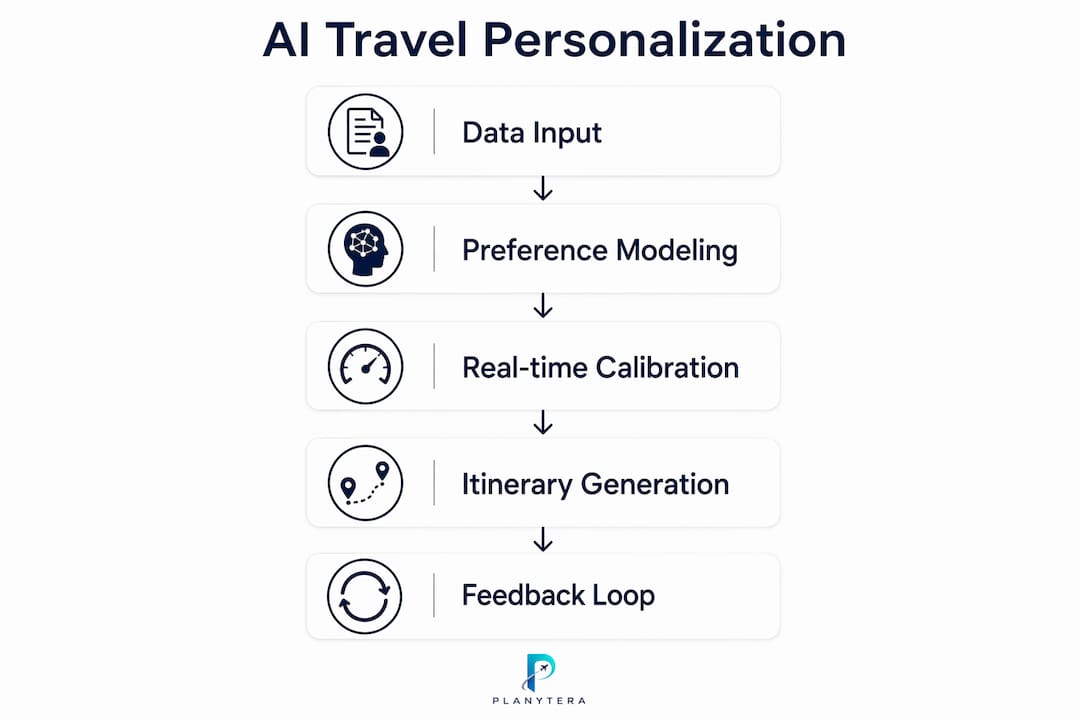
AI learns your travel preferences by continuously analyzing what you search, book, browse, and say, then building a dynamic picture of who you are as a traveler. It does not rely on a single snapshot. Instead, it updates that picture every time you interact with it, pulling from historical booking data, real-time behavioral signals, and conversational cues.
A 2025 user study found that AI travel assistants using this dynamic approach scored 4.28/5 for usefulness and 4.2/5 for ease of use, with participants confirming the system correctly identified their preferences across travel style, interests, accommodation, transport, and dietary needs.
Here is what that process actually captures:
- Travel style: adventure, slow travel, luxury, backpacking
- Interests: food, culture, outdoor activities, wellness
- Accommodation preferences: boutique hotels, hostels, eco-lodges
- Transportation habits: direct flights, train travel, road trips
- Dietary needs: plant-based, gluten-free, halal
- Mood and energy signals: high-energy prompts suggest hikes; low-energy prompts suggest cafés
The result is a plan that feels like it was made for you, not for the average traveler.

What data and AI models actually power this learning
AI personalization in travel depends on deep, layered data, not just a quick read of your last search. The most effective systems combine long-term booking history with real-time behavioral signals and conversational inputs to build a genuinely accurate picture of your preferences.
Common AI techniques used:
- Collaborative filtering: recommends options based on what travelers with similar profiles have enjoyed
- Content-based filtering: matches new options to features you have previously liked, such as mountain views or eco-lodges
- Hybrid models: blend both methods to handle niche interests and new user cold starts
- Neural networks and deep learning: process complex patterns, including image-based searches and nuanced preference signals
- Large Language Models (LLMs): extract preferences from natural conversation in real time
AI models represent your actions, such as searches, bookings, and clicks, as high-dimensional vectors. These get compressed for efficient real-time computation, so the system can match you to the right destination in seconds rather than hours.
One of the most useful mechanisms is the calibration phase. When you type something vague like "somewhere warm," the AI does not guess. It asks clarifying questions: beach vibes or adventure vibes? Relaxing or exciting? This preference calibration shifts the output from generic to genuinely personal. It is the difference between a list of popular warm destinations and a shortlist that actually fits your mood right now.
Pro Tip: When using an AI travel planner, give it specific context upfront: your energy level, who you are traveling with, and any hard constraints like budget or mobility needs. The more signals you provide, the faster it calibrates.
Privacy matters here too. Responsible AI systems let you opt out of personalization based on historical data, and they anonymize behavioral signals before feeding them into models. The goal is better recommendations, not surveillance.
What experts say about AI's role in personalizing travel
The most compelling shift in AI travel personalization is not technical. It is emotional. Generative AI no longer just matches keywords to destinations. It reads context, senses mood, and co-creates experiences.
"Tourism products are experiences. That means our friend, generative AI, is going to imagine with us, feel with us, sense our mood, and ultimately anticipate what we need and want to do. The result is co-created experiences tailored to the individual." — Dr. Juan Luis Nicolau, J. Willard and Alice S. Marriott Professor of Revenue Management, as cited in Phys.org
Dr. Nicolau describes generative AI as a cognitive layer that senses a traveler's mood in real time, enabling experiences that adapt emotionally, not just logistically. A prompt like "I hiked yesterday and I'm tired" produces different suggestions than "I'm energized and want to explore." The AI reads the signal and responds accordingly.
Expedia Group experts reinforce this point: effective personalization depends on integrating decades of booking patterns with live engagement data, not surface-level destination requests. That depth is what separates a genuinely tailored plan from a repackaged generic itinerary.
Mark Pulliam, Head of Business Development at Uniphore, frames it differently. He sees AI as a virtual host, handling the data-heavy tasks so human travel professionals can focus on care and connection. The vast amount of information collected on travelers can now power that same level of personalized attention for every traveler, not just high-value guests.
How Planytera uses AI to build your personalized itinerary
Planytera puts these principles into practice in a way that is genuinely easy to use. You tell it your travel style, interests, accommodation preferences, transport habits, dietary needs, and budget. It does the heavy lifting from there, generating a tailored day-by-day itinerary ready in moments.
What sets Planytera apart is how it keeps learning as your trip evolves. Plans change. You might feel tired on day two, or discover a neighborhood you want to explore longer. Planytera lets you adjust your itinerary on the fly, and its AI factors those changes into the rest of your plan automatically.
Key features that make Planytera's AI personalization work for you:
- Dynamic itinerary adjustment: update plans mid-trip without starting over
- Offline access: your personalized plan is available even without a connection
- Travel journal: document memories and experiences as you go
- Group and family planning: collaborate with others and merge preferences into one plan
- Dietary and accessibility inputs: built into the planning process from the start
Planytera's AI itinerary customization approach reflects exactly what the research validates: dynamic, conversational preference learning produces plans that feel personal because they are. For solo travelers, the platform's preference profiling goes even deeper, capturing the nuances that generic planners miss entirely.
What the future of AI travel personalization looks like
AI travel personalization is moving fast, and the direction is clear: more adaptive, more emotionally aware, and better at handling the messy reality of how people actually plan trips.
Research on 347 tourists confirms that AI-driven personalization is positively associated with traveler satisfaction, working through a chain of trust and perceived value. Travelers who trust the AI's recommendations feel more value from the experience, and that perceived value is what drives real satisfaction. Technology readiness moderates this effect, meaning travelers who are comfortable with AI tools get more out of personalized systems.
Hybrid recommendation models are becoming the standard. By blending collaborative and content-based filtering, they handle both new users with no booking history and experienced travelers with niche interests. Neither approach alone solves both problems. Together, they keep recommendations accurate across the full spectrum of traveler types.
The challenge that remains hardest to crack is vague or emotional input. "I want something different" or "I need a break" are real traveler requests, and they require the calibration phase described earlier to become actionable. The best systems in 2026 handle this through multi-turn conversation, asking two or three targeted questions before generating any suggestions. For destinations with specific personalization needs, like golf travel, the same multi-layered data logic applies across course recommendations and activity matching.
Privacy will shape how far personalization can go. Travelers increasingly expect transparency about what data is used and how. Systems that offer clear opt-out options and explain their recommendations in plain language will earn more trust, and more trust means more data shared voluntarily, which means better personalization over time.
How AI collects and processes your travel data responsibly
Responsible AI travel systems collect data through three main channels: what you explicitly tell them, what your behavior signals, and what your booking history reveals. Each layer adds depth without requiring you to fill out a lengthy form.
Explicit inputs are the simplest: you state your budget, travel dates, group size, and dietary needs. Behavioral signals are subtler: how long you spend reading about a destination, which hotels you click on, what you ignore. Booking history is the richest source, revealing patterns you might not even notice yourself, like a preference for boutique properties or a habit of traveling in shoulder season.
Ethical data handling means anonymizing these signals before they enter AI models, storing preferences securely, and giving you control over what is saved. Platforms that follow privacy-by-design principles build personalization on aggregated patterns rather than individually identifiable records. You get a plan that feels personal without your data being exposed.
The key principle is consent. You should know what data an AI travel planner uses, be able to update or delete your preferences, and opt out of behavioral tracking if you choose. Good systems make this easy, not buried in a settings menu.
Key Takeaways
AI learns traveler preferences most effectively by combining real-time conversational signals with long-term behavioral data, producing itineraries that adapt to your mood, not just your destination.
| Point | Details |
|---|---|
| Dynamic learning beats static profiles | AI updates your preference profile with every interaction, not just at setup. |
| Calibration questions close the gap | Asking "beach vibes or adventure vibes?" turns vague inputs into precise recommendations. |
| Trust drives satisfaction | A study involving tourists found AI personalization boosts satisfaction through trust, then perceived value. |
| Hybrid models handle every traveler type | Blending collaborative and content-based filtering solves both new-user and niche-interest problems. |
| Planytera adapts as your trip evolves | Real-time itinerary adjustment means your plan stays accurate even when your plans change. |
Try Planytera's AI trip planner for free

You deserve a travel plan that actually fits you, not a generic itinerary built for the average traveler. Planytera's AI reads your preferences, builds your day-by-day plan in moments, and keeps adapting as your trip unfolds.
Solo trip, family vacation, or group adventure, Planytera handles the planning so you can focus on the experience. Start planning your trip today and see what genuinely personalized travel feels like.