
How travel journaling enhances trips: the short answer
Travel journaling actively deepens your experience while you are still on the road. It is not just a way to remember where you went. It is a tool for feeling more present, processing emotions in real time, and building memories that last far longer than any photo album.
Here is what keeping a travel journal does for you:
- Strengthens memory retention by forcing your brain to actively encode experiences, not just passively observe them
- Reduces travel stress by offloading frustrations onto the page, clearing mental space to enjoy what is in front of you
- Deepens emotional connection to the places you visit, making destinations feel personal rather than just checked off a list
- Sparks creativity by encouraging you to describe, sketch, and reflect on what you are seeing
- Supports mental well-being through expressive writing that psychologists link to reduced anxiety and better resilience
- Creates a keepsake you can revisit for decades, one that brings back sensory details no photo can replicate
- Enriches storytelling so you can share your travels with others in a way that actually conveys how it felt
The benefits compound. The more you journal, the more you notice. The more you notice, the richer your experience becomes.
Journaling preserves the memories photography misses
Photography freezes a moment. Journaling explains it. That distinction is where the real value of travel journaling lives, and it is why travelers who write daily form stronger emotional bonds with destinations than those who rely on photos alone.

A photo of a market in Oaxaca shows color and light. Your journal entry captures the smell of dried chiles, the vendor who laughed at your pronunciation, and the strange feeling of being completely out of your depth in the best possible way. Those sensory and emotional layers are what your brain actually needs to reconstruct a vivid memory years later.
Pro Tip: Before you write each entry, ask yourself one question: "What did I notice today that I almost walked past?" That single prompt pulls you out of autopilot and trains your eye to catch the micro-moments that make a trip feel alive.
Rick Steves, who has spent decades traveling and writing about it, puts the practice plainly:
"Collecting intimate details on the road and then distilling them into your journal sharpens your ability to observe and creates a souvenir you'll always cherish. The key is being both observant and disciplined — to take the time to notice what you're noticing."
— Rick Steves, The Art and Value of Journaling as You Travel
That phrase, "notice what you're noticing," is the core habit. When you know you will write about your day, you pay closer attention during it. You look at street signs, faces, and food with a different kind of curiosity. The journal does not just record the trip. It changes how you experience it while it is happening.

How journaling supports emotional processing and self-reflection
Travel is not always easy. Delayed flights, culture shock, loneliness in a beautiful place — these experiences need somewhere to go. Journaling acts as what psychologists call cognitive offloading: you move the frustration from your head onto the page, and your brain is free to let it go.
Psychologist James Pennebaker's research on expressive writing found that writing about stressful experiences for even short sessions produced measurable reductions in anxiety and improved emotional recovery. The same principle applies on the road. When you write about a bad day, you are not dwelling on it. You are processing it and moving on faster.
"Travel journaling turns experience into a reflective art form, empowering travelers to stand back and evaluate their growth and shifting perspectives."
— Rick Steves' Travel Blog
Here is a simple framework for using your journal as an emotional processing tool:
- Write the facts first. What happened today, in plain terms? Getting the timeline down takes the chaos out of your head.
- Add the feelings. How did you actually feel about what happened? Not how you think you should feel — how you did feel.
- Find one thing that surprised you. Surprise is a signal that your assumptions were challenged, which is where personal growth lives.
- Note what you want to carry forward. A lesson, a question, an intention for tomorrow.
This four-step reflection takes about ten minutes and turns even a rough travel day into something you can learn from. Over a two-week trip, those entries become a record of how you adapted, what moved you, and who you were in that specific moment in time.
Journaling sparks creativity and keeps curiosity alive on the road
Writing about what you see forces you to find the right words for it. That search is creative work. When you try to describe the exact shade of light on a canal at 6:00 AM, or the rhythm of a street musician's tempo, you are training your brain to look more carefully and think more originally.
Travel journaling naturally opens up creative approaches that go well beyond plain prose:
- Descriptive writing: Capture a scene using all five senses, not just what you saw
- Sketching: A quick drawing of a doorway or a market stall adds visual texture that words alone cannot
- Collected fragments: Ticket stubs, pressed flowers, a torn corner of a menu — these become part of the page
- Overheard dialogue: Write down a conversation you half-understood; it often reveals more about a culture than any guidebook
- Questions you cannot answer yet: "Why does this city feel so different from the last one?" Leaving a question open keeps your mind working on it
- Future ideas: A trip to Kyoto might spark an idea for a novel, a business concept, or a life change. Write it down before it disappears
The creative habit also feeds back into your travel planning. When you build an experience-based itinerary, you start thinking about what you want to feel and discover, not just what you want to see. Journaling sharpens that instinct.
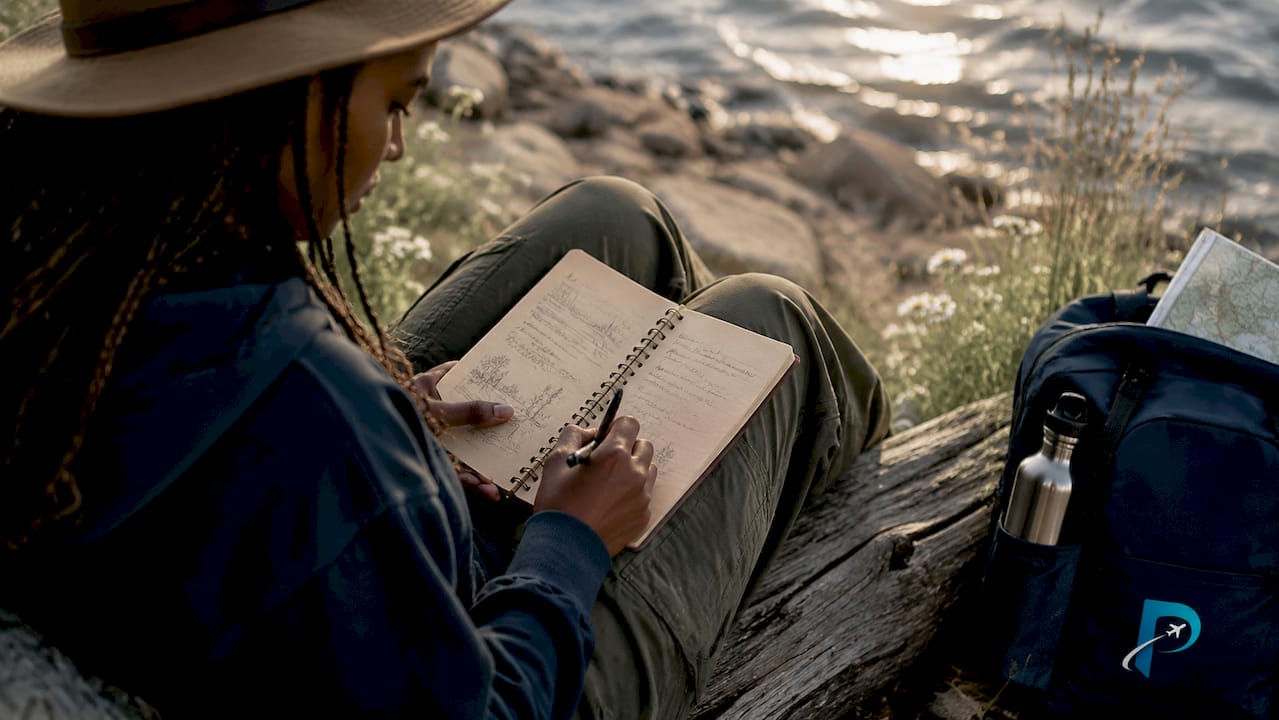
Practical tips for keeping a travel journal that you will actually use
The biggest obstacle to travel journaling is not time. It is the pressure to do it perfectly. The moment you feel like your entry needs to be polished or comprehensive, you stop writing. The fix is to lower the bar deliberately.
- Start with the 3-sentence method. Write one factual observation, one sensory detail, and one personal feeling. That is a complete entry. Everything else is a bonus.
- Write while it is fresh. Memories are most vivid within 48 hours. A quick note on your phone right after lunch beats a detailed reconstruction three days later.
- Carry something you actually want to use. A beautiful notebook or a reliable app you enjoy opening makes the habit easier to keep.
- Combine handwriting and digital tools. Jot quick notes on your phone during the day, then transfer and expand them in a physical journal at night. You get the speed of digital and the depth of handwriting.
- Add photos with captions, not just photos. A one-line caption written the same day adds context that you will not remember a year from now.
- Include mementos. Tape in a boarding pass, a coffee receipt, or a museum ticket. These physical objects trigger memory in a way that text alone does not.
- Skip the days you miss without guilt. Minimal-friction journaling means honest and imperfect, not exhaustive. A journal you write in six days out of ten beats a perfect journal you abandon on day three.
- Use prompts when you are stuck. "What surprised me today?" or "What would I tell a friend about this place?" are enough to get started.
- Try thematic journaling. Instead of a daily log, focus each entry on one theme: food, people you met, moments of discomfort, or things that made you laugh.
- Bullet journaling works too. A rapid-fire list of ten things you noticed today is faster than prose and still captures the texture of the experience.
For couples documenting shared adventures, collaborative journaling adds another layer. Each partner writes their own perspective on the same day, and the contrast between entries reveals how differently two people can experience the exact same moment. That difference is worth preserving.
What research says about journaling's impact on travel
The psychological case for travel journaling is well established, and the findings go further than most travelers expect.
Expressive writing improves emotional processing and long-term memory retention compared to relying on photography alone. The act of writing shifts you from passive observer to active participant, a process researchers call experiential processing. Two people can take the same trip; the one who journals integrates the experience in a way the other does not.
One of the more striking findings involves what happens after you get home. Reminiscing about positive travel experiences activates the same reward circuits in the brain as the original experience itself. Re-reading your journal entries essentially lets you relive the dopamine of the trip. That is why journaling is one of the most effective tools for combating post-vacation blues.
"A trip without documentation is a one-time event. A trip with a journal is a renewable resource of happiness."
— TripMemo Blog on Travel Journaling Benefits
For couples, the research points to a specific benefit. Partners naturally notice different things: one remembers the food, the other remembers the architecture. A shared journal captures both perspectives and creates a unified record that reduces post-trip memory conflicts and strengthens the relationship over time.
| Research finding | What it means for your trip |
|---|---|
| Expressive writing improves emotional processing | Writing about hard travel days helps you recover faster and enjoy more |
| Journaling builds stronger emotional bonds with destinations | Places feel more personal and meaningful when you have written about them |
| Reminiscing reactivates brain reward circuits | Re-reading your journal extends the joy of travel well beyond the trip itself |
| Collaborative journaling reduces couples' memory disputes | A shared record reconciles different perspectives into one cohesive story |
| Minimal-friction journaling beats elaborate documentation | Short, honest entries written consistently outperform detailed entries written rarely |
Key Takeaways
Travel journaling transforms a trip from a series of events into a lived, integrated experience that stays with you long after you return home.
| Point | Details |
|---|---|
| Memory goes deeper with writing | Travelers who journal form stronger emotional connections to destinations than those who rely on photos alone. |
| Journaling clears mental stress | Writing offloads travel frustrations, helping you return to enjoyment faster during the trip. |
| Reminiscing reactivates reward circuits | Re-reading journal entries activates the same brain pathways as the original travel experience. |
| Short entries beat no entries | The 3-sentence method (observation, sensory detail, feeling) keeps the habit going without pressure. |
| Couples benefit from shared journals | Collaborative journaling reconciles different memories and creates a relationship artifact both partners value. |
Why I think journaling is the most underrated travel habit
Most travelers spend weeks planning where to go and almost no time thinking about how to actually experience it once they arrive. That gap is where journaling does its best work.
What strikes me most about the research is not the memory retention angle, though that is real. It is the creativity finding. When you commit to describing what you see in your own words, you start looking at the world differently. You slow down. You ask better questions. You notice the alley you would have walked past, the expression on a stranger's face, the way a city smells at 7:00 AM before the tourists arrive. Journaling does not just record the trip. It teaches you how to travel.
The pressure to document for social media has made this harder. When you are composing a photo for an audience, you are performing travel rather than experiencing it. A private journal flips that entirely. You write for yourself, which means you can be honest about the bad days, the loneliness, the moments that did not match the expectation. Those entries often turn out to be the most valuable ones.
Planytera's built-in journal feature is designed with exactly this in mind: low friction, always with you, and connected to your itinerary so the context is already there when you sit down to write. Pair that with a personalized AI itinerary that builds in the right pace and breathing room, and you have a travel experience that is genuinely worth writing about.
The travelers who get the most out of their trips are not the ones who see the most. They are the ones who pay the most attention. A journal is the simplest tool for doing that.

Ready to plan a trip worth writing about? Planytera builds your personalized, day-by-day itinerary in moments, with a journal feature built right in so you can capture memories as they happen. Start planning your next trip and travel with intention.