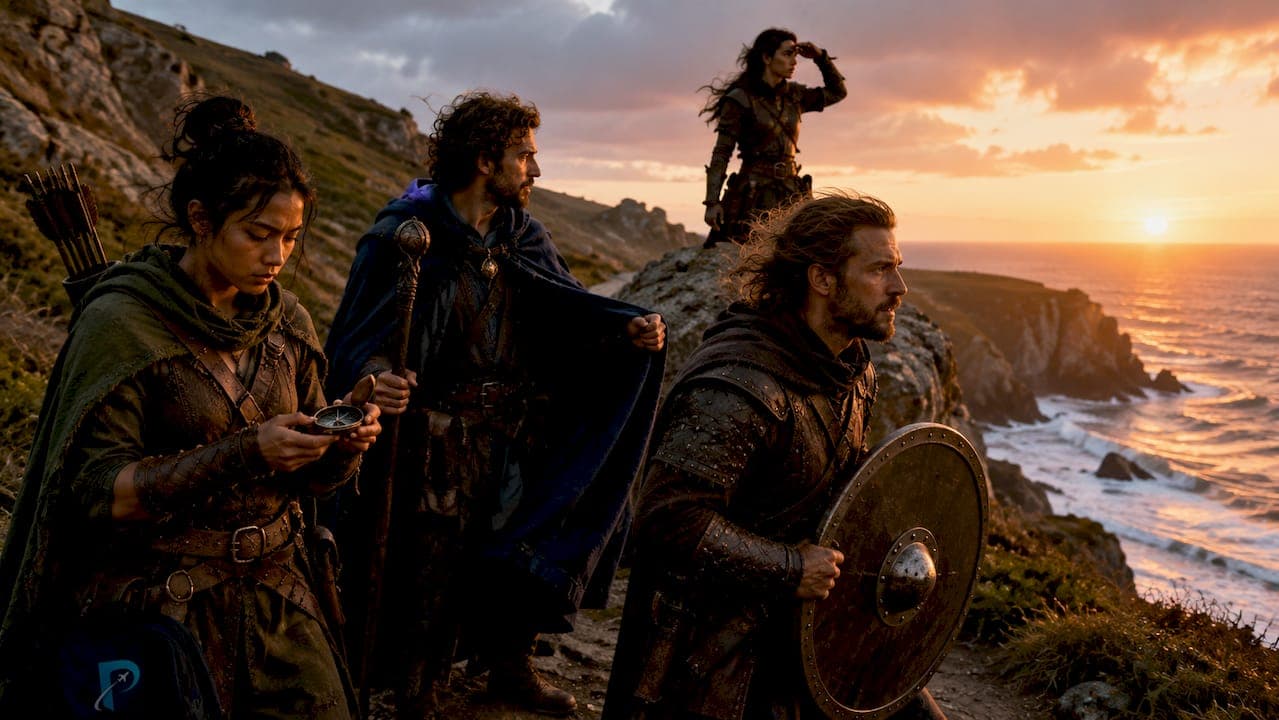
Travel pace preferences in Dungeons & Dragons 5e determine exactly how far your party moves each day, and the choice between Slow, Normal, and Fast pace shapes everything from perception checks to exhaustion risk. Here's the quick breakdown you need before your next session:
The three official travel paces in D&D 5e:
- Slow pace: 200 feet per minute, 2 miles per hour, 18 miles per day. Allows stealth and grants no penalties to perception.
- Normal pace: 300 feet per minute, 3 miles per hour, 24 miles per day. No bonuses or penalties. The default for most overland travel.
- Fast pace: 400 feet per minute, 4 miles per hour, 30 miles per day. Imposes a -5 penalty to passive Wisdom (Perception) checks.
Your pace choice does more than set a distance number. It signals your party's posture: cautious and aware, balanced and efficient, or urgent and exposed. Slow pace opens the door to stealth approaches and richer environmental detail. Fast pace gets you to the next town before nightfall but leaves you vulnerable to ambush. Normal pace sits in the middle, asking nothing extra of your characters. Understanding how these travel speed preferences interact with terrain, exhaustion, and resource consumption is what separates a party that survives the wilderness from one that limps into the dungeon half-dead.
How travel pace preferences work: the math behind the rules
The numbers behind D&D 5e travel pace are clean once you see the formula. The game assumes a standard travel day of 8 hours. Multiply your pace's miles-per-hour rate by 8, and you get your daily distance. Normal pace at 3 miles per hour times 8 hours equals 24 miles. Fast pace at 4 miles per hour gives you 30 miles. Slow pace at 2 miles per hour yields 18 miles.

| Pace | Feet per Minute | Miles per Hour | Miles per Day |
|---|---|---|---|
| Slow | 200 ft | 2 mph | 18 |
| Normal | 300 ft | 3 mph | 24 |
| Fast | 400 ft | 4 mph | 30 |
One of the most common misconceptions at the table is that a character with a higher base movement speed travels farther each day. That is not how it works. Base movement speed governs tactical, round-by-round combat movement, not overland travel distance. A ranger with 35 feet of movement covers the same 24 miles per day at Normal pace as a dwarf with 25 feet. The travel pace rules operate on a completely separate track from combat speed.
The 8-hour travel day is also a firm baseline, not a suggestion. Characters can push beyond it, but the rules treat that as a Forced March with real consequences (covered in a later section). Resting for 8 hours after travel resets the clock. If your party stops for a short rest during travel, that time still counts against the 8-hour window.
Pro Tip: When your party needs to cover a specific distance, work backward from the miles. Divide the total distance by the pace's miles-per-hour rate to find how many hours of travel are required. If the answer exceeds 8 hours, you'll need to plan for a Forced March or an overnight stop.
What each pace type actually does to your game
Pace is not just a speed dial. Each setting carries mechanical weight that affects how your party interacts with the world around them.
Slow pace: stealth, awareness, and patience
Slow pace is the tactical choice for parties moving through hostile territory. At 18 miles per day, you cover less ground, but your party can move stealthily, meaning the group can attempt to avoid detection by enemies and creatures. Passive Perception stays fully active, so your scouts catch more of what the wilderness throws at you. Slow pace improves stealth and reduces the chance of being surprised, which can be the difference between a prepared ambush and a chaotic one.
The tradeoff is real, though. Slower travel means more time in the wilderness, which means more random encounter checks, more rations consumed, and more spell slots potentially spent on survival. Choosing Slow pace is a resource management gamble, not a free upgrade.
Normal pace: the reliable middle ground
Normal pace asks nothing extra of your characters. No penalties, no special abilities, just steady movement at 24 miles per day. For most overland travel between known locations, Normal pace is the right call. Your party stays alert, covers reasonable ground, and arrives without penalty.
This is the pace most DMs default to when travel is a transition rather than a focus of the session. It keeps the story moving without trivializing the wilderness.
Fast pace: urgency at a cost
Fast pace gets your party to 30 miles per day, but it comes with a meaningful mechanical penalty. Every character traveling at Fast pace takes a -5 to passive Wisdom (Perception). That is a significant drop. A character with a passive Perception of 14 effectively drops to 9, making them far more likely to miss hidden threats, traps, or ambushes.
Fast pace is the right call when urgency outweighs caution: racing to warn a city, fleeing a pursuing force, or closing distance before a deadline. Use it deliberately, not as a default.
| Pace | Miles per Day | Stealth Possible? | Passive Perception Penalty | Best Used When |
|---|---|---|---|---|
| Slow | 18 | Yes | None | Hostile territory, scouting |
| Normal | 24 | No | None | Standard travel, transitions |
| Fast | 30 | No | -5 | Urgency, pursuit, deadlines |
Pro Tip: If your party has a Scout or a character with the Observant feat, their passive Perception may be high enough to absorb the Fast pace penalty without falling below a useful threshold. Check the numbers before committing to Fast pace in dangerous terrain.
How terrain and special conditions change your travel pace
Flat numbers only tell part of the story. The world your party moves through bends those numbers in ways the basic pace table does not show.
Common terrain and condition modifiers:
- Difficult terrain (dense forest, swamps, rubble, deep snow) halves movement. A party traveling at Normal pace through difficult terrain effectively moves at Slow pace distances, covering roughly 12 miles per day instead of 24. Difficult terrain does not change your pace category, but it cuts the actual distance in half.
- Roads and cleared paths allow travel at full pace without penalty. A well-maintained road through otherwise difficult terrain can be the difference between reaching a destination in one day or two.
- Mounts increase the distance a party can cover, particularly for the first portion of a journey. A riding horse can cover ground faster than a walking party, but mounts still need rest and cannot override Forced March exhaustion effects.
- Vehicles such as wagons or riverboats follow their own speed rules. A keelboat moving downstream may cover far more ground than a walking party, while the same boat moving upstream may cover less.
- Weather can impose difficult terrain conditions across entire regions, effectively halving travel pace without any change in the party's pace setting.
- Darkness and low visibility may require the party to slow down or stop entirely, depending on the DM's ruling and available light sources.
Terrain is the DM's most powerful tool for making travel feel real. A 24-mile Normal pace day across open grassland and a 24-mile Normal pace day through a mountain pass are mechanically identical but narratively worlds apart. Adjusting terrain difficulty is how DMs control the pressure on a party without changing a single rule.
Just as real-world travelers adjust their rhythm based on the environment around them, D&D parties need to read the terrain and adapt. A group planning an adventure-paced itinerary across varied terrain learns quickly that flexibility beats rigid scheduling every time.
Extended travel and Forced March: when exhaustion becomes the enemy
Eight hours is the safe limit. Push past it, and the rules shift from travel mechanics into survival mechanics.
When a party travels for more than 8 hours in a single day, each character must make a Constitution saving throw at the end of each additional hour. The DC starts at 10 and increases by 1 for every hour beyond the 8-hour baseline. Travel 9 hours and the DC is 11. Travel 10 hours and the DC is 12. Fail the saving throw and the character gains one level of exhaustion.
Exhaustion levels and their effects on travel:
- Level 1: Disadvantage on ability checks. Skill checks used for navigation, survival, and stealth all suffer.
- Level 2: Speed halved. A character at this level covers half the normal daily distance, compounding the very problem that caused the Forced March in the first place.
- Level 3: Disadvantage on attack rolls and saving throws. Combat readiness drops sharply.
- Level 4: Hit point maximum halved. Characters become dangerously fragile.
- Level 5: Speed reduced to 0. The character cannot travel at all.
- Level 6: Death.
Exhaustion levels are cumulative and stack. A character who fails two consecutive Forced March saves in a single extended travel day gains two levels of exhaustion, potentially hitting Level 2 before the party even stops for the night. Exhaustion negatively impacts movement, skill checks, hit points, and combat effectiveness, creating a downward spiral that is hard to recover from without a full long rest.
The trap many parties fall into is trying to make up lost time by pushing harder after a setback. A party that gets delayed by difficult terrain might attempt a Forced March to compensate, only to arrive at their destination exhausted and unable to fight effectively. The math rarely works in their favor.
Forced March risk summary:
- Each extra hour beyond 8 requires a Constitution save.
- DC = 10 + 1 per additional hour traveled.
- Failure adds one exhaustion level.
- Only a long rest removes exhaustion levels (one level per rest).
- Faster pace during a Forced March does not reduce the number of saves required.
Using travel pace strategically to build better D&D campaigns
Travel pace is one of the most underused levers in D&D 5e. When DMs and players treat it as a deliberate choice rather than a background assumption, it transforms overland travel from a montage into a meaningful part of the game.
1. Match pace to campaign tone
Experienced DMs use travel pace as a dial for campaign atmosphere. Slow pace sessions build tension and survival stakes. The party is careful, resources drain steadily, and every rustle in the undergrowth matters. Fast pace sessions convey urgency and narrative momentum. The world feels like it is moving around the party, not waiting for them. Normal pace is the neutral setting that keeps the story flowing without demanding attention.
2. Use pace to manage resource consumption
Travel pace directly affects how quickly your party burns through supplies. Faster travel means fewer days in the wilderness, which conserves rations and reduces random encounter exposure. Slower travel means more days out, more food consumed, and more opportunities for the wilderness to test the party. Faster or longer travel intensifies resource use and exhaustion risk, so pace choice is always a resource management decision.
3. Let pace signal party intent to the DM
When players declare their pace, they are telling the DM what kind of experience they want right now. Slow pace says "we are taking this seriously, we want to engage with the environment." Fast pace says "get us there, we have a goal." A good DM reads these signals and adjusts encounter frequency and detail accordingly. Strict enforcement of pace rules enhances survival challenges, while relaxed rules accelerate storytelling, and both approaches are valid depending on what the table needs.
4. Build tension with Forced March decisions
Nothing raises stakes at the table like a Forced March decision. The party is two hours from safety, it is getting dark, and they have already traveled 8 hours. Do they push on and risk exhaustion, or camp in hostile territory? That is a genuine dramatic choice with mechanical teeth. Build those moments intentionally by placing objectives just beyond comfortable reach.
5. Reward pace awareness with narrative detail
Parties traveling at Slow pace deserve richer environmental description. They are paying attention. Give them the details: the distant smoke on the horizon, the tracks in the mud, the sound of water that might mean a stream or might mean something else. Fast pace parties get the broad strokes. They are moving too quickly to notice the fine print.
6. Use pace to balance party composition
Not every party has the same strengths. A party with a high-Wisdom ranger and the Observant feat can absorb the Fast pace Perception penalty better than a party of low-Wisdom fighters. Understanding your party's stats lets you choose pace based on actual capability, not just preference. Blending different pace preferences within a group is a real skill, whether you are planning a campaign arc or a single session's travel.
7. Adjust pace mid-journey based on new information
Pace is not locked in at the start of a travel day. If the party scouts ahead and spots a patrol, switching from Normal to Slow pace mid-journey is a perfectly reasonable tactical response. The distance covered up to that point stays fixed; only the remaining travel changes. This flexibility makes pace feel like a living decision rather than a form to fill out at the start of the session.
Pro Tip: Before a long travel sequence, ask your players what their pace priority is for this leg of the journey: speed, stealth, or balance. That one question generates more meaningful engagement with travel mechanics than any random encounter table.
Key Takeaways
Travel pace in D&D 5e is a three-way choice between Slow (18 miles/day), Normal (24 miles/day), and Fast (30 miles/day), and each option carries mechanical consequences that shape the entire session.
| Point | Details |
|---|---|
| Three pace options | Slow covers 18 miles/day, Normal covers 24 miles/day, and Fast covers 30 miles/day. |
| Fast pace perception penalty | Fast pace imposes a -5 penalty to passive Wisdom (Perception), increasing ambush risk. |
| Base speed does not affect daily travel | A character's combat movement speed has no impact on overland travel distance. |
| Forced March DC scales per hour | Each hour beyond 8 requires a Constitution save at DC 10 + 1 per extra hour; failure adds exhaustion. |
| Pace shapes campaign tone | Slow pace builds tension and survival stakes; fast pace conveys urgency and narrative momentum. |
Plan Your Next Adventure with Planytera

Travel pace matters just as much outside the game as inside it. Whether you are planning a real-world expedition or mapping out your next campaign arc, getting the pacing right makes all the difference. Planytera builds AI-powered, personalized itineraries that account for your pace preferences, budget, and travel style, so you spend less time planning and more time exploring.
From solo trips to group adventures, Planytera generates tailored day-by-day plans that flex with you. Adjust on the fly, access your itinerary offline, and document your journey with the built-in journal feature. Your next great adventure is ready when you are.