
Group preferences in travel apps are defined as the aggregated individual tastes, budgets, dietary needs, and activity priorities that a travel platform collects and reconciles to generate recommendations the whole group can accept. The role of group preferences in travel apps goes far beyond a simple average. Apps that handle this well use hybrid recommender systems, role-based collaboration models, and AI-driven filtering to turn a messy pile of opinions into a workable itinerary. Understanding how this process works helps you pick the right tools and get more out of every group trip you plan.
How do travel apps collect and process group preferences?
Travel apps collect group preferences through three main channels: individual member profiles, structured surveys, and in-app voting tools. Each channel captures a different layer of what people want. Profiles store long-term preferences like cuisine type or travel pace. Surveys capture trip-specific needs like budget caps or must-see destinations. Voting tools surface real-time consensus when the group needs to make a quick call.

Once the data is in, the heavy lifting falls to recommendation algorithms. The most effective systems use a hybrid approach that combines Content-Based Filtering with Neural Collaborative Filtering. TF-IDF vectorization and neural collaborative filtering weighted scoring mechanisms are the technical backbone of platforms like TripSmart, a prototype ML-based travel decision support system. This combination increases both recommendation relevance and diversity for groups, which matters when you have eight people with eight different wish lists.
AI also helps solve a persistent technical problem called the cold-start issue. This happens when a new group member has no history in the system, so the app has nothing to base recommendations on. Machine learning models handle this by drawing on similar user profiles and destination metadata to fill the gap. The result is a more accurate first recommendation, even for someone the app has never seen before.
- Individual profiles: Store dietary needs, pace preferences, and past trip data
- Structured surveys: Capture budget ranges and destination priorities before planning begins
- In-app voting: Let members rank options in real time to surface fast consensus
- AI refinement: Machine learning models improve accuracy as more preference data accumulates
Pro Tip: Set up individual profiles before your group's first planning session. Apps with pre-loaded preferences skip the back-and-forth and generate better first-round suggestions.
What challenges arise from conflicting preferences in group travel planning?
Conflicting preferences are the single biggest obstacle to smooth group travel planning. One traveler wants a beach resort under $150 a night. Another wants a city hotel with a rooftop bar. A third has a gluten-free diet and needs restaurant options within walking distance. These are not edge cases. They are the norm for any group of four or more people.
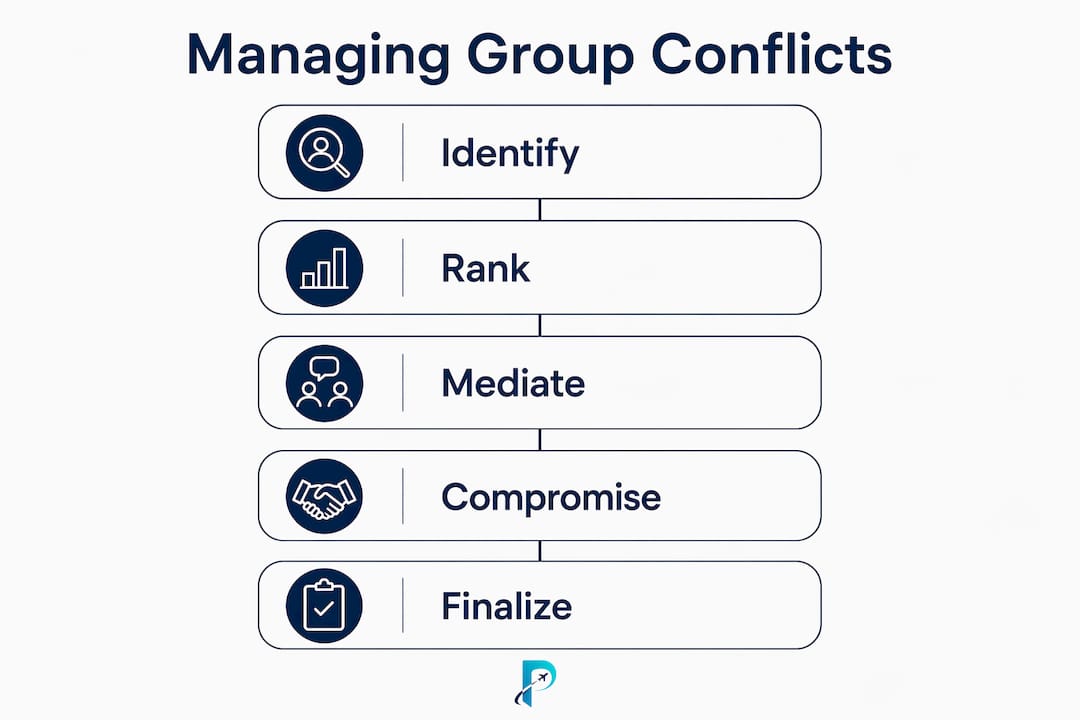
The problem gets worse when apps rely on simple aggregation methods. Group-level averages often conflict with individual tastes, and a basic average can produce a recommendation that nobody actually wants. A hybrid analytical methodology combining sentiment analysis and stochastic modeling produces better results, but most entry-level group travel apps do not use it. That gap between what the technology can do and what most apps actually deliver is where groups run into trouble.
Decision delays compound the frustration. When no one can agree, planning stalls. Neglecting role-based collaboration and incompatible preferences often results in suboptimal group satisfaction and planning inefficiency. The fix is not just better algorithms. It is also better structure within the planning process itself.
Here are the most common conflict types groups face:
- Budget gaps: Wide income differences make it hard to agree on accommodation or activity tiers.
- Destination mismatches: Some members want adventure; others want relaxation. These goals rarely overlap.
- Activity incompatibility: A group with young children and a group of solo adults need completely different daily schedules.
- Dietary restrictions: One vegan and one carnivore in the same group can derail restaurant planning fast.
- Pace differences: Night owls and early risers clash on daily start times and how much to pack into each day.
Pro Tip: Before opening any app, ask every group member to rank their top three non-negotiables. This single step cuts planning time significantly because it separates deal-breakers from nice-to-haves.
How do modern travel apps support group organizers in managing preferences?
Most group recommender systems overlook scenarios where a single organizer manages preferences and makes the final decision for the group. This is a significant blind spot. In practice, most group trips have one person doing the bulk of the coordination. That person needs tools designed for their specific role, not just a shared voting screen.
The MyFoodGRS prototype addresses this directly. It supports an organizer who anticipates member preferences and mediates incompatibilities before they surface as conflicts. The system lets the organizer input each member's constraints, then generates options that satisfy the most critical requirements across the group. This approach shifts the burden from real-time negotiation to upfront planning, which is far less stressful for everyone involved.
More advanced platforms use optimization techniques like ELECTRE-III, a multi-criteria decision analysis method that ranks options by how well they satisfy each group member's priorities without forcing a single winner. Role-based preference aggregation with constraint modeling produces better outcomes than simple majority voting. The difference shows up most clearly in complex itineraries with multiple destinations and activity types.
Here is what strong organizer support looks like in a well-designed travel app:
- Preference input on behalf of members: The organizer can enter constraints for members who are not active in the app
- Incompatibility alerts: The system flags when two members' preferences cannot both be satisfied and suggests trade-offs
- Scenario planning: The organizer can model two or three itinerary options before presenting them to the group
- Structured polling: Limited-choice polls (pick one of three, not open-ended) reduce decision fatigue
- Deadline enforcement: Built-in deadlines prevent the planning process from dragging on indefinitely
| Feature category | What it does for the organizer |
|---|---|
| Preference proxy input | Lets one person enter data for the whole group |
| Conflict detection | Flags incompatible constraints before they cause delays |
| Scenario modeling | Generates multiple itinerary options for group review |
| Structured voting | Narrows choices to prevent open-ended debate |
| Deadline tools | Keeps the planning timeline on track |
AI-driven hybrid recommendation systems markedly improve planning efficiency and accuracy compared to manual methods. For organizers managing a group of ten or more, that efficiency gain is the difference between a plan that comes together in a weekend and one that drags on for months.
What practical strategies can groups use in travel apps to maximize trip satisfaction?
The best technology only works if the group uses it well. Locking dates first, setting a clear budget, and narrowing destination choices are the three steps that prevent decision paralysis and keep planning moving. These are not just common sense. They are the structural foundation that every other planning decision rests on.
Assigning a single point person matters just as much as the tools you use. That person does not make all the decisions alone. They manage the process, set deadlines, and break ties when the group is stuck. Structured polling and assigning a point person improve communication efficiency and reduce the messaging overload that kills group chats. You can read more about managing mixed group preferences in Planytera's preference category guide.
Here are the strategies that consistently produce better group trips:
- Lock the dates first. Everything else depends on who can actually go. Start there.
- Set a per-person budget range early. A $500 gap between the highest and lowest spender needs to be addressed before you book anything.
- Use polls with limited options. Offer three destination choices, not an open field. Fewer options produce faster decisions.
- Build in solo time. Not every activity needs to be a group activity. Itineraries with built-in free hours reduce friction significantly.
- Assign daily leads. Rotate who makes the call on each day's main activity. This distributes ownership and reduces resentment.
- Set response deadlines. Give members 48 hours to vote on a poll. After that, the organizer decides. This prevents indefinite delays.
- Use offline-capable apps. International destinations often have spotty connectivity. An app that works without Wi-Fi keeps the group on track regardless of signal.
For groups with very different travel styles, consider splitting the itinerary into shared anchor activities and optional add-ons. The anchor activities are non-negotiable and agreed on upfront. The add-ons let individuals or subgroups pursue their own interests without derailing the shared plan. This structure works especially well for families planning group trips where age ranges and energy levels vary widely.
Key Takeaways
Group preferences in travel apps work best when a single organizer uses structured tools, AI-driven filtering, and clear deadlines to reconcile individual needs before conflicts arise.
| Point | Details |
|---|---|
| Hybrid AI models outperform manual methods | Systems using neural collaborative filtering and TF-IDF deliver more accurate group recommendations. |
| Organizer-focused tools are underbuilt | Most apps overlook single-organizer scenarios; look for platforms with proxy input and conflict detection. |
| Simple averages fail groups | Aggregating preferences by average produces recommendations nobody wants; sentiment-weighted models work better. |
| Structure prevents decision paralysis | Locking dates, setting budgets, and using limited-choice polls keeps group planning on track. |
| Role-based collaboration improves outcomes | Assigning daily leads and using deadline enforcement reduces friction and speeds up decisions. |
Why the organizer role is the most underrated factor in group travel
I have watched groups spend three weeks in a planning chat and still board the plane without a confirmed dinner reservation. The technology was fine. The problem was that nobody owned the process. Every app I have tested assumes the group will self-organize, and that assumption is almost always wrong.
The research on systems like MyFoodGRS and TripSmart points in a clear direction: the next generation of travel apps needs to be built around the organizer, not the group as a whole. The organizer is the one who inputs the constraints, breaks the ties, and keeps the timeline moving. Giving that person better tools, specifically conflict detection, scenario modeling, and deadline enforcement, produces better trips for everyone.
AI will keep improving the recommendation side of this equation. But the human side, the facilitation, the negotiation, the willingness to make a call when the group is stuck, is something no algorithm replaces. The best outcome comes from pairing a capable organizer with an app that does the analytical heavy lifting. That combination is what actually gets a group of twelve people to the same destination with a plan they all feel good about.
The apps that figure this out first will win the group travel market. Right now, most are still treating groups as a collection of individuals rather than a system that needs a coordinator at its center. That gap is the biggest opportunity in AI travel itinerary design today.
— Dom
Plan your next group trip with Planytera
Planning a group trip with mixed preferences does not have to mean endless back-and-forth. Planytera builds AI-powered, day-by-day itineraries that account for dietary needs, budget ranges, and travel pace across your entire group.
One organizer can input the group's constraints, and Planytera generates a tailored plan ready in moments. You can adjust any part of the itinerary on the fly, share it with the group for feedback, and access it offline when you land. Whether you are coordinating a family reunion or a friends' trip with very different budgets, Planytera's AI trip planner handles the complexity so you can focus on the fun.
FAQ
What is the role of group preferences in travel apps?
Group preferences in travel apps are the aggregated individual needs, budgets, and activity priorities that the platform uses to generate recommendations the whole group can accept. Apps that handle this well use hybrid AI models to reconcile conflicting inputs rather than relying on simple averages.
How do travel apps handle conflicting group preferences?
Advanced apps use techniques like ELECTRE-III multi-criteria analysis and neural collaborative filtering to rank options by how well they satisfy each member's priorities. Role-based collaboration models, where one organizer inputs constraints and the system flags incompatibilities, produce the best outcomes.
What features should I look for in a group travel app?
Look for structured polling with limited choices, deadline enforcement, preference proxy input so one organizer can enter data for the group, and offline access. Hybrid filtering frameworks that combine content-based and collaborative approaches also improve recommendation quality significantly.
How can a group avoid decision paralysis when planning a trip?
Lock travel dates first, set a per-person budget range before any other decisions, and use polls with no more than three options. Assigning a single point person who can break ties and enforce deadlines prevents planning from stalling indefinitely.
Does AI actually improve group travel planning?
Yes. Hybrid group recommender systems reach precision up to 0.886 and F1-score 0.874 compared to manual planning methods. That accuracy translates directly into recommendations that better match what the group actually wants.