
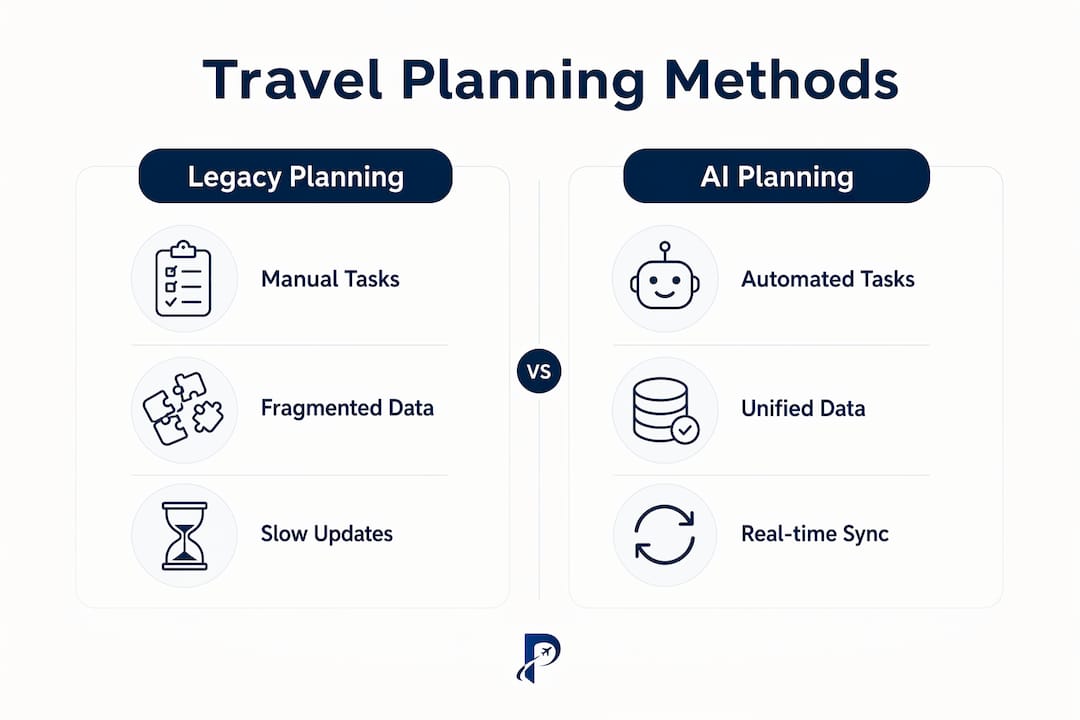
AI is replacing legacy travel planning methods by compressing what once took multiple website visits, many page views, and hours of research into a single, conversational workflow that handles the bulk of routine planning automatically. The shift is not incremental. It is architectural. Agentic AI now functions as a reasoning engine that satisfies dozens of constraints simultaneously, from dietary needs and budget to pacing and accessibility, and delivers a coherent, day-by-day itinerary in moments. Planytera is a practical example of this in action: its AI-first platform generates personalized itineraries without the spreadsheets, tab-switching, or hours of manual research that defined legacy travel planning.
Three implications follow for travel planners and industry teams right now:
- Shift from manual search to prompt-and-verify workflows. Your job moves from aggregating information to directing AI and validating its output.
- New distribution model. AI systems choose which suppliers appear in a synthesized shortlist. Ranking on a search results page is no longer enough; being cited by agentic systems is the new visibility objective.
- Human verification is non-negotiable for high-stakes items. AI handles the heavy lifting, but a human must sign off on anything that cannot be undone.
Pro Tip: Never let AI finalize visa requirements, non-refundable bookings, or compliance-sensitive items without a human check. These are exactly the categories where stale training data causes real-world problems.
Table of Contents
- How the travel funnel is shifting from search to agentic planning
- Concrete AI use cases that replace manual planning tasks
- What replacing legacy workflows means for your operations
- Legacy systems and data challenges that block full AI automation
- Trust, hallucination risk, and where human oversight is required
- Adoption timeline, costs, and ROI signals for travel businesses
- Practical steps to replace legacy planning tasks with AI now
- How Planytera shows AI replacing legacy planning in practice
- Key Takeaways
- The hybrid model is the only durable outcome
- Planytera makes the hybrid workflow practical from day one
- Useful sources and further reading
How the travel funnel is shifting from search to agentic planning
The travel funnel used to start with a search bar. A traveler typed a destination, landed on an OTA, filtered hundreds of options, cross-referenced review sites, and eventually booked after days of back-and-forth. That model is giving way fast.

Today, the funnel increasingly begins with a conversation. A traveler describes what they want, and an agentic AI interprets the intent, synthesizes options from multiple sources, and returns a shortlist or a full itinerary. "Agentic AI" means a system that can take multi-step actions autonomously, not just answer a single question. It optimizes across preferences, availability, budget, and pacing in one continuous pass.
The numbers reflect how quickly this is happening. Klook Travel Pulse 2026 reports that 91% of global travelers have used at least one form of AI-assisted trip planning, signaling a structural change in how travelers discover and evaluate options, not just a new tool layered on top of the old process.
Legacy funnel vs. agentic funnel:
- Legacy: Search → OTA browse → review sites → price comparison → booking → post-booking research
- Agentic: Conversational prompt → synthesized shortlist → inline booking or redirect → continuous real-time assistance
The operational consequence for brands is significant. AI platforms synthesize content from reviews, forums, and publications to decide which options surface. The sources an AI engine weights determine which brands get recommended. Ranking on page one of Google no longer guarantees visibility inside an AI-generated shortlist. Being citable, meaning having structured, accurate, and authoritative content that AI systems can extract and trust, is the new objective.
Concrete AI use cases that replace manual planning tasks
AI does not replace travel planners wholesale. It replaces specific, repeatable tasks that used to consume most of a planner's day. Here is where the replacement is already happening:
- Automated itinerary generation. Legacy task: hours of manual research, spreadsheet assembly, and formatting. AI generates a complete, day-by-day plan in seconds by ingesting preferences, budget, and pace. Controlled trials show AI-generated itineraries can be cheaper for standard city-break requests, partly because the model optimizes across more options than a human can manually compare.
- Conversational discovery. Legacy task: keyword searches across multiple OTAs and review sites. AI interprets intent-based requests ("something relaxing near the coast, kid-friendly, under $3,000") and returns curated options without requiring the traveler to filter hundreds of listings.
- Review summarization. Legacy task: reading dozens of reviews to extract consensus. AI reads thousands of reviews and surfaces the key themes, common complaints, and standout positives in a sentence or two.
- Live disruption handling. Legacy task: manual rebooking calls and email chains when a flight is delayed. AI can detect a disruption, identify alternatives, and present rebooking options in real time. Traditional search cannot react at that speed.
- Dynamic packaging and upsells. Legacy task: manually assembling flight + hotel + activity bundles. AI identifies combinations that fit the traveler's stated preferences and budget, then surfaces relevant add-ons at the right moment.
- Accessibility and personalization. Legacy task: calling properties to verify accessibility features or dietary options. AI ingests these requirements upfront and filters inventory accordingly, surfacing only options that genuinely fit.
For group trip planning, AI adds another layer of value: it reconciles conflicting preferences across multiple travelers simultaneously, something that used to require multiple rounds of email negotiation.
Pro Tip: Use multimodal inputs to get better outputs. Upload a photo of a restaurant you loved, paste a calendar, or attach a receipt from a past trip. Iterative prompting, refining the conversation over multiple turns rather than expecting perfection from one prompt, consistently produces better plans than a single-shot request.

A note on model selection: no single AI model excels at every task. Creative large language models are best for itinerary structure and storytelling. Web-connected models are required for live pricing. Low-hallucination models handle fact-sensitive checks. The expert workflow combines all three.
What replacing legacy workflows means for your operations
The operational impact of AI adoption goes well beyond faster itinerary drafts. It reshapes channel economics, revenue management priorities, and how marketing content needs to be structured.
Distribution. Less referral traffic flows through traditional OTA ranking. More exposure comes from being cited inside AI-generated answers. Share of Citations, meaning how often your brand appears in AI-synthesized shortlists, is the new KPI that matters alongside share of search. Brands that have not structured their content for AI extraction will lose visibility even if their product is strong.
Revenue management. AI enables dynamic rebooking and price-forecasting integration that legacy RM systems cannot match. When a flight is disrupted, an AI layer can automatically surface the next-best option within the traveler's original budget parameters. That requires near-real-time pricing feeds, not the batch updates most legacy systems still run.
Marketing. Content optimized for keyword ranking is not the same as content optimized for AI citation. AI systems extract structured, factual, specific content. Thin, keyword-stuffed pages get ignored. Detailed, well-structured content with clear facts, amenity lists, and accessibility information gets cited.
Pro Tip: Start renegotiating fulfillment integrations with OTA and GDS partners now. Once AI surfaces inventory differently, commission structures and referral agreements built around click-through traffic will need to be revisited. Get ahead of that conversation before your partners do.
Practical follow-ups for operations teams:
- Update data feeds to include structured amenity, accessibility, and pricing data
- Negotiate API-level fulfillment integrations with key OTA and GDS partners
- Add Share of Citations to your monthly reporting dashboard alongside organic search metrics
Legacy systems and data challenges that block full AI automation
AI can replace a lot of manual work, but the technical blockers are real and worth planning around honestly. The central constraints are fragmented inventory feeds, inconsistent APIs, stale data, and privacy gaps that prevent full automation from day one.
The core legacy problems:
- GDS and OTA fragmentation. Inventory lives across dozens of systems with different schemas, update frequencies, and authentication methods. AI cannot reliably synthesize what it cannot consistently access.
- Inconsistent ancillary APIs. Seat upgrades, meal preferences, and accessibility accommodations often live in separate systems with no standardized interface.
- Stale data. Many legacy systems update pricing and availability in batch cycles, not in real time. An AI that pulls from stale data will surface wrong prices and unavailable options.
- Siloed CRM and past-booking data. Personalization depends on knowing what a traveler has done before. When that data lives in disconnected CRM systems, the AI cannot access it to inform recommendations.
| Challenge | Operational Impact | Remediation |
|---|---|---|
| Fragmented inventory feeds | AI surfaces incomplete or conflicting options | Normalize feeds via middleware; implement a canonical inventory layer |
| Inconsistent ancillary APIs | Personalization gaps; missed upsell opportunities | Adopt standardized ancillary schemas (e.g., NDC-aligned) |
| Stale pricing data | Wrong prices shown; booking failures | Shift to event-driven pricing updates; require near-real-time feeds |
| Siloed CRM data | Generic recommendations; poor repeat-traveler experience | Integrate CRM into AI orchestration layer via secure API |
| Privacy and data governance gaps | Regulatory risk; inability to use personal data for personalization | Implement consent management and data minimization policies |
Pro Tip: Build a hybrid stack: an AI orchestration layer on top of a canonical data model. The orchestration layer handles model routing and task sequencing. The canonical model normalizes inventory data from all sources into a single schema. Engineering priorities should be near-real-time pricing feeds and idempotent booking calls that can be safely retried without creating duplicate reservations.
Understanding what travel customization actually involves at the data layer, dietary flags, pace signals, accessibility requirements, helps teams scope the normalization work accurately before committing to a timeline.
Trust, hallucination risk, and where human oversight is required
AI reduces routine friction significantly. It also introduces hallucination and staleness risks that make human verification mandatory for anything fact-sensitive. Planners who treat AI output as a finished product will eventually hand a traveler a wrong bus schedule, a closed restaurant, or an expired visa requirement.
Common error modes and the verification checkpoint for each:
- Stale prices. AI training data has a cutoff; live prices require a web-connected model or a direct API call. Verify all pricing before presenting to a client.
- Closed or relocated venues. Restaurants, attractions, and hotels close or move. Cross-check any specific venue recommendation against a live source before confirming.
- Wrong schedules. Transit schedules change seasonally. Always verify departure times and routes through the operator's official site or a live API.
- Misread visa rules. Visa requirements change with little notice. Never rely on AI for visa guidance without checking the relevant government source directly.
- Hallucinated reviews or ratings. Some models invent review scores. Verify ratings against the original platform.
Model selection matters here. Independent testing in April 2026 reported varying hallucination rates for different AI models on factual travel queries. For fact-sensitive tasks, model choice is a risk management decision, not just a preference.
The recommended verification workflow: treat AI output as a living draft. Use a second model or a live API call to cross-check specific facts. Reserve human sign-off for non-refundable bookings, visa and legal items, and anything with a compliance dimension.
Pro Tip: Run a two-pass workflow. Use a creative model to generate the itinerary structure, then feed the specific factual claims (venue names, schedules, prices) into a web-connected model for live verification. This catches most hallucinations without requiring a full manual review of every line.
The AI travel itinerary guide from Planytera walks through how to structure this kind of iterative, verification-aware workflow at the product level.
Adoption timeline, costs, and ROI signals for travel businesses
Realistic AI adoption follows three phases: pilot, hybrid deployment, and scale. Pilot to scale typically spans several months depending on integration depth, data readiness, and organizational change management.
| Phase | Milestone | Typical Cost Drivers | ROI Signal |
|---|---|---|---|
| Pilot (months 1–3) | AI generates itineraries for a defined trip type; staff reviews output | Model API access; prompt engineering; staff training | Time saved per itinerary; staff feedback on output quality |
| Hybrid (months 4–) | AI handles first draft; humans verify and finalize; basic API integrations live | Integration engineering; data normalization; change management | Conversion lift from AI-cited recommendations; reduction in agent hours per booking |
| Scale (months 12–) | Full booking automation for standard requests; enterprise GDS/NDC integration | NDC integration; enterprise security review; ongoing model costs | Share of Citations growth; cost per booking reduction; repeat traveler rate |
Fast wins are available immediately: creative itinerary generation and customer-service triage both deliver measurable time savings within weeks of a pilot launch. Full booking automation and enterprise GDS integration are long-lead investments that require data normalization work first.
Building a business case is straightforward when you measure the right things. Track time-per-plan before and after AI introduction. Measure conversion lift from AI-cited recommendations. Monitor Share of Citations monthly. These three metrics give leadership a clear picture of where AI is delivering and where integration gaps are limiting returns.
Practical steps to replace legacy planning tasks with AI now
The single most important principle: start with high-volume, low-stakes tasks and pair AI outputs with human verification for anything high-stakes. Do not try to automate everything at once.
Onboarding checklist for travel teams:
- Select a narrow pilot scope. Choose one trip type (e.g., domestic city breaks, recurring corporate itineraries) where volume is high and stakes are manageable.
- Audit your data. Inventory your pricing feeds, amenity data, and CRM records. Identify gaps before you build on top of them.
- Assess API readiness. Confirm which OTA and GDS connections can support near-real-time data. Flag batch-only connections as integration priorities.
- Train staff on prompt design. Teach your team to write specific, constraint-rich prompts. Vague prompts produce generic itineraries. Specific prompts produce plans worth using.
- Define verification rules. Document which output categories require human sign-off (prices, visa items, non-refundable bookings, schedules) before the pilot goes live.
- Set up monitoring and KPIs. Track time-to-final-plan, Share of Citations, and conversion lift from day one so you have baseline data to compare against.
- Run iterative refinement cycles. Treat each AI conversation as a living document. Refine constraints over multiple turns rather than accepting the first output. Expert workflows consistently show that iterative prompting outperforms single-shot requests.
For model selection, match the tool to the task. Use creative models for itinerary structure, web-connected models for live pricing, and the lowest-hallucination model available for fact-sensitive checks. Mixing models in a pipeline is not complexity for its own sake; it is the workflow that actually produces reliable output.
Pro Tip: Measure "time-to-final-plan" as your primary efficiency metric and Share of Citations as your primary distribution metric. Together, they tell you whether AI is saving time internally and whether it is growing your brand's reach externally.
How Planytera shows AI replacing legacy planning in practice
Planytera provides an AI-first itinerary generation workflow that automates the bulk of logistics while keeping human edits and collaboration fully accessible at every step.
Here is how specific Planytera features map to the legacy touchpoints described earlier:
- Personalized day-by-day itineraries. Replaces the manual research-and-assembly process. Planytera ingests dietary requirements, travel pace, budget, and accessibility needs upfront and generates a complete plan ready in moments, not hours.
- Live travel guidance and real-time advisories. Replaces the reactive scramble when conditions change. Planytera surfaces live advisories so travelers and planners know about disruptions before they become problems.
- Offline access. Replaces the dependency on connectivity for in-destination guidance. Plans are available without a data connection, which matters in remote destinations or international roaming situations.
- Group collaboration tools. Replaces the email chains and shared spreadsheets that group planning used to require. Multiple travelers can view, edit, and contribute to a shared itinerary in one place.
- Agency tools for bulk planning and custom branding. Replaces the manual effort of building individual itineraries for each client. Agencies can run batch trip jobs, apply custom branding, and manage team collaboration from a single dashboard.
- Trip journal. Replaces the post-trip scramble to reconstruct memories. Travelers document experiences as they happen, inside the same platform they used to plan.
For agencies integrating Planytera into their operations, the AI itinerary customization guide covers how to operationalize human edits alongside AI-generated drafts, which is exactly the hybrid workflow the earlier sections describe.
On verification: Planytera surfaces live advisories and flags conditions that warrant human review. For non-refundable bookings, visa items, and compliance-sensitive decisions, human sign-off remains the correct final step regardless of platform.
Pro Tip: If you are an agency starting a Planytera pilot, begin with group itineraries or recurring corporate trip types. These have the highest volume of repetitive planning work and the clearest before/after comparison for measuring time savings.
Key Takeaways
AI replacing legacy travel planning methods is not a future scenario. It is an operational transition happening now, and the teams that pilot hybrid AI-plus-human workflows today will have a measurable head start on distribution, efficiency, and traveler satisfaction.
| Point | Details |
|---|---|
| Funnel is already agentic | Klook Travel Pulse 2026 reports that 91% of global travelers have used AI-assisted planning; the discovery-to-booking funnel now often starts with a conversation, not a search bar. |
| Human verification stays mandatory | Model testing in April 2026 showed varying hallucination rates; human sign-off is required for prices, schedules, visa rules, and non-refundable bookings. |
| Share of Citations is the new KPI | Being ranked on search is no longer sufficient; brands must earn citation-level authority inside AI-generated shortlists. |
| Start narrow, then scale | Pilot one high-volume, low-stakes trip type first; full booking automation and GDS integration typically take many months of integration work. |
| Planytera as the hybrid workflow | Planytera automates itinerary generation, live advisories, and group collaboration while preserving human edits at every step. |
The hybrid model is the only durable outcome
The teams I see getting this right are not the ones who handed everything to AI and hoped for the best. They are the ones who treated AI as a very capable first-draft engine and kept humans in the loop for the decisions that actually matter.
What changed in daily workflows is not the disappearance of human judgment. It is the reallocation of it. Planners who used to spend 80% of their time assembling information now spend that time verifying, refining, and advising. The AI does the aggregation. The human does the quality control and the relationship work that no model can replicate.
The distribution shift is the part most teams underestimate. When a traveler asks an AI assistant for hotel recommendations in Charleston and your property does not appear, it is not a search ranking problem anymore. It is a content structure and citation authority problem. That requires a different fix than traditional SEO, and the teams that recognize this early will have a real advantage.
For deeper implementation guidance, the Planytera blog covers AI travel planning techniques and practical workflows that translate directly into operational changes for agencies and in-house planning teams.
Planytera makes the hybrid workflow practical from day one
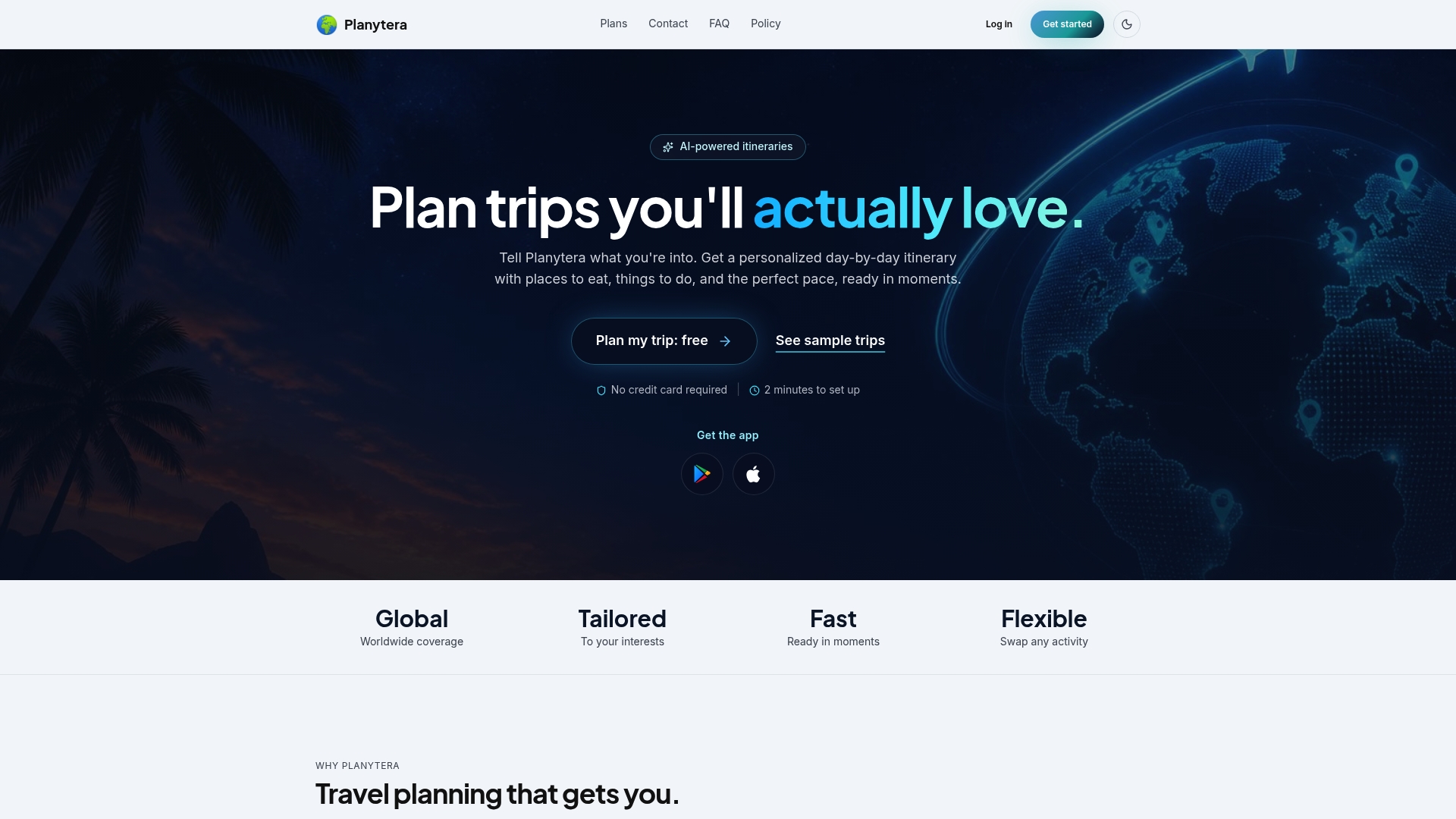
Replacing legacy planning tools with AI does not have to mean a long, expensive rebuild. Planytera gives travel agencies and planning teams an AI-first itinerary platform that is ready to use now, with the flexibility to grow as your operations do.
Here is what that looks like in practice:
- Personalized itineraries in moments, not hours, built around dietary needs, pace, budget, and accessibility requirements your clients actually have
- Group collaboration built in, so teams and travelers can co-edit a shared plan without email chains or version-control headaches
- Live advisories and offline access, so the plan stays useful from the moment it is generated through the last day of the trip
- Agency tools for bulk planning and custom branding, letting your team run multiple client itineraries efficiently without starting from scratch each time
Pro Tip: Start your Planytera pilot with a recurring trip type, like a corporate offsite or a family group itinerary. The repetitive structure makes the time savings immediately visible and gives you clean before/after data to share with leadership.
Ready to see how it works? Try Planytera and generate your first AI-powered itinerary today.
Useful sources and further reading
These are the most relevant sources for planners who want to verify the evidence or go deeper on specific topics:
- The OTA Is Dead: AI Concierges Replace Travel Agents (Gist) — The source for the 38-website-visit and 5-hour research statistic; useful for quantifying the legacy planning burden.
- AI Travel Planning 2026: How Smart Agents Are Redefining the Itinerary (Vagabond Diaries) — Covers agentic AI mechanics, the 91% adoption figure, and the 18% cost reduction finding; good technical background on how agentic systems work.
- How to Plan a Vacation with AI in 2026 (Fello AI) — April 2026 model testing with hallucination rates by model; essential for trust and accuracy planning and model selection decisions.
- How AI Travel Planning Is Changing the Way the World Moves (Tech Research Online) — Explains the citation-authority shift and why Share of Citations is replacing search rank as the key distribution metric.
- How to Use AI for Travel Planning (Awesome Agents) — Practitioner guidance on iterative prompting and treating AI output as a living document; directly applicable to workflow design.
- How AI Is Revolutionizing Travel Planning (University of South Florida) — Academic perspective on AI's structural impact on the travel industry; useful for building a business case with leadership.
- Generative AI in Travel: A Measured Look at the Tourism Industry (AltexSoft) — Technical deep-dive on generative AI applications in travel; covers integration architecture and data challenges in detail.
- The Death of Search? Building Travel Apps for the AI Assistant Era (AVIXA Xchange) — Explains the shift from search-driven to conversation-driven travel apps and what it means for product and platform teams.
- Planytera Blog: Travel Planning, Budget & Itinerary Tips — Practical implementation guides for AI-first itinerary workflows, including customization, group planning, and agency operations.
- Discover New Destinations Through Quizzes (Worldlecity) — Covers interactive discovery techniques that complement AI personalization; useful context for conversational discovery design.