
For most U.S. couples who want a personalized, stress-free honeymoon, the best starting shortlist is Planytera for fast AI-driven itineraries, Black Tomato for ultra-luxury bespoke trips, The Honeymoon Co. for honeymoon-specific booking support, Elsewhere for culturally immersive design, and Pack Up + Go for surprise getaways. Here's the quick picture:
- Planytera: AI-powered, editable day-by-day itineraries with offline access and budget estimates. Best for couples who want fast personalization and flexible, lower-cost planning.
- Black Tomato: White-glove, fully bespoke luxury design. Best for once-in-a-lifetime trips with no budget ceiling.
- The Honeymoon Co.: Honeymoon-specialist advisors who handle bookings. Best for couples who want expert curation plus booking coordination in one place.
- Elsewhere: Design-forward, culturally immersive itineraries. Best for couples who care as much about aesthetic and local culture as the destination itself.
- Pack Up + Go: Mystery trip format with minimal decisions. Best for couples who love surprises and want to hand off all the choices.
- Remarkable Honeymoons: Boutique curation with romantic add-ons. Best for couples seeking handpicked local stays and personal touches.
- Luna Moons: Romance-first planning with surprise elements. Best for couples who want every detail to feel intentional and unexpected.
Planning timeline tip: The Knot recommends starting planning well in advance, especially for peak destinations or boutique properties, to secure the best rooms and experiences. A good rule of thumb from K&S The Travel Crusaders: limit yourself to one "big" activity per day so the trip stays restorative, not exhausting. (Experts recommend maximizing downtime and limiting high-effort activities to one per day to keep the honeymoon restorative.)
Table of Contents
- How do the top honeymoon itinerary planners compare?
- Quick profiles: what each planner actually offers
- How do you choose the right honeymoon planner for your trip?
- Why the "one big activity per day" rule makes your itinerary better
- What really differs between planners: booking, cancellations, and on-trip support
- What are typical cancellation and refund policies for honeymoon planners?
- How flexible are planners when you need to make changes after booking?
- What does a honeymoon itinerary typically cost, including hidden fees?
- How long does honeymoon planning take from first call to finalized itinerary?
- Key Takeaways
- Why this shortlist makes sense for most couples
- Planytera gives you a personalized honeymoon itinerary in minutes
- Useful sources and further reading
How do the top honeymoon itinerary planners compare?
The table below covers the dimensions that actually move the needle when you're choosing a planner. "Pricing model" cells explain how each service charges, not a final price. "Support" refers to what's available once you're on the ground.
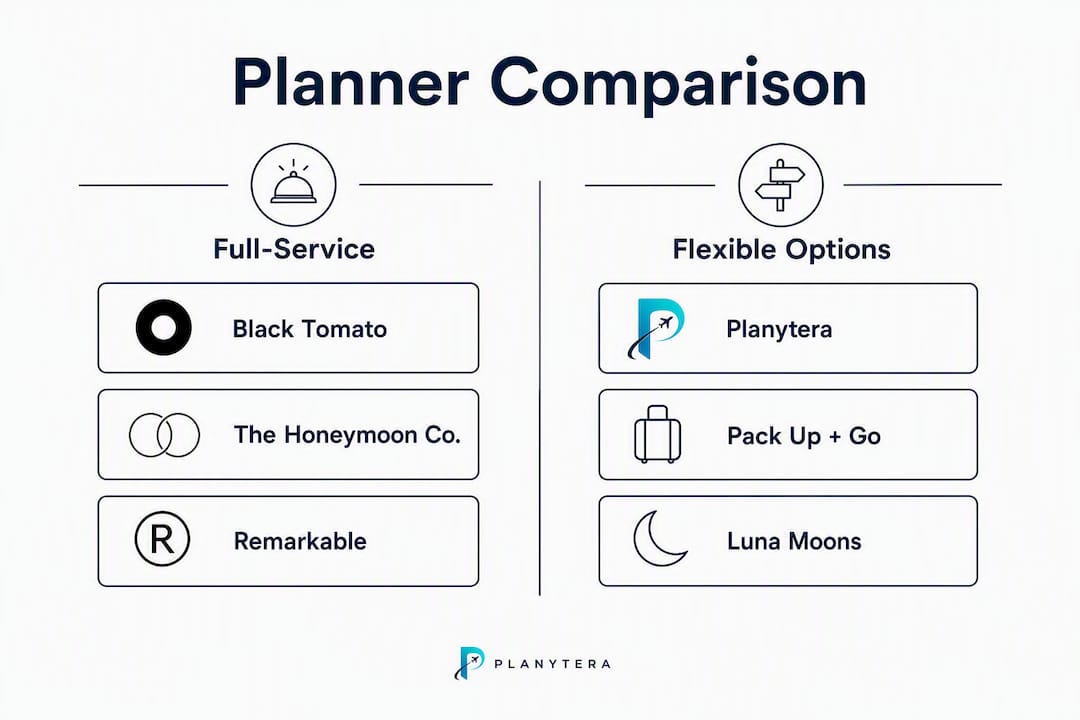
| Planner | Best For | Service Type | Customization | Pricing Model | On-Trip Support | Booking Included | Change Policy | Sample Itineraries Published |
|---|---|---|---|---|---|---|---|---|
| Planytera | Fast personalization, flexible budget | Itinerary-only / AI self-serve | High (AI + manual edits) | Subscription or per-credit | Live guidance + real-time advisories | No (DIY booking) | Edit anytime | Yes |
| Black Tomato | Ultra-luxury bespoke | Full-service + booking | Ultra-high | Bespoke quote | Dedicated specialist + local reps | Yes | Flexible, case-by-case | Yes |
| Remarkable Honeymoons | Boutique curation, romantic add-ons | Full-service + booking | High | Bespoke quote | Local partner network | Yes | Case-by-case | Yes |
| Luna Moons | Romantic surprises, detail-driven | Full-service + booking | High | Bespoke quote | Varies | Yes | Case-by-case | Limited |
| Pack Up + Go | Surprise getaways, low-decision | Surprise trip service | Low (by design) | Flat fee | Standard | Partial | Limited | No |
| The Honeymoon Co. | Honeymoon-specific expertise + booking | Full-service + booking | High | Bespoke quote | Dedicated advisor | Yes | Flexible | Yes |
| Elsewhere | Cultural immersion, design-forward | Full-service + booking | High | Bespoke quote | Local guides + reps | Yes | Case-by-case | Yes |
How to read this table: "Bespoke quote" means pricing is set after a consultation and depends on destination, trip length, and service scope. "Case-by-case" change policies mean you'll need to ask directly about fees and timelines. "Live guidance" for Planytera refers to in-app real-time travel advisories and editable itineraries you can update on the fly.
Quick profiles: what each planner actually offers

Planytera
Planytera generates personalized, editable day-by-day itineraries in minutes using AI that factors in your travel pace, dietary needs, budget, and interests. You can tweak every detail, share the plan with your partner, access it offline, and get live travel guidance throughout the trip. Pricing runs on a subscription or per-credit model, so there's no long-term commitment required.
- Pros: Instant output, fully editable, offline access, budget estimates built in, collaborative editing
- Cons: You handle your own bookings; no dedicated human advisor for complex multi-country logistics
Sample day: Morning at a local market, afternoon at one anchor activity (a cooking class or scenic hike), evening dinner reservation. Everything is editable if plans change.
Where to ask: Check Planytera's subscription plans for current tier pricing and credit options.

Black Tomato
Black Tomato designs fully bespoke itineraries for couples who want experiences most travelers can't access on their own. Think private safaris, exclusive villa buyouts, and curated local encounters. A dedicated specialist handles every booking and stays available throughout the trip.
- Pros: Unmatched access to exclusive experiences, white-glove service, strong local partner network
- Cons: Premium pricing; requires a consultation before any itinerary work begins
Sample day: Private sunrise game drive, midday at a boutique lodge with a spa treatment, sunset dinner arranged by the local team.
Remarkable Honeymoons
Remarkable Honeymoons focuses on boutique curation, pairing handpicked local stays with romantic add-ons like private dinners and flower-strewn arrivals. Their strength is the personal relationship between the planner and the couple.
- Pros: Boutique feel, strong local partnerships, romantic detail orientation
- Cons: Pricing is quote-based; ask specifically about planning fees vs. booking fees
Sample day: Late breakfast at a family-run guesthouse, one anchor activity (a private boat trip), evening with a pre-arranged in-room surprise.
Luna Moons
Luna Moons leads with romance and surprise. They build itineraries where certain details are revealed as you go, keeping the trip feeling spontaneous even though everything is pre-arranged.
- Pros: Surprise-driven design, highly personal touches, strong romantic focus
- Cons: Sample itineraries are limited publicly; ask for examples during your first call
Sample day: A mystery morning activity revealed at breakfast, afternoon free time, a surprise dinner venue disclosed at the hotel.
Pack Up + Go
Pack Up + Go is a different animal. You fill out a preferences survey, pay a flat fee, and receive your destination the week before departure. It's not a custom itinerary service in the traditional sense; it's an experiential surprise product.
- Pros: Zero planning stress, genuine novelty, flat-fee simplicity
- Cons: Low customization by design; not suited for couples with specific destination goals
Sample day: Revealed on arrival. The format works best for domestic U.S. weekend or short trips.
The Honeymoon Co.
The Honeymoon Co. specializes exclusively in honeymoons, which means their advisors understand the emotional weight of the trip and build itineraries that reflect it. They coordinate bookings and publish sample itineraries on their site, which is a useful trust signal.
- Pros: Honeymoon-specific expertise, booking coordination included, sample itineraries available
- Cons: Bespoke quote model; ask about revision rounds and what triggers additional fees
Sample day: Overwater bungalow check-in, one anchor excursion (snorkeling or a sunset cruise), private dinner on the beach.
Elsewhere
Elsewhere treats itinerary design as a creative discipline. Their trips are built around cultural immersion and visual coherence, so the stays, activities, and meals feel like they belong together. Strong choice for couples who want a trip that feels curated rather than assembled.
- Pros: Design-forward approach, deep cultural research, strong local guide network
- Cons: Premium positioning; not the right fit if your priority is relaxation over exploration
Sample day: Visit to a local artisan workshop, lunch at a chef-recommended neighborhood spot, afternoon at a design-forward boutique hotel.
Pro Tip: Ask every full-service planner for a sample itinerary from a trip similar to yours before signing anything. If they can't produce one, that's a gap worth noting.
How do you choose the right honeymoon planner for your trip?
Start with your trip style. Couples who define their priorities early (relaxation, adventure, cultural immersion, culinary focus) narrow the field fast and get more accurate quotes. Here's a practical checklist:
- Budget: Know your total trip budget before your first call. Full-service planners charge planning fees on top of trip costs.
- Booking preference: Do you want someone to handle reservations, or are you comfortable booking yourself?
- Support level: Do you need a human available if something goes wrong on the ground, or is in-app guidance enough?
- Flexibility: How likely are you to change plans mid-trip? Check change policies before committing.
- Timeline: The Knot's planning timeline recommends starting 6 months out at minimum for boutique, high-demand accommodations and popular honeymoon dates to secure the best rooms and experiences; some planners advise 9–12 months for peak destinations.
- Destination complexity: Multi-country itineraries with local logistics benefit most from a full-service agency.
Questions to ask in your first consultation:
- What is your planning fee, and is it separate from booking commissions?
- How many revision rounds are included before additional charges apply?
- What happens if a booked activity is canceled by the vendor?
- Do you have a 24/7 emergency contact for on-trip issues?
- Can you show me a sample itinerary from a similar trip?
Pro Tip: For boutique overwater suites, private villas, or high-demand safari camps, book at least six months in advance. The best rooms go first, and no planner can conjure availability that doesn't exist. For peak destinations, start booking 9–12 months in advance if possible.
Why the "one big activity per day" rule makes your itinerary better
K&S The Travel Crusaders recommend limiting yourself to one "big" activity per day on a honeymoon. A "big" activity is anything that requires a reservation, significant travel time, or sustained energy: a long excursion, a multi-course tasting dinner, a transfer between locations, or a full-day tour.
The logic is simple. Pack two or three anchor events into a single day and the trip starts to feel like a logistics sprint. One big activity leaves room for a slow morning, an unplanned walk, or just sitting somewhere beautiful without checking the time.
This connects to the anchors-vs.-blocks approach: build your itinerary around non-negotiable anchors (flights, hotel check-ins, major excursions) and let everything else fill in loosely. You get structure without rigidity.
A one-day example that applies the rule:
- Morning: Slow breakfast, no agenda
- Midday anchor: Private snorkeling tour (2–3 hours, pre-booked)
- Afternoon: Free time at the resort
- Evening: Dinner at a restaurant you've already reserved
That's it. One anchor, the rest unscheduled. Planytera's pacing guidance for couples follows this same structure, building itineraries that protect downtime rather than fill every hour.
The Aurora Wedding's planning guide adds a useful constraint: limit yourself to one base or a maximum of two locations for a two-week honeymoon. (One-base honeymoons reduce packing and transit stress; split stays are useful but should be limited to two locations for 1–2 week trips.) More than two stops means more packing, more transit, and less time to actually settle in.
Pro Tip: Add a buffer day at the end of any trip 7+ nights. Use it for a spa day, a spontaneous local meal, or just recovery before the flight home. It's the easiest upgrade you can make to any itinerary.
What really differs between planners: booking, cancellations, and on-trip support
Pricing models explained
Full-service planners typically charge in one of three ways:
- Flat planning fee: A fixed amount for the itinerary and booking work, regardless of trip cost. Transparent and predictable.
- Percentage of trip cost: Common at luxury agencies; the fee scales with the total spend. Ask what percentage and whether it applies to flights.
- Commission-based: The planner earns from hotel and vendor relationships. No upfront fee, but ask whether their recommendations are influenced by commission rates.
- Subscription or per-credit: Planytera's model. You pay for the platform, not per trip. Lower cost, no long-term contract, and you control the bookings.
Professional honeymoon planning can require 40–60 hours for a complex international trip. That's the real cost driver behind agency fees, and it's also what gives full-service planners access to boutique properties and local partners you can't reach through standard booking channels.
Red flags to watch for
- No published sample itineraries or refusal to share one on request
- Vague on-trip support ("we're available if needed" without a specific contact method)
- No written cancellation or refund policy before you sign
- Unclear whether the planning fee is refundable if you don't proceed
What happens when a vendor cancels?
Ask every planner this directly. A good answer includes: they rebook at no extra planning fee, they have backup vendor relationships, and they communicate proactively. A weak answer is "we'll do our best."
What are typical cancellation and refund policies for honeymoon planners?
Cancellation policies vary significantly across service types. Full-service agencies generally treat planning fees as non-refundable once itinerary work begins, since the labor has already been performed. Trip costs (hotels, flights, excursions) follow each vendor's individual policy, which the planner should communicate clearly before booking.
For AI-driven or subscription-based services like Planytera, the model is different. You're paying for platform access, not a service engagement, so there's no planning fee at risk. Unused credits or subscription time follow the platform's standard terms.
Key questions to ask any full-service planner before signing:
- Is the planning fee refundable if I cancel before the trip is booked?
- What portion of trip costs is refundable, and at what point does the cancellation window close?
- Do you recommend travel insurance, and do you assist with claims?
Travel insurance is worth mentioning here. For any honeymoon with non-refundable bookings, a comprehensive policy covers cancellation, medical emergencies, and trip interruption. No planner can substitute for that coverage.
How flexible are planners when you need to make changes after booking?
Change policies are one of the most underasked questions in honeymoon planning. Here's how the models typically differ:
Full-service agencies (Black Tomato, The Honeymoon Co., Elsewhere, Remarkable Honeymoons, Luna Moons): Changes after booking depend on vendor policies. Hotel date changes may carry fees; excursion swaps are often easier. Most agencies will handle the coordination, but ask whether change requests trigger additional planning fees.
Surprise trip services (Pack Up + Go): Flexibility is limited by design. The surprise format means the destination and activities are set; significant changes aren't part of the model.
AI-driven platforms (Planytera): Maximum flexibility. You can edit, reorder, or rebuild any day in your itinerary at any time, before or during the trip, with no change fees. Since you manage your own bookings, changes to reservations follow each vendor's policy directly.
The practical takeaway: if your travel style involves frequent pivots or you're not certain about your destination, a self-serve platform gives you more room to iterate. If you're committed to a specific trip and want someone else to manage the logistics, a full-service agency's change coordination is worth the fee.
What does a honeymoon itinerary typically cost, including hidden fees?
Costs split into two categories: the planning fee and the trip itself.
Planning fees:
- Full-service agencies: typically range from a few hundred dollars to several thousand, depending on complexity and the agency's positioning. Luxury specialists like Black Tomato sit at the higher end.
- Subscription/AI platforms: Planytera's tiered plans are publicly listed at planytera.com/subscription-plan, with per-credit options for one-off trips.
Trip costs: Entirely destination and style dependent. A domestic U.S. honeymoon costs much less than a two-week international trip with boutique hotels and private excursions.
Hidden fees to ask about:
- Booking commissions charged to you (not just earned from vendors)
- Fees for revision rounds beyond the included number
- Change or cancellation coordination fees
- Markup on flights or accommodations vs. retail prices
The most common surprise cost is the revision fee. Some planners include two or three rounds; additional changes cost extra. Get this in writing before you start.
How long does honeymoon planning take from first call to finalized itinerary?
The timeline depends on trip complexity and service type.
Full-service agencies: Expect 4–8 weeks from initial consultation to a finalized, booked itinerary for a standard international honeymoon. Complex multi-country trips or those requiring rare accommodations can take longer. The Knot notes that professional planning for a complex international trip can involve 40–60 hours of work.
AI-driven platforms: Planytera generates a personalized day-by-day itinerary in minutes. You can refine it over days or weeks, but the first draft is ready immediately.
Practical timeline for couples:
- 12+ months out: Ideal start for peak-season destinations, overwater villas, or safari camps
- 6–9 months out: Standard window for most international honeymoons
- 3–6 months out: Workable for domestic U.S. trips or destinations with good availability
- Under 3 months: Possible with flexible dates and an AI platform; full-service agencies may have limited availability
The earlier you start, the more options you have. That's especially true for boutique properties, where the best rooms are gone months before peak dates.
Key Takeaways
For most couples, the right honeymoon planner comes down to three factors: how much personalization you want, whether you need booking support, and how quickly you need a plan.
| Point | Details |
|---|---|
| Start with your trip style | Define relaxation, adventure, cultural, or culinary priorities first; it narrows your shortlist fast. |
| One big activity per day | Limit anchor events to one per day to keep the trip restorative, not exhausting. |
| Book boutique early | Start 6–12 months out for high-demand properties; the best rooms go first. |
| Ask about hidden fees | Confirm revision rounds, change fees, and refund policies in writing before signing. |
| Planytera for fast, flexible planning | Planytera generates editable, personalized itineraries instantly, with no planning fee and full control over your bookings. |
Why this shortlist makes sense for most couples
The criteria for this comparison were straightforward: personalization depth, pricing clarity, on-trip support, sample itinerary transparency, and planning speed. Those are the five things that actually determine whether a honeymoon planner is worth using.
Full-service agencies like Black Tomato and The Honeymoon Co. earn their place on this list because they offer something an app can't replicate: human judgment, vendor relationships, and someone to call when a flight gets canceled. For couples planning a complex, multi-country luxury trip, that's worth the premium.
But most couples don't need that level of infrastructure. They need a clear, personalized itinerary they can edit, share with their partner, and actually follow. That's where the balance tips toward a faster, more flexible approach. The boutique planners on this list (Remarkable Honeymoons, Luna Moons, Elsewhere) sit in an interesting middle ground: more personal than a platform, less expensive than the top-tier agencies, but still quote-based and time-intensive.
The honest tension in honeymoon planning is between control and convenience. High-touch agencies give you a human who cares about your trip. AI-driven platforms give you speed, editability, and a lower cost of entry. Neither is universally better. The right choice depends on how complex your trip is and how much you want to hand off.
Planytera gives you a personalized honeymoon itinerary in minutes
There are strong agencies on this list, and for a complex luxury trip, they're worth every dollar. But if you want a fully personalized, editable day-by-day honeymoon itinerary without a consultation queue, a planning fee, or a weeks-long wait, Planytera is a faster path.
Here's what you get:
- AI-personalized itineraries — built around your travel pace, interests, dietary needs, and budget
When does an agency make more sense? If your honeymoon involves rare accommodations, complex multi-country logistics, or you simply want a human managing every detail, a full-service planner is the right call. But for couples who want fast personalization, iterative edits, and a lower cost, Planytera handles the heavy lifting. Check subscription plans and credit options and generate your first itinerary draft today.
Useful sources and further reading
- Plan a Honeymoon Itinerary That Feels Effortless (K&S The Travel Crusaders) — source for the one-big-activity pacing rule and anchors-vs.-blocks planning approach
- A Honeymoon Planning Timeline (The Knot) — planning timeline guidance and lead-time recommendations for boutique properties
- Honeymoon Planner: Find Your Perfect Romantic Destination (Packzup) — overview of planner service types from DIY tools to full-service agencies
- Where to Go on Honeymoon: A Guide to Help You Choose (Do Not Disturb) — trip-style matching guidance for narrowing down planner choices
- Honeymoon Itinerary Planning Guide (The Aurora Wedding) — practical guidance on limiting destinations and structuring split stays
- Couples Travel Pace Preferences: Real Examples and Tips (Planytera Blog) — real couple examples applying the one-big-activity rule and block-based itinerary mapping