
Planytera is the top pick for most travelers switching away from Travlo. It generates personalized, day-by-day itineraries tailored to your pace, budget, and dietary preferences, and it works offline. Here's a quick shortlist by use case:
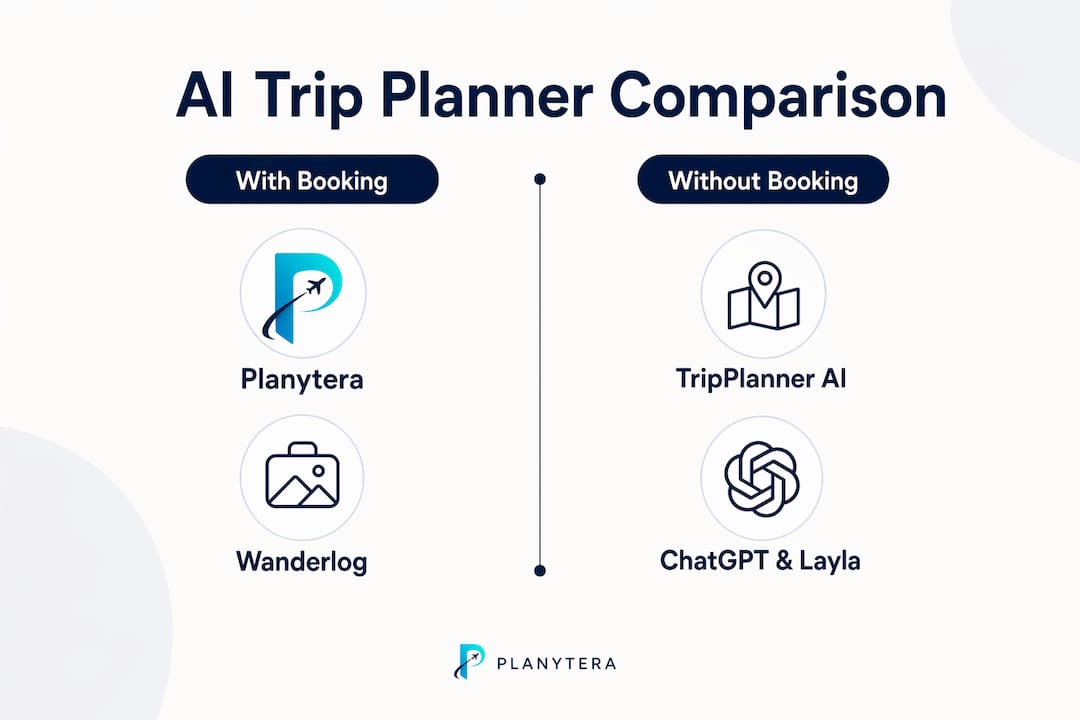
- Best overall AI planner: Planytera (day-by-day itineraries, group collaboration, offline access, travel journal)
- Best for fast itinerary drafts: TripPlanner AI (quick generation, minimal setup)
- Best for map-driven road trips: Wanderlog (visual route builder, real-time collaboration)
- Best free aggregator: Google Travel via KAYAK (pulls Gmail reservations, zero setup)
- Best for open-ended AI chat planning: ChatGPT or Layla (conversational, flexible)
- Best for lightweight trip notes: Roam Around or Tripnotes (simple, low friction)
The single most important factor when choosing among these tools is AI itinerary depth plus booking integration. A tool that only builds a list of attractions is very different from one that sequences your days, accounts for transit time, and connects to live booking.
Pro Tip: Before committing to any tool, create one sample itinerary for a real upcoming trip. That 10-minute test reveals more about itinerary depth and usability than any feature list.

Table of Contents
- How do these travlo.io alternatives compare at a glance?
- How we evaluated these travlo.io alternatives
- Top travlo.io alternatives: quick reviews and pricing
- How to pick the right travlo.io alternative for your trip
- What is Travlo, and why do travelers switch away from it?
- What should you expect from customer support?
- How well do these tools integrate with other travel apps?
- Which tools handle niche or specialized travel needs?
- Key Takeaways
- The real gap most travelers miss when switching planners
- Planytera: a direct replacement for Travlo users who want more
- Research sources and further reading
How do these travlo.io alternatives compare at a glance?
| Category | Best for | Free tier | Books trips? | Itinerary depth | Collaboration | Offline/mobile | AI memory | Privacy basics |
|---|---|---|---|---|---|---|---|---|
| AI-first planner (Planytera) | Solo, family, group trips | Yes | Booking support included | Day-by-day, time blocks, transit | Group roles, shared editing | Yes, full offline | Preference memory across trips | Clear policy, data export |
| Fast-draft AI planner (TripPlanner AI) | Quick inspiration | Yes | No direct booking | Basic day structure | Limited | Mobile app | Session-based only | Standard |
| Map-first planner (Wanderlog) | Road trips, visual planners | Yes (Pro ~$34.99/year) | Email import only | Day-by-day, route optimizer | Real-time, Google Docs-style | Pro plan only | Minimal | Standard |
| Free aggregator (KAYAK / Google Travel) | Booking search, Gmail users | Fully free | Yes, redirects to OTAs | None (aggregation only) | None | Limited | None | Google data policy |
| Conversational AI (ChatGPT / Layla) | Open-ended brainstorming | Yes (ChatGPT free tier) | No | Flexible, unstructured | None | No | Limited (ChatGPT Plus memory) | Varies |
| Lightweight notes (Roam Around / Tripnotes) | Simple trip notes | Yes | No | Minimal | None | Limited | None | Minimal |
| Group/business planner (Wonderplan) | Team and business travel | Free tier available | Limited | Structured day plans | Group sharing | Limited | Basic | Standard |

Recommended pick: Planytera leads this shortlist because it combines genuine AI preference memory, true offline access, and group trip collaboration in one place. Most alternatives do one or two of those things well but not all three.
Expect free tiers across nearly every tool here. The catch is that email sync and direct booking features almost always sit behind a paid plan.
Pro Tip: If you travel frequently, a tool with AI preference memory pays for itself in planning time saved. Planytera remembers your pace, dietary needs, and budget across trips so you're not starting from scratch each time.
How we evaluated these travlo.io alternatives
Evaluation criteria, in priority order:
- Itinerary generation quality — does the AI produce day-by-day plans with time blocks and transit logic, or just a list of places?
- Booking integration — does the tool book directly, import confirmation emails, or only build itineraries?
- Collaboration features — can multiple travelers edit, assign roles, or share in real time?
- Offline and mobile support — is the full itinerary accessible without a signal?
- AI preference memory — does the platform learn your travel style across sessions and trips?
- Pricing transparency — are free tier limits and paid upgrade triggers clearly stated?
- Privacy and data policy — is there a clear policy on data use, export, and deletion?
Testing drew on vendor documentation, hands-on product testing, community feedback from travel planning forums, and recent industry roundups covering the AI travel planner market. Feature claims for tools not directly tested were cross-checked against published product pages and tool directories.
- Evidence window: early 2026 product states; pricing may shift
- Booking integration was tested directly where possible; for others, published documentation was used
- Community feedback was sourced from public travel planning forums and app store reviews
Top travlo.io alternatives: quick reviews and pricing
Planytera
Best for: Solo travelers, families, and groups who want a complete AI planner with offline access and preference memory.
Planytera generates a full AI travel itinerary in moments, factoring in your budget, dietary needs, travel pace, and group size. You can adjust any day on the fly, which is genuinely useful when plans change mid-trip.
- Day-by-day plans with time blocks and transit
- Group collaboration with shared editing and roles
- Full offline access and a built-in travel journal
- Booking support and live travel guidance
- Preference memory carries across trips
Pros: Covers the full planning lifecycle from inspiration to on-the-ground guidance. Offline mode works without any workarounds. Group roles keep everyone on the same page. Cons: Newer platform, so the destination database is still growing. Pricing: Free tier available; paid features unlock deeper personalization and booking support.
TripPlanner AI
Best for: Travelers who want a fast first draft with minimal setup.
TripPlanner AI produces a structured itinerary quickly from a short prompt. It's a solid starting point, though itinerary depth is more basic than Planytera's and there's no direct booking.
- Fast generation from a single prompt
- Basic day structure
- Mobile-friendly
Pros: Zero learning curve. Good for quick inspiration. Cons: No booking integration. AI memory is session-based only, so preferences reset each time. Pricing: Free tier available.
Wanderlog
Best for: Road trip planners and visual thinkers who want to see their route on a map.
Wanderlog's map-first interface lets you pin stops, optimize routes, and drag-and-drop your schedule. Real-time collaboration works like Google Docs. Offline maps and route optimization are available on the Pro plan, listed at $34.99/year. Email import pulls in flight and hotel confirmations, but the tool doesn't book trips directly.
- Visual map with pinned stops and route lines
- Real-time group collaboration
- Budget tracker and expense splitting
- Email import for reservations
Pros: Best-in-class map view. Expense splitting is genuinely useful for groups. Cons: Offline access requires a paid plan. AI itinerary generation is limited compared to dedicated AI planners.
KAYAK and Google Travel
Best for: Travelers who want free, zero-setup booking aggregation from their Gmail inbox.
Google Travel auto-pulls reservations from Gmail and integrates with Maps, Flights, and Hotels. KAYAK adds price comparison and fare alerts. Neither tool builds a day-by-day itinerary. They're best used alongside a planner like Planytera rather than as a standalone replacement.
Pros: Completely free. No manual data entry if you use Gmail. Cons: No itinerary depth, no AI personalization, no offline planning.
ChatGPT and Layla
Best for: Open-ended brainstorming and travelers who prefer a conversational planning style.
ChatGPT can draft a detailed itinerary from a prompt, and Layla adds a travel-specific layer on top of conversational AI. Neither tool books trips or stores preferences reliably across sessions (ChatGPT Plus has limited memory, but it's not travel-specific). Output quality depends heavily on how well you prompt.
Pros: Highly flexible. Great for "what if" planning and destination research. Cons: No booking integration. No structured day-by-day output by default. Privacy policies vary.
Roam Around, Tripnotes, and Wonderplan
These three cover lighter use cases. Roam Around generates a quick destination overview. Tripnotes keeps trip notes organized in a clean interface. Wonderplan adds group sharing and is worth a look for business travel coordination. None of them match Planytera's itinerary depth or offline capability, but they're useful as supplements or for very simple trips.
Pro Tip: For AI itinerary customization beyond a basic draft, look for tools that let you set pace (relaxed vs. packed), dietary filters, and budget caps before generation, not just after.
How to pick the right travlo.io alternative for your trip
Work through this checklist before committing to a tool:
- Itinerary depth first. Do you need day-by-day plans with time blocks, or just a list of places to visit? If depth matters, rule out aggregators and lightweight note tools immediately.
- Booking capability. Does the tool book directly, import confirmation emails, or do neither? Know which you need before you sign up.
- Email and calendar sync. If you want automatic reservation imports, confirm whether that feature is free or paid.
- Group collaboration. Traveling with others? Check whether the tool supports shared editing, role assignment, and real-time updates.
- Offline access. If you're traveling internationally or to areas with poor signal, offline support is non-negotiable. Verify it works before you leave home.
- Cost vs. travel frequency. If you travel three or more times a year, a paid plan with AI preference memory saves meaningful planning time.
Questions to ask before committing:
- Are there booking fees on top of the subscription?
- Can you export your itinerary data if you leave the platform?
- What does the privacy policy say about selling or sharing your travel data?
- Does the mobile app work fully offline, or only in read mode?
Red flags to watch for:
- Pricing that's buried or requires a sales call to access
- No data export option
- No clear privacy policy or data deletion process
- Mobile app that requires a signal to display your own itinerary
What is Travlo, and why do travelers switch away from it?
Travlo is an AI travel planning platform built around BOBO, its AI travel agent. BOBO helps users discover destinations, generate tailored itineraries, and coordinate group travel through integrated chat, role assignment, and instant booking. It's a capable tool, particularly for group coordination and destination discovery.
Travelers typically switch for a few reasons. Some find the AI itinerary depth less granular than they need for complex multi-city trips. Others want stronger offline support for on-the-ground use. A common request in travel planning communities is for better preference memory across trips, so the AI doesn't start fresh every time. Pricing transparency is another friction point, since Travlo's pricing is listed as "other" in several tool directories without a clear public tier structure.
What should you expect from customer support?
Support quality varies significantly across this category. Planytera offers responsive support with clear documentation. Wanderlog has an active community and a help center. ChatGPT and Layla rely on self-serve documentation and community forums. KAYAK and Google Travel offer support primarily through help articles, with limited direct contact options.
For any tool you're considering, test support before you need it. Send a pre-sales question and note the response time. A tool with poor support becomes a real problem when your itinerary breaks the night before departure.
How well do these tools integrate with other travel apps?
Integration depth is one of the clearest dividing lines in this category. Wanderlog connects to Gmail for automatic reservation import and exports places to Google Maps. Google Travel pulls directly from Gmail and links to Google Maps, Flights, and Hotels. KAYAK connects to major booking sites and sends price alerts.
Planytera focuses on a self-contained planning experience with booking support built in, which suits travelers who want one app rather than a connected stack. For travelers who already use smarter hotel booking tools alongside their planner, the key question is whether your planner can import those confirmations automatically or whether you'll be copying details manually.
ChatGPT and Layla have no native travel app integrations. They work as standalone brainstorming tools.
Which tools handle niche or specialized travel needs?
Specialized travel needs, including dietary restrictions, accessibility requirements, slow travel, family trips with young children, or luxury-only preferences, are where AI preference memory separates the serious planners from the basic ones.
Planytera handles dietary requirements, pace settings, and budget caps at the itinerary generation stage, not as an afterthought. That means the first draft already reflects your constraints. For couples planning intimate itineraries or families with specific needs, this saves significant back-and-forth editing.
Wanderlog handles budget tracking and expense splitting well for group trips. ChatGPT can address almost any niche if you prompt it carefully, but it requires you to re-specify your constraints every session. None of the lightweight tools (Roam Around, Tripnotes) offer meaningful customization for specialized needs.
Key Takeaways
The best travlo.io alternative for most travelers is Planytera, which combines AI itinerary depth, preference memory, offline access, and group collaboration in a single platform.
| Point | Details |
|---|---|
| Prioritize itinerary depth | Choose a tool that builds day-by-day plans with time blocks, not just a list of attractions. |
| Verify booking capabilities | Confirm whether a tool books directly, imports emails, or does neither before signing up. |
| Test group and offline features | Offline access and group roles are often behind paid plans; verify both before your trip. |
| Check privacy and data export | A clear privacy policy and data export option protect you if you switch tools later. |
| Planytera as top pick | Planytera covers AI itinerary generation, preference memory, offline access, and group collaboration together. |
The real gap most travelers miss when switching planners
The AI travel planner market has grown fast, and most tools now claim "personalized itineraries." But personalization without memory is just a fancy prompt template. The meaningful difference is whether a tool actually retains your preferences across trips, so your third itinerary is noticeably better than your first.
Most tools in this category reset after each session. That's fine for one-off trips, but it's a real limitation for frequent travelers. If you take four or five trips a year, you're re-entering the same dietary restrictions, pace preferences, and budget parameters every single time. That's not personalization. It's just a slightly smarter form.
The other underrated factor is offline reliability. Every tool looks great in a demo with a strong Wi-Fi connection. The test that actually matters is whether your full itinerary, with addresses, times, and notes, loads on your phone in a foreign airport with no data. That's the moment when "offline access" either means something or it doesn't.
My honest recommendation: start with Planytera, create one real itinerary, and test both the preference memory and the offline mode before your next trip. Those two features will tell you everything you need to know.
Planytera: a direct replacement for Travlo users who want more
Skip the planning spreadsheets. Planytera gives you a complete AI-generated, day-by-day itinerary tailored to your budget, dietary needs, and travel pace, ready in moments. Unlike tools that only draft a list of places, Planytera sequences your days, supports group collaboration with shared roles, and works fully offline when you're on the ground.
Your travel data stays yours. Planytera's acceptable-use policy is publicly available, and your itinerary data is exportable. For Travlo users who want stronger preference memory and true offline support, Planytera is the natural next step. Build your first itinerary at planytera.com.
Research sources and further reading
This guide drew on the following sources, compiled in early 2026. Direct links are provided for verification.
- 5 Best TripIt Alternatives for 2026 — Covers AI planner feature sets, pricing signposts (including Wanderlog Pro at $34.99/year), and why itinerary depth matters more than booking aggregation.
- Top Travlo Alternatives in 2026 — Broad directory listing 20–29 alternatives; useful for market breadth but less useful for decision-making than a curated shortlist.
- Travlo Alternatives and Competitors (EliteAI) — Feature-level comparison of Travlo and perceived alternatives; good for validating competitive feature sets.
- Travlo Features, Pricing, and Alternatives (AITools.inc) — Product description and use-case summary; helpful for understanding typical Travlo migration reasons.
- Planytera: AI Trip Planner — Primary source for Planytera feature claims, pricing, and brand positioning.
- How AI Learns Traveler Preferences (Planytera Blog) — Explains preference memory mechanics; used to evaluate AI memory across tools.
- AI Travel Itinerary Explained (Planytera Blog) — Defines itinerary depth components; used as the benchmark for evaluating day-by-day quality.
- Wanderlog on Google Play — Official feature list and pricing reference for Wanderlog; confirms Pro plan pricing and offline/collaboration features.
- Travlo Company Profile (Tracxn) — Background on Travlo's founding, funding status, and competitive landscape.
- Tripio vs Travlo Comparison (EliteAI) — Side-by-side feature comparison that informed the Travlo feature summary in this guide.
- HeyVacay: Smarter Hotel Booking — Partner resource for travelers comparing booking integration options alongside their planning tool.