
A flexible itinerary is a travel plan built around a few non-negotiable anchor points, with the rest of your schedule left open as movable blocks or optional extras. TL;DR: lock your flights, first and last nights, and any timed events, then leave everything else fluid. That single habit protects your trip without boxing you in.
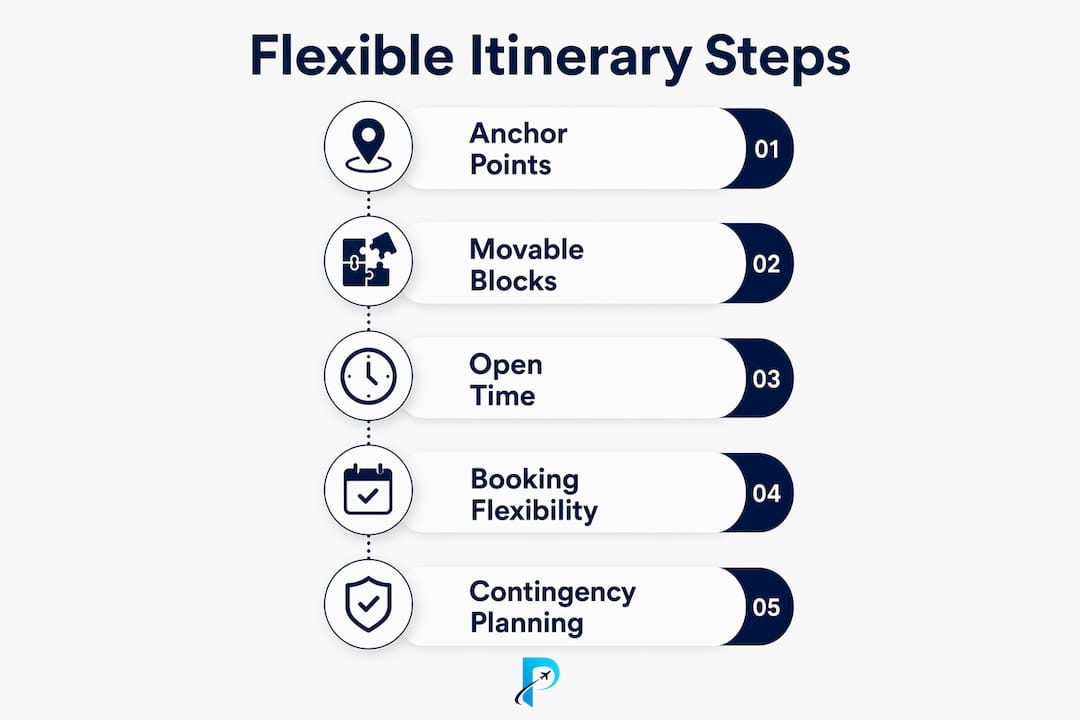
The three layers you'll hear about throughout this guide are anchor points (fixed commitments), movable blocks (planned but shiftable activities), and optional extras (a wish list with no commitment). Master those three, and itinerary flexibility becomes a skill, not an accident.

Table of Contents
- What does a flexible itinerary really mean?
- The three-layer modular model: how it actually works
- What should you actually lock in early?
- How to leave space: pacing, buffers, and avoiding over-moving
- How to keep your bookings flexible in practice
- What to do when plans change: a contingency checklist
- Ready-to-use templates: a flexible day and a 3-day trip
- Benefits and tradeoffs: is a flexible itinerary right for your trip?
- How AI tools like Planytera make flexible plans easier to manage
- Key Takeaways
- The part most travelers get backwards
- Planytera keeps your flexible plan organized from start to finish
- Useful sources and further reading
What does a flexible itinerary really mean?
A flexible itinerary is not a blank calendar. It's a structured travel plan with deliberate gaps built in, where the structure protects your essentials and the gaps protect your sanity. Think of it as an open map with a handful of pins: the pins are your anchors, and everything between them is yours to fill as the trip unfolds.
Common myths worth clearing up:
- "Flexible means winging it." Not true. Flexible itineraries require more upfront thinking than rigid ones, not less. You decide in advance what can move and what cannot.
- "Flexible bookings always cost more." Sometimes, yes. But refundable hotel rates and flex fares are often only marginally higher, and the cost of a missed connection on a rigid plan can dwarf that difference.
- "You'll miss out on popular experiences." Only if you leave anchors unbooked. Timed-entry museums, popular tours, and sold-out restaurants still need advance reservations. Flexibility lives in the spaces around those anchors.
Pro Tip: Place your flexibility intentionally. The best spot for open time is right after arrival and right before a major commitment, not scattered randomly through the week.
Tools like Google Flights flexible-date mode, KAYAK's date-range search, and Planytera's AI-powered itinerary builder all exist specifically to help you design that kind of deliberate flexibility from the start.

The three-layer modular model: how it actually works
The modular planning model gives you a simple decision rule for every item on your list: is this an anchor, a movable block, or an optional extra?
| Layer | Purpose | Example items | Commitment level | Backup option |
|---|---|---|---|---|
| Anchor points | Non-negotiable fixed commitments | Flights, first/last hotel nights, timed-entry tickets | Fully booked, non-refundable acceptable | None needed — these are the fixed pins |
| Movable blocks | Planned activities with flexibility to shift | Day trips, restaurant reservations, museum visits | Booked but refundable or reschedulable | Swap with another movable block |
| Optional extras | Wish-list items with no commitment | Scenic drives, local markets, spontaneous tours | Not booked | Skip without impact |
Picture a three-day city trip. Day 1 anchor: airport arrival and hotel check-in. Movable block: a food tour booked for Day 2 afternoon, but cancellable 24 hours out. Optional extra: a rooftop bar someone recommended. If Day 2 brings rain, you reschedule the food tour and hit an indoor gallery instead. Nothing collapses.
Decision rules to apply as you plan:
- If missing it would ruin the trip, it's an anchor. Book it now.
- If it would be great but isn't essential, make it a movable block with a refundable rate.
- If you'd only do it if the mood strikes, keep it on the optional list and don't book it at all.
What should you actually lock in early?
Some bookings genuinely need to happen well in advance. Leaving these open in the name of flexibility is where trips actually fall apart.
Book these as anchors:
- Outbound and return flights — prices rise sharply as departure approaches, and availability on popular routes disappears.
- First and last nights' accommodation — you need somewhere to land after a long travel day and somewhere confirmed before your flight home.
- Timed-entry tickets — popular attractions like national parks with timed permits, major museums, and guided tours sell out weeks or months ahead.
- Airport transfers tied to fixed times — a missed transfer on arrival day cascades into everything else.
Practical booking guidance consistently recommends anchoring arrival and event nights first, then using refundable options for the middle segment of any trip, where you're most likely to want to adjust.
Rough timing guidance:
- Flights: 6–12 weeks out for domestic, 3–6 months for international.
- Popular timed-entry tickets: as soon as they open, often 60–90 days ahead.
- First and last hotel nights: book early with a refundable rate if possible.
- Middle-trip accommodation: hold off and book 1–2 weeks out when you know your pace.
Advance booking discounts are real, but they come with rigidity. The practical balance: pay for certainty on anchors, pay a small premium for refundability on movable blocks.
How to leave space: pacing, buffers, and avoiding over-moving
Flexibility on paper disappears fast when your daily schedule is packed. The most effective pacing rule is simple: one major anchor activity per day, maximum. That leaves a half-day open for whatever the trip brings.
A few concrete habits that protect your flexibility:
- Limit hotel changes. Every move creates hidden rigidities: checkout times, luggage logistics, transit windows. Fewer moves means more freedom within each base. Staying in one neighborhood for two or three nights preserves far more optionality than moving daily.
- Place buffers strategically. Open blocks land best right after arrival days and right before major commitments. A buffer on arrival day absorbs jet lag, delayed bags, and the time it takes to simply orient yourself. A buffer before a big event means a delay elsewhere won't make you late for the thing that matters.
- Avoid back-to-back long transfers. Two consecutive travel-heavy days drain energy and leave no room to absorb anything unexpected.
The hidden cost of over-moving is time. Every hotel change eats two to four hours of your day in packing, transit, and settling in. That's time you could spend actually being somewhere.
Pro Tip: When planning a multi-city route, cluster geographically. Two nights in each of three nearby cities beats one night in six spread-out ones. You keep the variety without the logistical drag. For pace-sensitive itinerary design, this clustering approach is one of the highest-leverage moves you can make.
How to keep your bookings flexible in practice
Good intentions about flexibility only hold if your actual bookings support them. Here's how to build that into your search and purchase process.
Step-by-step booking tactics:
- Search with flexible dates first. KAYAK's flexible-date feature searches a window around your target dates to surface cheaper or more convenient options. Google Flights' Date grid and Price graph let you compare fares across nearby dates at a glance.
- Set a price alert before you buy. Both Google Flights and KAYAK let you track a route. Watch for a few days before committing, especially for non-urgent travel.
- Choose refundable or low-penalty rates for movable blocks. Hotels often offer a refundable rate for a modest premium. For the middle segment of your trip, that premium is usually worth it.
- Read the change and cancellation terms before you click. Policies vary widely. A "flexible" hotel rate might require 48-hour notice; an airline's flex fare might waive change fees but still charge fare differences.
- Buy flex fares for high-risk legs. Flexible fare products let you change travel dates without transaction fees, though fare differences may still apply and can sometimes exceed the original ticket cost for certain low-cost fare classes.
On the cost tradeoff: flexible fares and refundable rates cost more upfront. They're worth it when the leg is disruption-prone (weather-sensitive routes, tight connections) or when your plans in that segment are genuinely uncertain. For a confirmed anchor booking you'd never change, a standard non-refundable rate is fine.
One practical note: "flexible" means different things to different airlines and hotel chains. Always check whether "free cancellation" applies to the full amount or only to taxes and fees. The role of flexible cancellation policies in protecting your trip is significant, but only if you've actually read the terms before booking.
What to do when plans change: a contingency checklist
Even a well-built flexible itinerary hits disruptions. The goal isn't to prevent them. It's to absorb them without losing the whole trip.
Step-by-step when something goes wrong:
- Check transport status first. Is the disruption temporary (a two-hour delay) or structural (a cancelled flight, a closed route)? That determines whether you wait or act.
- Assess accommodation flexibility. Can you extend your current stay by a night? Can you push your next check-in? Call ahead rather than assuming.
- Identify your backup activities. A modular itinerary makes this easy: pull from your optional extras list or swap a movable block to a different day.
- Communicate with travel companions early. The longer you wait to flag a change, the more stress it creates for everyone. A quick message with two or three options beats a last-minute group scramble.
- Decide: reschedule, cancel, or absorb? If the disruption costs less than the experience is worth, absorb it and move on. If rescheduling is possible without cascading effects, do that. Cancel only when the cost or logistics make the original plan unworkable.
Quick scenario responses:
- Delayed flight: Use the buffer you built on arrival day. If the delay is significant, call your first hotel to push check-in and check whether your Day 1 movable block can shift to Day 2.
- Bad weather: Swap outdoor movable blocks for indoor optional extras. This is exactly why you kept that gallery or cooking class on your list.
- Unexpected local event (festival, closure): Treat it as a gift. Drop a movable block and attend. Your optional extras list stays intact for another day.
Ready-to-use templates: a flexible day and a 3-day trip
Sample flexible day
| Time block | Layer | Example |
|---|---|---|
| Morning (fixed) | Anchor | Timed museum entry |
| Late morning | Movable block | Nearby neighborhood walk or café |
| Afternoon (open) | Buffer / optional | Rest, spontaneous market, or extend morning |
| Evening | Movable block | Restaurant reservation (refundable until 4 PM) |
3-day flexible trip template
| Day | Anchor (fixed) | Movable block | Optional extras |
|---|---|---|---|
| Day 1 | Arrival + hotel check-in | Light neighborhood dinner | Evening stroll, local bar |
| Day 2 | Timed-entry attraction (AM) | Afternoon food tour (refundable) | Rooftop, local market |
| Day 3 | Checkout + departure flight | Morning café + transit to airport | Souvenir shop if time allows |
Printable checklist for your own trip:
- Flights booked (outbound + return)
- First and last nights confirmed
- Timed-entry tickets secured for must-do anchors
- Refundable rates selected for mid-trip hotels
- One movable block per day identified with cancellation terms noted
- Optional extras list written (no bookings needed)
- Buffer blocks placed after arrival and before major commitments
- Companions briefed on the plan and the flexibility rules
For day-by-day travel planning that prevents burnout, this template structure works equally well for slow travel (stretch each day into two) and packed city trips (add a second movable block per day, keep the buffer).
Benefits and tradeoffs: is a flexible itinerary right for your trip?
Benefits:
- Trip resilience. One disruption doesn't cascade. A delayed flight or a rainy afternoon hits a buffer, not your whole schedule.
- Better experiences. High-value travel memories often come from unstructured time. Limiting daily anchors preserves energy and increases the chance of unexpected discoveries.
- Lower stress. Knowing you have room to adapt removes the anxiety of running behind.
- Local responsiveness. You can follow a recommendation from a local, extend a stay in a place that surprises you, or skip something that doesn't fit your mood.
Tradeoffs:
- Flexible fares and refundable rates cost more upfront.
- Popular experiences (sold-out tours, timed-entry sites) require advance booking regardless of your overall flexibility approach.
- Group coordination gets harder when plans are fluid. More communication is needed.
- Longer decision windows can create choice fatigue on the road.
When to prefer a rigid plan: tight schedules with back-to-back commitments, once-in-a-lifetime events with no rescheduling option, or short trips where every day counts and spontaneity isn't the goal.
When flexibility wins: longer trips, exploratory travel, destinations where weather or local conditions are unpredictable, and any trip where the journey matters as much as the destination. Budget considerations also play a role: a tighter budget often benefits from flexibility, since you can shift to cheaper options as they appear.
How AI tools like Planytera make flexible plans easier to manage
Keeping a flexible itinerary organized used to mean juggling spreadsheets, email confirmations, and a running notes app. Modern AI planning tools change that significantly.
What a tool like Planytera does for flexible travel:
- Tags each item in your itinerary as an anchor, movable block, or optional extra so you always know what can shift.
- Supports live itinerary edits, so when a plan changes mid-trip, you update once and the whole day reorganizes.
- Enables collaborative planning for groups and families, so everyone sees the same version of the plan in real time.
- Generates alternative suggestions when a block needs to move, pulling from your preferences and pace settings.
Two quick use-case examples:
- Your afternoon food tour cancels due to rain. Planytera surfaces three indoor alternatives nearby that match your dietary preferences and budget, ready to book in moments.
- Your travel companion wants a slower Day 2. You open the shared itinerary, drag the morning anchor to Day 3, and the movable blocks auto-adjust around it.
Pro Tip: Use an AI planner to build your optional extras list before you leave home. A pre-loaded wish list of 8–10 ideas means you're never starting from scratch when a block opens up mid-trip.
For travelers who want to blend two travel styles into one trip, AI-assisted planning is especially useful: the tool can hold both paces simultaneously and surface options that work for both.
Disclosure: Planytera is the publisher of this guide. The platform features described above reflect its current product capabilities.
Key Takeaways
A flexible itinerary works because it separates what must be fixed from what can move, giving you structure without rigidity.
| Point | Details |
|---|---|
| Lock anchors early | Book flights, first/last nights, and timed-entry tickets well in advance — these are non-negotiable. |
| Use the three-layer model | Organize every plan item as an anchor, movable block, or optional extra for clear decision-making. |
| Place buffers intentionally | Put open time right after arrival and before major commitments to absorb disruptions without stress. |
| Know the cost tradeoff | Flexible fares and refundable rates cost more upfront but protect you when disruption-prone legs change. |
| Planytera simplifies the process | Planytera's AI planner tags layers, enables live edits, and surfaces alternatives when plans shift mid-trip. |
The part most travelers get backwards
There's a version of flexible travel planning that sounds appealing but doesn't actually work: deciding to "just see how it goes" and booking nothing in advance. That approach feels free until you're standing in line for a sold-out attraction, paying three times the rate for a last-minute hotel, or scrambling for a flight because you waited too long.
Real itinerary flexibility is a design choice, not an absence of planning. The travelers who get the most out of it are the ones who spent time upfront deciding exactly which parts of their trip are sacred and which parts are negotiable. That clarity is what makes the open time feel genuinely free rather than just unresolved.
The other thing worth saying: flexibility is harder in groups. When you're traveling solo, a changed plan is just a changed plan. With two or more people, it's a negotiation. The fix isn't to abandon flexibility. It's to agree on the anchor points together before you leave, so that when something shifts, everyone already knows what's fixed and what isn't. That conversation, had at home over a shared itinerary, saves a lot of friction on the road.
Planytera keeps your flexible plan organized from start to finish
Flexible itineraries are easy to sketch and surprisingly hard to maintain once you're actually traveling. Planytera was built for exactly that gap.
With Planytera's AI trip planner, you can tag each item as an anchor, movable block, or optional extra, then adjust the whole plan live when something changes. It handles the heavy lifting: generating day-by-day plans around your pace, budget, and dietary needs, then reorganizing when you need to shift a block. Solo travelers, families, and groups all use it to stay on the same page without the back-and-forth.
- Personalized itineraries ready in moments, built around your preferences
- Live edits that update the whole plan, not just one line
- Collaborative access so every travel companion sees the same version
- Offline access and a built-in journal to document what actually happened
Check out Planytera's subscription plans and start building a trip that's structured where it needs to be and open everywhere else.
Useful sources and further reading
These are the sources used in this guide. Each one is worth bookmarking if you want to go deeper on a specific aspect of flexible travel planning.
- How to Build a Flexible Itinerary (and Actually Enjoy It) — The clearest explanation of planned slack and buffer placement available online. Start here if you want to understand the mindset behind flexibility.
- Flexible Itineraries: How to Plan Without Fixed Commitments — Strong on trip resilience and the emotional case for modular planning.
- How to create a flexible travel itinerary that works — Practical daily pacing advice, including the one-anchor-per-day rule.
- Flexible Itinerary Planning for Travel Uncertainty — Good overview of the modular anchor-plus-movable-blocks model.
- How to Build a Flexible Travel Plan for Stress-Free Adventures — Tactical checklist-style guidance on anchor nights and refundable bookings.
- What Is a Flexible Ticket? A Business Traveler's Guide — Honest breakdown of flex fares, including when fare differences can exceed the original ticket cost.
- KAYAK Flexible Date Search — Explains how the +/- 3-day window search works and when to use it.
- Google Flights — Use the Date grid and Price graph to compare fares across nearby dates before committing.
- The Role of Flexible Cancellation in Travel — Useful primer on how cancellation policies work and what "flexible" actually means in booking terms.
Always check the current cancellation and change terms directly with your airline or hotel before booking. Policies change, and the terms at the time of purchase are the ones that apply to your reservation.