Here is the short version: organize your friends trip step by step with this 9-step plan, use Planytera to generate and share your itinerary, check the U.S. Department of State travel advisories for international destinations, and enroll in STEP. For health prep, consult the CDC Yellow Book. The 9 steps:
- Confirm the group
- Set a shared budget
- Lock in dates
- Assign roles
- Draft a day-by-day itinerary framework
- Book transport
- Book lodging
- Reserve activities and meals
- Confirm documents and share the final plan
Key Takeaways
Organizing a friends trip step by step works best when you separate decisions from bookings, assign four clear roles, and use a shared itinerary tool from day one.
| Point | Details |
|---|---|
| Book early with flexibility | Flights 3+ months out; hotels 3+ months for large groups; use refundable holds until headcount is firm. |
| Assign four roles upfront | Leader, finance lead, booker, and comms lead cover every planning task without overlap. |
| Draft the framework first | Build a day-by-day itinerary skeleton before any booking to catch gaps early. |
| Safety prep is not last-minute | Check U.S. Department of State advisories, enroll in STEP, and build a CDC-guided health kit at the planning stage. |
| Planytera handles the heavy lifting | Generate a collaborative, editable itinerary with cost estimates and live advisories in minutes. |
Table of Contents
- Your printable friends travel checklist and booking timeline
- How to organize a friends trip step by step: the full workflow
- Which tools help you coordinate the planning smoothly?
- What safety and health steps should your group take before traveling?
- How do you keep the group functional and handle disagreements?
- What to confirm before you leave and how to run the trip daily
- What planners most often miss
- Planytera makes group trip planning faster and less stressful
- Sources
Your printable friends travel checklist and booking timeline
Print this, paste it into your group chat, and check off each item as you go. Booking windows matter more than most groups realize, so the timeline shorthand is built right in.
Flights
- Book 3+ months out for peak season or holiday weekends; 6–8 weeks out for shoulder season
- Check group fares or split-ticket options; set fare alerts on Google Flights
Hotels and vacation rentals
- Book 3+ months ahead for groups of 6 or more (inventory shrinks fast)
- 4–6 weeks is workable for standard travel in low-demand periods
- Prioritize refundable holds or free-cancellation rates until headcount is firm
Activities and restaurant reservations
- Secure group slots 6–8 weeks in advance, especially for popular tours or tasting menus
- Confirm minimum group sizes and deposit requirements before committing
Last-minute checks (48–72 hours before departure)
- Reconfirm all bookings and share confirmation numbers with the group
- Check weather and any local alerts
- For international trips: verify entry requirements and travel advisories and confirm STEP enrollment
Pro Tip: Refundable holds are your best friend in the early weeks. Lock the date with a free-cancellation booking, then convert to a non-refundable rate once everyone has paid their share.
How to organize a friends trip step by step: the full workflow
Planning experts consistently recommend this sequence: confirm the group, set the budget, pick dates, assign roles, draft the itinerary framework, then move into bookings in this order: transport, lodging, activities. Here is how each step works in practice.
Step 1–3: Group, budget, and dates
Start with a simple group poll. Ask two questions: "Are you in?" and "What's your max budget per person?" Collect answers in 48 hours. Anyone who misses the deadline is out of the decision.
Sample budget split (6 people, 3 nights):
Use a shared budget spreadsheet to track who has paid what. One person collects all funds before any booking is confirmed.
Step 4: Assign roles
Four roles cover everything a group trip needs:
- Leader: final decision-maker, owns the master itinerary
- Finance lead: collects payments, tracks the shared ledger
- Booker: executes reservations once the leader approves
- Comms lead: manages the group chat, sends reminders, shares updates
Step 5: Draft the itinerary framework
Build a day-by-day framework before you touch a single booking. This reveals gaps early and cuts rework. The Princeton group travel checklist recommends drafting transport, lodging, meals, and activities before finalizing any service.
Sample 3-day framework:
| Day | Morning | Afternoon | Evening |
|---|---|---|---|
| Day 1 | Arrive, check in, grocery run | Explore neighborhood | Group dinner (book in advance) |
| Day 2 | Activity block (tour, hike, etc.) | Free time / optional activity | Shared home-cooked meal |
| Day 3 | Leisure morning | Pack and check out | Depart |
Condé Nast Traveler advises keeping at least one shared meal per day and building in unscheduled time. Overscheduling is the fastest way to burn out a group.
Steps 6–9: Book, confirm, and execute
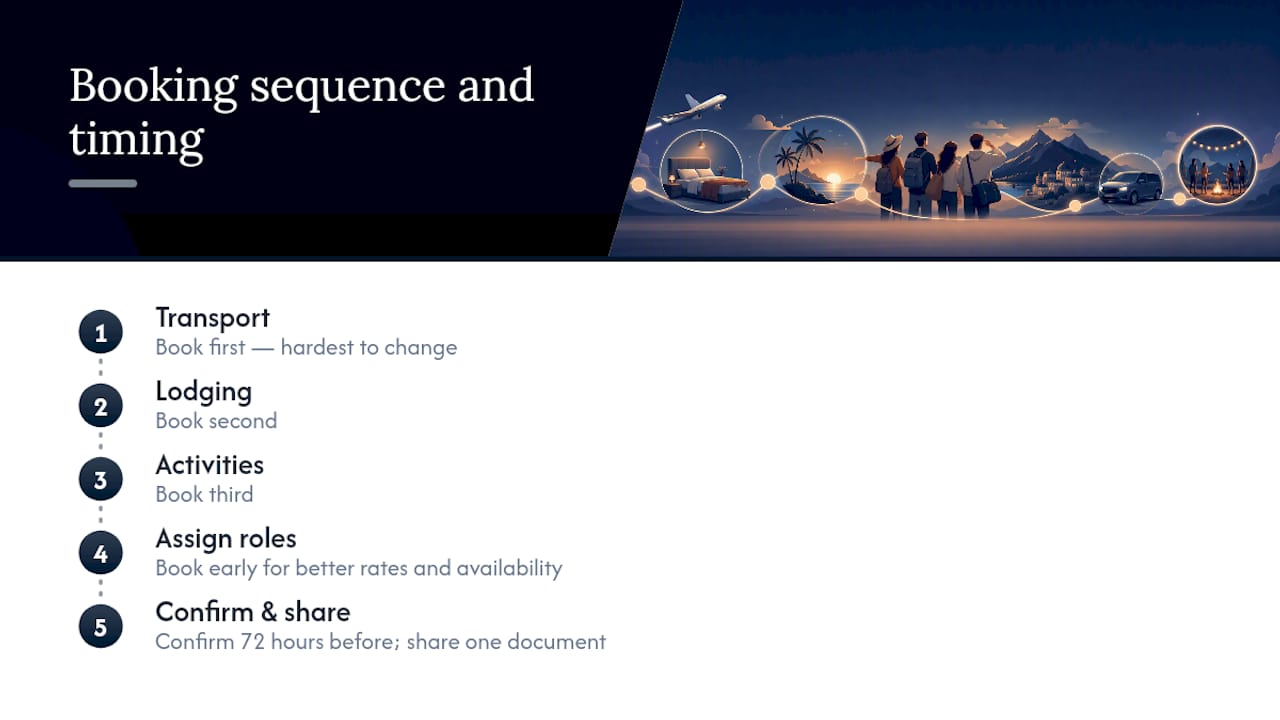
Book in this order: transport first (hardest to change), then lodging, then activities. Early booking and role assignment consistently unlock better rates and availability. Confirm everything 72 hours before departure and share a single document with all confirmation numbers.
Which tools help you coordinate the planning smoothly?
The fastest coordination setup is a shared, editable itinerary plus a single payments ledger and one decision-maker. That combination eliminates the two biggest friction points: "Where are we going tomorrow?" and "Who owes what?"
Recommended tools by task:
- Shared itinerary: Planytera generates a personalized, collaborative day-by-day plan the whole group can edit and access offline
- Budget tracking: A shared Google Sheet or the Planytera cost-estimate feature; centralizing payments with a finance lead prevents post-trip disputes
- Group decisions: Google Forms or a free poll tool (Doodle for dates, a simple form for lodging preferences)
- Group chat: WhatsApp or iMessage for real-time updates; pin the shared itinerary link at the top
- Preference collection: Planytera's group preference tools let you input dietary needs, pace, and budget so the itinerary fits everyone from the start
For groups with mixed preferences or accessibility needs, a tool that accounts for those inputs at the itinerary-generation stage saves hours of back-and-forth.
What safety and health steps should your group take before traveling?
Always check the U.S. Department of State travel advisory for your destination and enroll every traveler in STEP before an international trip. STEP sends embassy alerts directly to your email if conditions change. Do this at the itinerary-drafting stage, not the week before departure.
For medical prep, the CDC Yellow Book distinguishes between a basic personal kit and an expanded group kit for remote travel. Scale your kit by itinerary risk, trip duration, group size, and access to local care.
Group travel health kit checklist (scale to trip risk):
- Prescription medications in original labeled containers (each traveler carries their own)
- Over-the-counter pain relievers, antidiarrheal medication, and antacids
- Adhesive bandages, gauze, and antiseptic wipes
- Insect repellent (DEET-based for high-risk destinations)
- Sunscreen (SPF 30+)
- Oral rehydration salts (add for remote or hot-climate travel)
- Any destination-specific items your travel health provider recommends
Additional safety steps:
- Purchase travel insurance that covers medical evacuation before departure
- Store one copy of all passports and insurance cards in a shared cloud folder
- Identify the nearest hospital or clinic at each destination before you arrive
- Assign one person to carry the group's emergency contact list
How do you keep the group functional and handle disagreements?
A small leadership team of 1–3 people cuts decision paralysis and keeps planning moving. The four-role matrix from Step 4 is your operating structure. Here is how to use it when things get complicated.
Roles and responsibilities matrix:
Conflict-resolution rules to set upfront:
- Majority vote on non-critical items (restaurant choice, activity order)
- Opt-outs are always allowed for optional activities, no explanation needed
- One schedule swap per person during the trip, agreed by the leader
For mixed preferences, build at least one free-choice block per day. That single buffer absorbs most disagreements before they become arguments.
Sample poll script (paste into group chat):
What to confirm before you leave and how to run the trip daily
At 72 hours out, the leader sends one message with every confirmation number, the meeting point, and the shared itinerary link. At 24 hours, the comms lead sends a final reminder with departure times and the day-one plan.
48–72 hour pre-departure checklist:
- Passports, IDs, and visas confirmed valid for the full trip duration
- Printed or downloaded copies of all booking confirmations
- Travel insurance policy numbers shared with the group
- Transport reconfirmed (flight check-in open, rental car reserved, rideshare scheduled)
- Venue and restaurant reservations reconfirmed by phone or email
- Group chat pinned with the itinerary link and emergency contacts
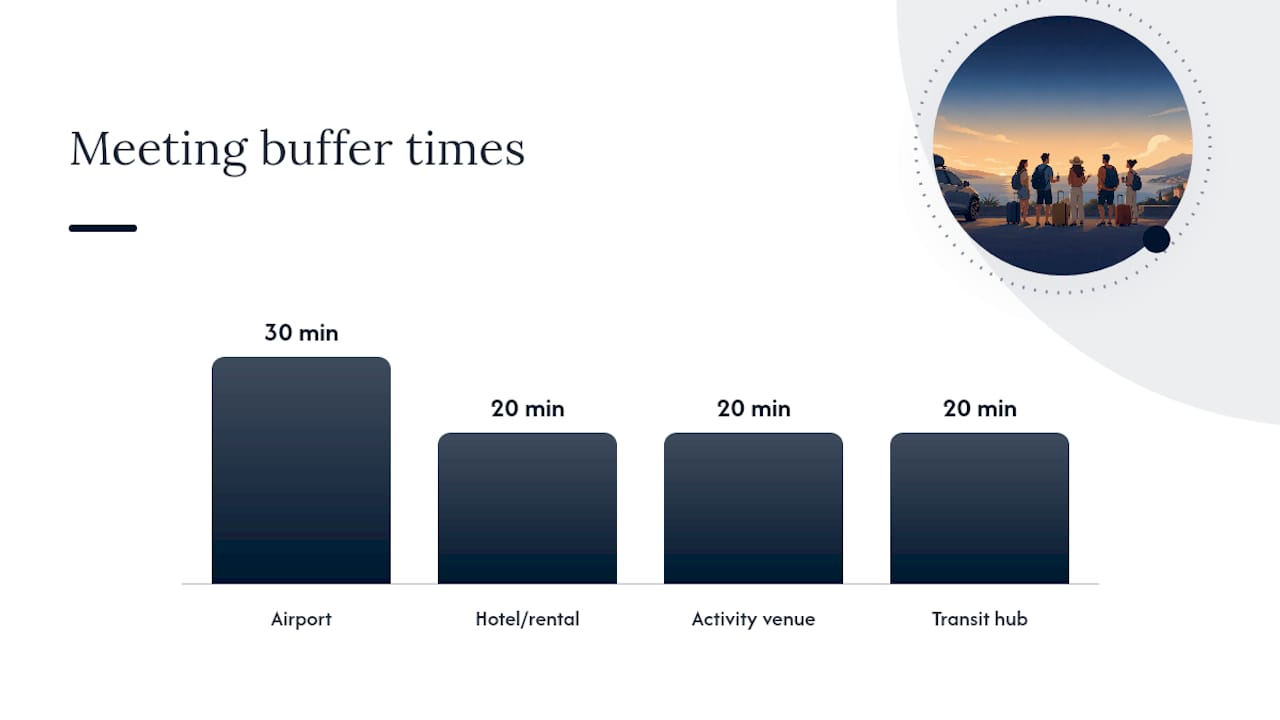
Day-of coordination: meeting points and time buffers
| Location | Primary Meeting Point | Fallback | Buffer Time |
|---|---|---|---|
| Airport | Airline check-in counter | Airport information desk | 30 minutes |
| Hotel/rental | Front entrance | Lobby seating area | 20 minutes |
| Activity venue | Main entrance | Nearest café | 20 minutes |
| Transit hub | Ticket gates | Platform entrance | 20 minutes |
One person carries a printed copy of the full itinerary. Everyone else has the digital version. If a phone dies, the group still has a plan.
What planners most often miss
The structured approach in this guide works because it separates decisions from bookings. Most group trips stall when both happen at the same time, and everyone ends up in a chat thread voting on flights while nobody has actually checked availability.
What planners consistently underestimate is the transition time between activities. Getting six people from a restaurant to a museum to a bar takes longer than the map suggests. Build 20-minute buffers between every block on Day 1 until you know the group's actual pace. You can always tighten the schedule on Day 2.
Planytera makes group trip planning faster and less stressful
Skip the spreadsheet chaos. Planytera generates a shareable, editable day-by-day itinerary in minutes, built around your group's budget, dietary needs, and travel pace. Every traveler gets offline access, so the plan is always available even without a signal.

The features map directly to the steps in this guide: collaborative editing for role-based planning, built-in cost estimates for your budget split, and live travel advisories so your safety prep stays current. When plans change mid-trip, one person updates the itinerary and everyone sees it instantly.
Start your first group itinerary free at Planytera, or explore subscription plans if your group travels more than once a year.
Sources
Use these official sources and templates to verify guidance and copy materials directly into your planning workflow.
- International Travel Guidance
- Travel Health Kits | CDC Yellow Book™
- Group Travel Planning Checklist (Princeton)
- How to plan the perfect group trip without the stress — Afar
- Complete guide to group travel — Condé Nast Traveler
- Booking
- 7 tips you need to know before planning a group trip — WeTravel Academy